Land Stewardship Project

Land Stewardship Project
  • About Us
    • Our Mission
    • Long Range Plan
    • Staff Directory
    • Board of Directors
      • LSP Board Committees
    • LSP Steering Committees & Working Groups
    • Contact Us
    • Past LSP Projects
    • Employment & Volunteer Opportunities
    • LSP Publications
    • Financial Statements
  • The Latest
    • Community Care
    • Songs for the Soil
    • CSA Farm Directory
    • Upcoming Events
    • News
      • News Releases
      • Media Contacts
      • LSP in the News
    • Blog
    • Podcast
    • Land Stewardship Letter
    • LIVE-WIRE Sign-up
    • Myth Busters
    • Fact Sheets
    • Farm Crisis Resources
  • For Farmers & Landowners
    • Farmland Clearinghouse
    • New Farmers
      • Farm Beginnings Class
      • Journeyperson Course
      • Farm Dreams
      • Accessing Farmland
      • Farmland Clearinghouse
      • Beginning/Retiring Farmer Tax Credit
      • Beginning Farmer Profiles
      • Fresh Voices Podcast Series
    • Retiring Farmers & Landowners
      • Farmland Clearinghouse
      • Farm Transition Course 2026
      • Conservation Leases
      • Beginning/Retiring Farmer Tax Credit
      • Land Transition Tools
      • Transition Stories
    • Soil Health
      • Cover Crops
      • Grazing
      • No-till
      • Microbiology
      • Kernza
      • Soil Builders’ Network
      • Soil Builders’ E-Letters
      • Soil Health Steering Committee Members
      • Ear Dirt Soil Health Podcast Series
    • Cropping Systems Calculator
    • Conservation Leases
  • Creating Change
    • Community-Based Food Systems
      • Ear Bites Community-Based Food Podcast Series
    • Policy Campaigns
      • Soil Health & Climate Change
      • Healthcare
      • Factory Farms
        • Anti-Competitiveness & Price Gouging
      • Federal Policy
        • A Farm Bill For Us
      • State Policy
        • MN Farm, Food & Climate Funding
      • Developing Leadership
    • Justice & Stewardship
    • Organizational Stewardship
  • Get Involved
    • Your Membership Matters
    • Take Action!
    • Upcoming Events
    • Land Stewardship Action Fund
    • Connect with LSP
      • Stay Connected
      • Join, Donate, or Renew Today!
      • Shop
      • Employment & Volunteer Opportunities
      • Legacy Giving
    • Network with LSP Members
      • Farmland Clearinghouse
      • Soil Health
    • Farmland Clearinghouse
  • Join, Donate, or Renew Today!
  • Stay Connected
  • Contact Us
  • Shop
Search
More...

2022 Minnesota Legislative Session Wrap-up — Maybe?

More Undone than Done, but Some Key Wins LSP is Eager to Build on

By Amanda Koehler
May 25, 2022

Share

  • Facebook
  • Pinterest
  • email
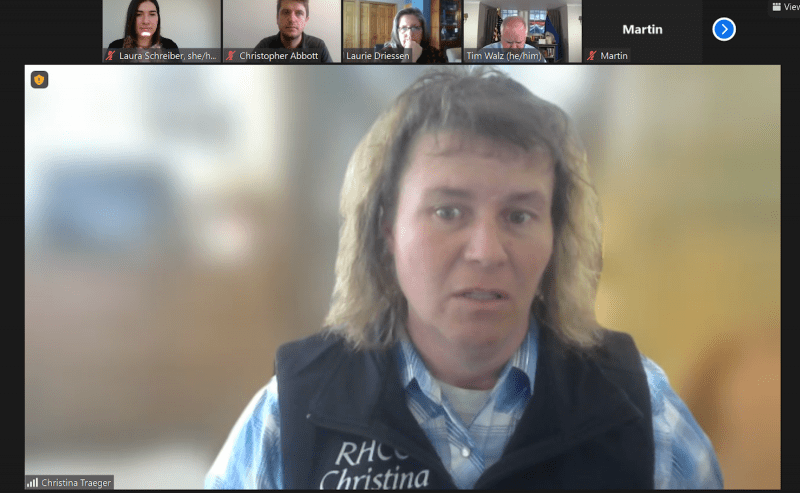
During an LSP virtual town hall meeting, Member Christina Traeger, owner of Rolling Hills Traeger Ranch and Grillin Meats, secured Minnesota Governor Tim Walz’s support for investments in local meat processing.
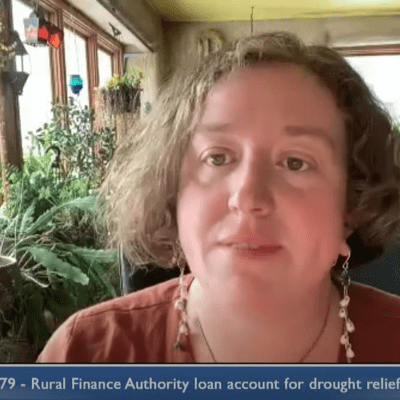
LSP member Liz Dwyer, a livestock and CSA farmer, testifying in a Senate hearing about the urgent need for drought relief for specialty crop farmers.

The 2022 Minnesota legislative session held incredible promise in the form of a historic budget surplus that had the opportunity to deliver tangible progress on the biggest challenges we face. For example, the Minnesota House Climate Action Caucus, chaired by Rep. Patty Acomb (DFL-Minnetonka), began the session with a bang, proposing a $1 billion investment in climate solutions, including $100 million for agriculture.

Unfortunately, the end of this legislative session left more undone than done. In numerous budget areas, members of the Senate Majority refused to negotiate or delayed so much that an agreement came too late. Luckily, one of the few omnibus bills that crossed the finish line was the budget for the Minnesota Department of Agriculture (MDA). Bills that included funding for the Board of Water and Soil Resources, Soil and Water Conservation Districts, and the Conservation Reserve Enhancement Program did not make it across the finish line in time.

We are hoping the Legislature will come back together to do its job and deliver the funding people and the land need and deserve. However, Senate Majority Leader Jeremy Miller has made it clear that the Senate Republican Caucus has no interest in doing so.

It’s not too late to demand that lawmakers come back to the table. You can take just two minutes to contact Senator Miller here.

What was on the table
and what passed?

Governor Tim Walz and the House of Representatives originally proposed robust budgets for the MDA of over $70 million and $60 million, respectively. The Senate, however, spent most of the historic budget surplus on tax cuts that would mostly benefit the rich, leaving just $5 million for their agriculture budget bill.
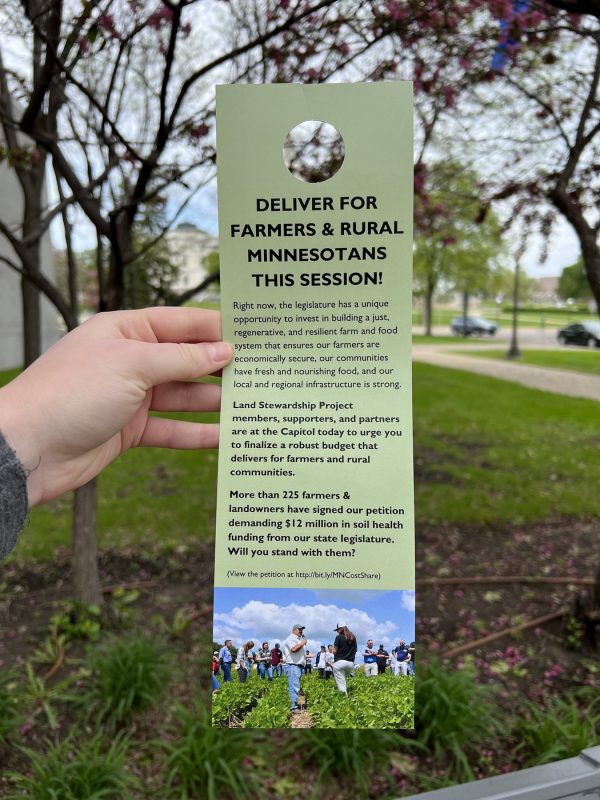
Door-hangers with LSP policy priorities and the LSP soil health cost-share petition were distributed to each Legislator in the final week of the legislative session.

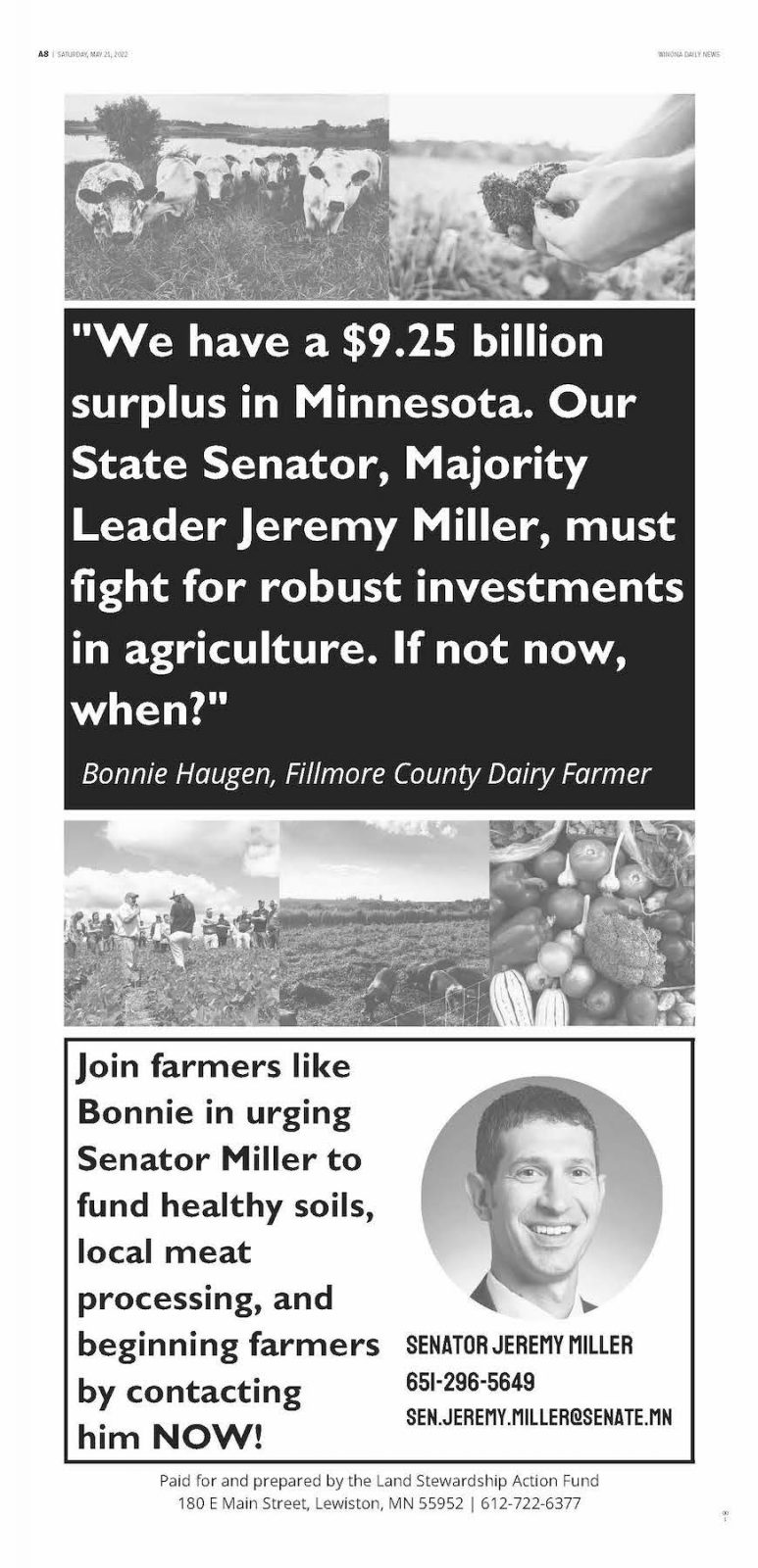
Land Stewardship Project members and supporters worked hard to push Senate Majority Leader Jeremy Miller (R–Winona) to agree to a budget for the MDA that was closer to the size of the House proposal. Dozens of LSP members who are Sen. Miller’s constituents attended a virtual in-district meeting, wrote letters-to-the-editor, and were featured in local newspaper advertisements, — yet he prioritized tax cuts that would primarily benefit the rich and set the joint agriculture budget at just $15 million.

Although Senate leadership squandered an opportunity to fully meet the needs of farmers, our food system, and rural communities in the agriculture budget (and by failing to pass other budget bills), the final agriculture proposal did include some key funding that we are eager to build upon in 2023.

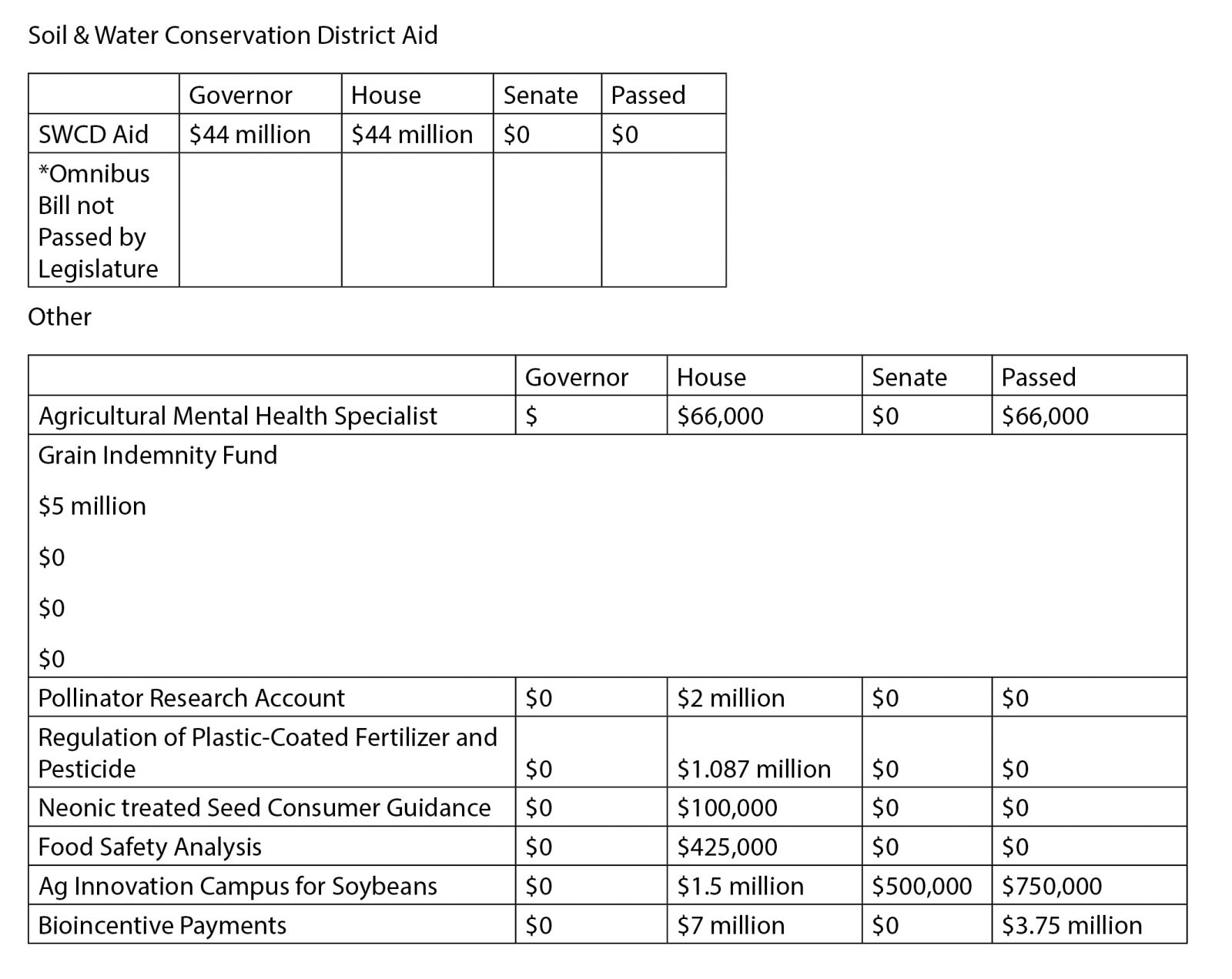
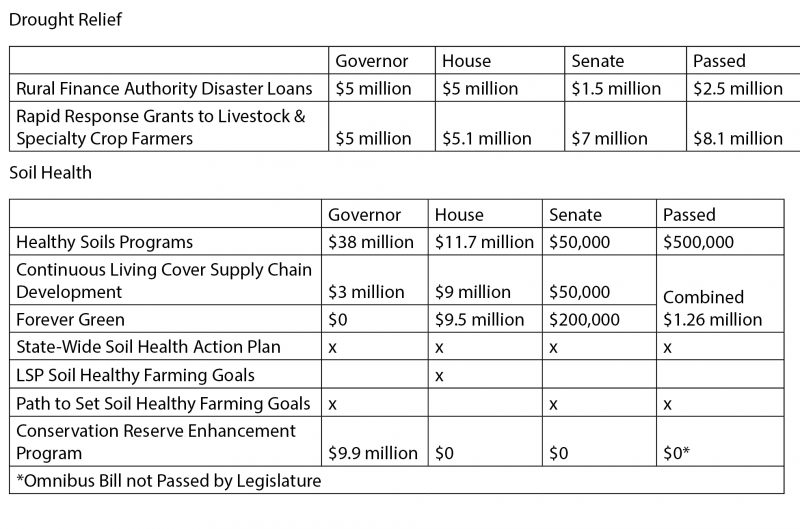
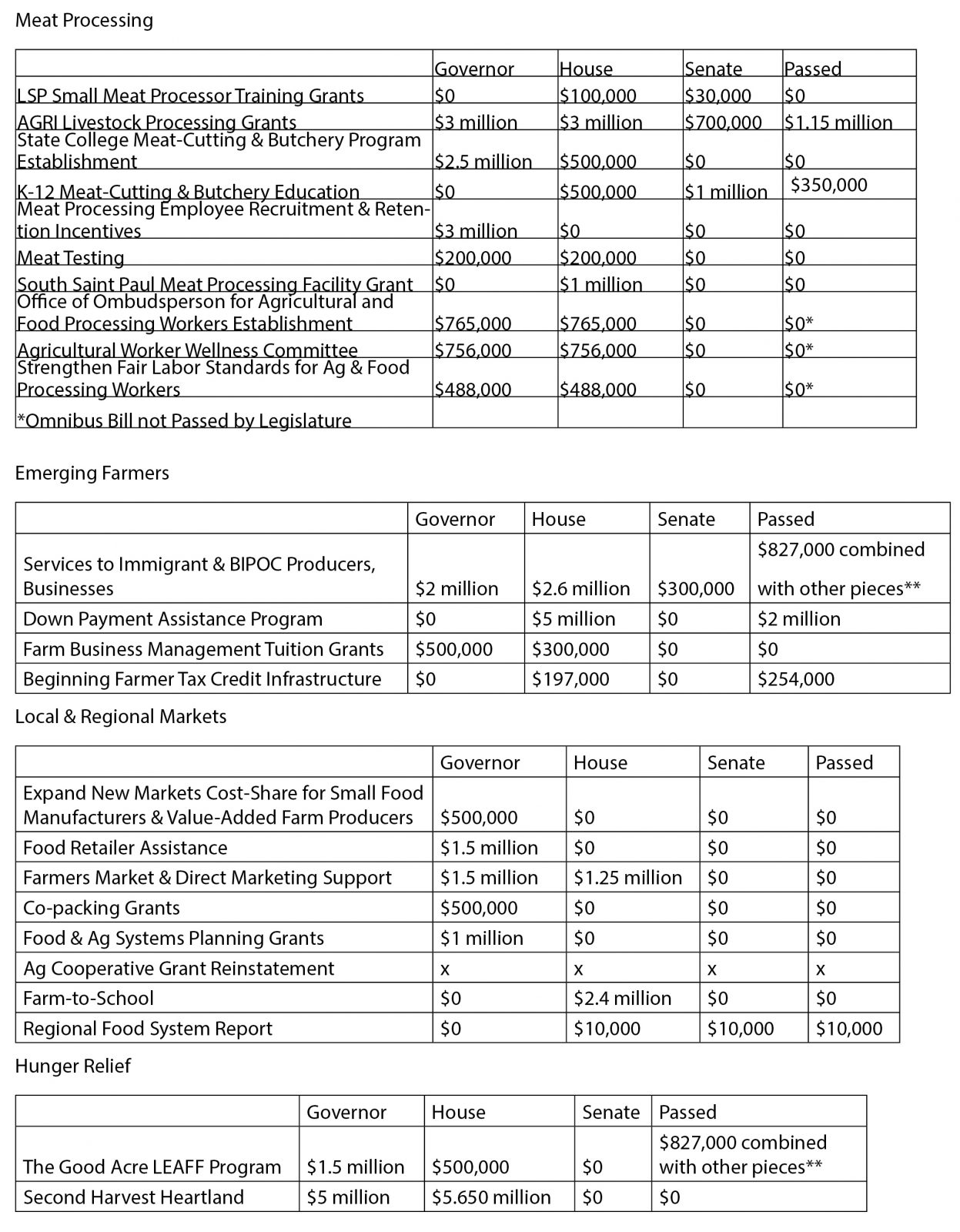
Key wins in the agriculture budget include $500,000 for soil health grants for farmers, directing the state to create a soil health action plan, and notable investment for livestock processing grants and education.


Below is what was proposed and what eventually passed for the 2022-2023 and 2024-2025 fiscal years:
Newspaper ad featuring LSP member and dairy farmer Bonnie Haugen urging Senate Majority Leader Jeremy Miller to pass a robust ag budget.

Summary

We’re facing compounding challenges that Land Stewardship Project members have testified to, written letters-to-the-editor on, met with their Legislators about, and took actions around: the climate crisis and extreme weather, consolidation in the meat supply chain, skyrocketing land costs, barriers to processing and markets for emerging crops, and more. What is clear is that the Governor and the House Majority, overall, proposed strong budgets for people and the land, while the Senate dismissed these real challenges threatening their communities to prioritize tax cuts for folks who don’t need them. And then they decided to not finish the job by leaving several budget bills on the table.

The Speaker of the Minnesota House, Representative Melissa Hortman (DFL–Brooklyn Park), and Gov. Walz are ready and willing to come back to the table to finish what was left undone. Senate Majority Leader Miller said the Senate Republican Caucus was not interested in a special legislative session and House Minority Kurt Daudt (GOP– Crown) said he wants to “sleep on it” for seven months.

Additionally, the legislative process has become increasingly opaque over time. Individual legislators were largely not in the loop during end-of-session negotiations unless they were committee chairs, making constituent and organizational engagement even more difficult. Numerous members of the Senate Majority also refused to meet with LSP members who are their constituents, despite repeated requests.

They also cobbled together massive omnibus bills with multiple agency budgets in each. If one part of the budget was agreed upon, but others weren’t, they didn’t pass any of it. We strongly believe that leadership from both parties and each body must make a commitment to transparent and public lawmaking and negotiating. Our democracy should be accessible, responsive, and effective.

Regardless of if the Legislature comes back together to finish the job, LSP will be working to create a holistic, member-developed state policy platform to aggressively organize around. We’re ready to get to work to make sure 2023 has a very different result than the 2022 legislative session. In addition, we’re planning on bringing back the Family Farm Breakfast and Day at the Capitol – stay tuned!

More Information

  • Governor Walz’s Supplemental Budget Proposal 
  • Legislative Spreadsheet that Shows House & Senate Final Proposals for Ag & Drought Relief
  • Final Ag & Drought Relief Bill

LSP policy manager Amanda Koehler can be reached via e-mail or at 612-400-6355.
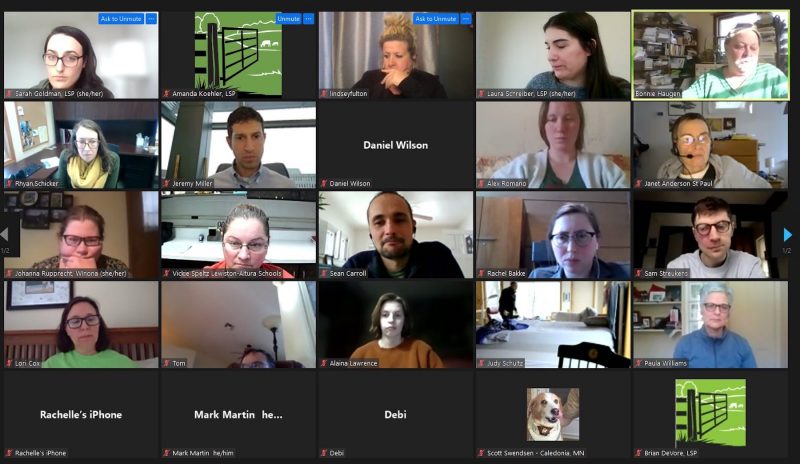
LSP virtual town hall with Senate Majority Leader Jeremy Miller.
Category: Blog
Tags: 100% Soil Healthy Campaign • drought relief • emerging farmers • local meat processing • Minnesota Legislature • regional food systems • soil health

Upcoming Events

×

November 2025

Wednesday November 19

12:15 pm – 1:45 pm
We Can Do Better Book Discussion at Iowa Nature Summit
Wednesday November 19
12:15 pm – 1:45 pm
We Can Do Better Book Discussion at Iowa Nature Summit
Olmsted Center, 2875 University Ave, Des Moines, IA 50311, USA

The Johnson Center for Land Stewardship Policy is excited to share that one of our its primary pillars of work — a published collection of Paul Johnson’s writings —  is set for release on Oct. 2.  The book features a brief biography and a discussion of Paul’s ideas within the historical and future contexts of private lands conservation. For details on We Can Do Better: Collected Writings on Land, Conservation, and Public Policy click here.

Curt Meine will speak about the book during the 12:15 p.m.-1:30 p.m. luncheon at the Iowa Nature Summit on Nov 19. 

Thursday November 20

All Day
Give to the Max Day
Thursday November 20
Give to the Max Day
Online

Give to the Max Day is coming up on Thursday, November 20. But you don’t have to wait until Give to the Max Day to make your gift to LSP. Any contribution made through the GiveMN portal, now until November 20, will count toward our $15,000 goal and is fully tax-deductible!

This Give to the Max Day season, the Land Stewardship Project is gearing up to share the stories of resilience, change, and action that LSP members are a part of in their towns and on their farms. 

 We’re up against some pretty overwhelming challenges these days and now is the time for turning hope into action and coming together over common goals. One way to do that is to support the work of building the farm and food system we want and need for the future.

We know the future of farming is diverse and innovative, and should be set up to reward stewardship-minded farmers for the solutions they bring to some of our biggest challenges like soil health, clean water, and a changing climate. 

Bringing that vision for the future into reality requires taking on the biggest of the big in the agriculture industry, supporting the next generation of farmers, and reforming farm policies, as well as developing new, reliable, fair markets for all farmers that support conservation, healthy food, and local prosperity. 

That’s a big mountain to climb and we need people power to make it happen. LSP brings farmers, rural, urban, and suburban people together to take action around our common goal of a fair and sustainable farm and food system in this country.

Give to the Max Day is a fun and collective way to get into the giving spirit across the entire state of Minnesota. Thank you for being part of LSP’s work to build a better future for our farm and food system.  Please join, renew, or make a special gift to LSP as part of Give to the Max Day this year.

Saturday November 22

1:00 pm – 4:00 pm
Farm Scale Deep Winter Greenhouse Open House
Saturday November 22
1:00 pm – 4:00 pm
Farm Scale Deep Winter Greenhouse Open House
Tintah Beach Farm, Thief River Falls, MN

Please join Marcus Langevin from Tintah Beach Farm and the University of Minnesota at an open house and ribbon cutting celebrating the completion of the farm scale deep winter greenhouse prototype on Nov. 22, from 1 p.m.-4 p.m. 

This new deep winter greenhouse design allows farmers in cold climates to grow crops for sale to their customers throughout the winter months. The heavily insulated greenhouse utilizes a steeply sloped south-facing glazing wall to capture solar heat which is stored in an underground soil thermal mass where it is available to heat the greenhouse at night when the outside temperatures drop. 

The new energy efficient greenhouse was designed to suit the needs of small and medium scale vegetable farmers. It is larger, cheaper per square foot to construct than previous designs, and is simple enough that farmers with minimal construction experience can build it themselves. Deep winter greenhouses like these allow farmers the ability to grow market crops year-round, thereby increasing their yearly revenues and allowing Minnesotans year-round access to healthy, fresh, locally grown produce. 

Registration: This event is free to attend, but registration is required at z.umn.edu/TintahBeachOpenHouse. Please register by November 15.

Download farm scale deep winter greenhouse building documents. This farm scale deep winter greenhouse design is available for free download from the UMN Extension RSDP’s deep winter greenhouse website. 

This work is made possible by University of Minnesota Extension; College of Food, Agriculture and Natural Resource Sciences (CFANS); College of Design Center for Sustainable Building Research (CSBR); and the Agriculture Research, Education, Extension and Technology Transfer Program (AGREETT). 

December 2025

Tuesday December 2

11:00 am – 12:00 pm
Integrating Habitat into Croplands: Prairie Strips and Bird Conservation
Tuesday December 2
11:00 am – 12:00 pm
Integrating Habitat into Croplands: Prairie Strips and Bird Conservation
Online

This 10-lesson Wild Farm Alliance virtual course teaches agricultural professionals and farmers how to support beneficial birds and manage pest birds on farms. By learning how to assess the farm’s avian needs and opportunities, farms can be designed to provide for a diversity of beneficial birds. 

If pest birds are a problem, they can be discouraged with specific practices during the shorter periods when they cause damage. The sessions cover the latest research, tools and resources, and are given by experts in avian pest control, entomology, ornithology and conservation. While many topics and species are specific to the Midwest, most of the principles discussed are applicable across regions. 

Continuing Education Credits have been requested and are expected to be approved from American Society of Agronomy.

For details and to register, click here. 

The Course Schedule:

LESSON 1

Why Birds Belong on the Farm: Biodiversity, Pest Control & A Thriving Landscape

Tuesday, September 23, 2 p.m. CT


LESSON 2

Birds as Pest Control Allies on the Farm

Tuesday, October 14, 11 a.m. CT


LESSON 3

Birds in the Balance: Pest Control Services Across Crop Types

Tuesday, November 4, 11 a.m. CT


LESSON 4

Integrating Habitat into Croplands: Prairie Strips and Bird Conservation

Tuesday, December 2, 11 a.m. CT


LESSON 5

Birds on the Farm: Balancing Biodiversity and Food Safety

Tuesday, January 13, 11 a.m. CT


LESSON 6

Beyond the Crop: Birds, Biodiversity, and the Power of Edge Habitat

Tuesday, February 3, 11 a.m. CT


LESSON 7

Bridging Forestry, Farming, and Habitat

Tuesday, February 24, 11 a.m. CT


LESSON 8

Perennial Pathways: Agroforestry for Birds and Biodiversity on Farms

Tuesday, March 17, 11 a.m. CT


LESSON 9

Birds on the Range: How Grazing Practices Shape Habitat for Grassland Species

Tuesday, April 7, 11 a.m. CT


LESSON 10

Birds at Risk: How Pesticides Shape Safety on Agricultural Lands

Tuesday, April 28, 11 a.m. CT

Wednesday December 3

9:00 am – 11:30 am
Organic Fruit Growers Cimate Resilience Workshop
Wednesday December 3
9:00 am – 11:30 am
Organic Fruit Growers Cimate Resilience Workshop
Zoom online

In December and January, the Organic Fruit Growers Association is offering a series of climate resilience workshops. Workshop goals are to learn about the changing climate in our region and the expected impacts on fruit farmers and to select climate resilience practices which are suited to your farm’s goals and values. The outcome of the workshops will be a written climate resilience plan with actionable steps to make your farm more resilient to changing climate. 
 
Workshops will be led by University of Minnesota extension educators Katie Black and Madeline Wimmer and include times for farmer-to-farmer discussion. This series includes the following four meetings. Expect to spend an additional 4-10 hours outside the meetings developing your farm’s climate resilience plan:

  • Wednesday Dec. 3, 9 a.m.-11:30 a.m. (online via Zoom)
  • Wednesday, Dec. 10, 9 a.m.-11:30 a.m. (online via Zoom)
  • Monday, Dec. 22, discussion (online via Zoom — optional but encouraged)
  • Wednesday, Jan. 7, 10 a.m.-3 p.m. (in-person workshop in La Crosse, Wis. Lunch provided, and you can be reimbursed for mileage traveling to and from the meeting.)

For details and to register, click here. 

View Full Calendar

Recent Posts

  • Land Line: Govt. Shutdown, Avian Flu, Nitrate Pollution, Nitrogen-Fixing Grains, Monopolies, Kernza, Farm to School November 14, 2025
  • Farm Transition Profile: Full Circle November 13, 2025
  • Land Line: Corn Belt Cancer, Integrating Crops & Livestock, Trade Turmoil, Farmland Access, Erosion, SNAP, Microbe Memory October 31, 2025
  •  ‘Big Ag, Big Problems’ Panel to Feature 2 Experts on Consolidation Nov. 4 in Lanesboro October 27, 2025
  • Reflections from LSP’s 2025 Summer Events Season October 24, 2025

Montevideo

111 North First Street
Montevideo, MN 56265

(320) 269-2105

Lewiston

180 E. Main Street
Lewiston, MN 55952

(507) 523-3366

Minneapolis

821 E. 35th Street #200
Minneapolis, MN 55407

(612) 722-6377

  • Privacy Policy

Copyright © 2025 Land Stewardship Project. All rights reserved.

https://landstewardshipproject.org/2022-minnesota-legislative-session-wrap-up-maybe