
Sign-up for LSP’s 2027 Farm Transition Planning Course by Jan. 15
LSP is now taking applications for the 2027 edition of its Farm Transition Planning Course, which will take place via Zoom on seven Tuesday evenings from January to March. Details are here.
After five decades on the same piece of property, Paul and Trudi Schaefer were pretty sure there was only one way they would make their exit. After all, they had poured their life into these 40 acres of mixed timber and pasture sitting on a ridge near the Mississippi River in western Wisconsin’s Pierce County. Over the years, they had rescued a broken-down 19th century farmhouse, established extensive raised bed gardens, provided pastureland for neighboring livestock producers, did extensive landscaping, revamped a barn and several other buildings, and raised two children.
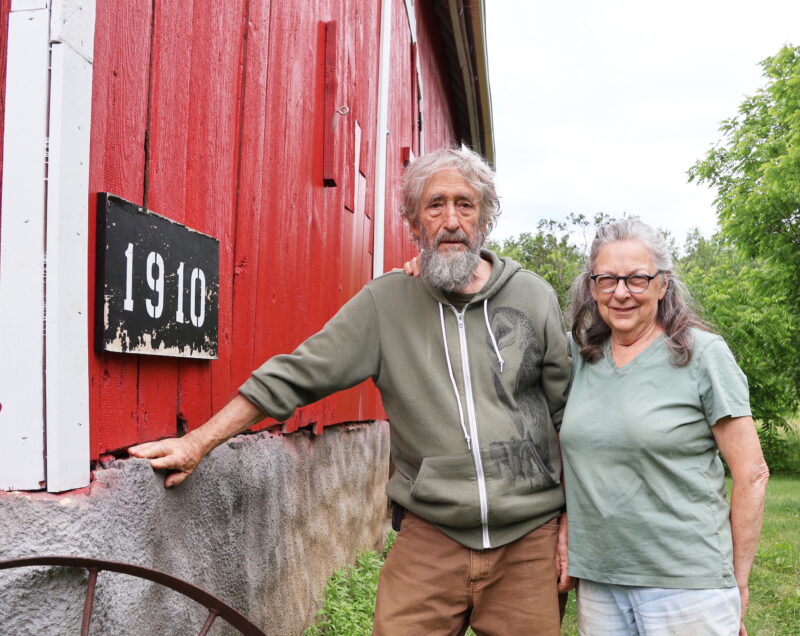
“The standard line for years has been, ‘We’re going out of here feet first,’ ” Trudi said with a laugh on a cloudy day in late June. She and Paul were sitting in the open dining/kitchen area of that refurbished house, just a few feet from a wood-burning stove and an exposed chimney that was a pile of bricks when they moved in. Laid out on the table was a photo album that chronicled their time on the land. One photo from 1976 showed a farmhouse that looked nearly abandoned. “That’s what we walked into,” said Trudi.
Outside, beyond the raised bed gardens and landscaped yard, and near a refurbished granary, were spread 50-year’s worth of tools, implements, and other items the Schaefers used to manage this farm and maintain the land. In a few weeks those items would be put up for sale; soon after that, the couple would pack up and drive to Northern California, where they would settle in near a son of theirs. In short, the couple — Paul is 82 and Trudi 80 — ended up leaving under their own power after all.
What changed?
It turns out a combination of a nasty snowstorm and a serendipitous connection made with a family who shared their values helped the couple see a future beyond the farm. But they concede none of that would have gotten them off the land if they hadn’t had the discipline and structure provided by the Land Stewardship Project’s Farm Transition Planning Course.
“Without the Farm Transitions Course, we probably would not have sold the farm,” said Paul. “We’d still be dillydallying. The course was instrumental.”
Rooted in Place
It’s somewhat surprising that the Schaefers became so rooted in one place, given the far-flung nature of their early years. Paul grew up in the Queens neighborhood of New York, and Trudi on the South Side of Chicago. After serving in the Air Force, Paul attended college in Arizona on the GI Bill, eventually getting a Phd in anthropology. For two years in the early 70s, the couple lived on Kosrae, an island that’s part of Micronesia, while Paul did field work.
Self-described hippies, a desire to “get back to the land” led the Schaefers to buy the 40 acres that would eventually become Windbeam Farm in 1976. Trudi worked in the landscaping business and Paul taught anthropology at Metropolitan State University as an adjunct professor. And they spent countless hours rehabbing the land and its buildings while growing vegetables for their own use and raising meat for direct-to-consumer sales; at various times they raised goats, pigs, chickens, and turkeys. They ran a thriving landscaping business for several years and hosted farm weddings, as well as other folks who needed access to garden plots, including a major garlic grower. Paul worked doing timber stand improvement for a time and was an organizer for a couple of nonprofits, including one that worked to promote sustainable farming practices in western Wisconsin.
“We needed every nickel,” he said.
A Winter Reckoning
That’s a lot of life and work packed onto one piece of terra firma, so the Schaefers could be forgiven if they assumed they’d never leave the land. But in December of 2025, a major winter storm hit the area, filling their long, sloping driveway with snowdrifts. They spent hours with a skid steer loader and shovels moving snow.
“When we got done, we came into the house and we both looked at each other and said, ‘That’s it. We’re not going to do another winter,’ ” recalled Trudi.
For a time, they had considered staying on the farm and inviting younger people to come and actually live on the place and manage it. But after giving it some thought, the couple admitted that they’d be too tempted to look out the window, where there would always be a garden to weed, a building to repair, a fence to fix.
“We like to work, but we realized finally in our ancient days we can’t stop if we are here on the land,” said Paul.
So the only solution was to sell the land and move. But once spring came and the snow was gone, how could they stay true to the promise they had made to themselves not to spend another winter on the farm? And how would they find someone who would take care of it the way they had?
“I was adrift,” Trudi says of her state of mind when they first started considering selling the farm and leaving it. “I was on a boat in the middle of the ocean and didn’t even know how to begin to put this project together.”
So, from January to March of 2026, the couple used LSP’s Farm Transition Planning Course as a way to navigate the rough waters of a major life change like leaving the farm. The Course was launched a decade ago by LSP as a way to help retiring farmers take key steps toward transitioning their land and operations to the next generation. The online program is built around the idea that, in a sense, people who are seeking land and those who are looking to pass it on to the next generation are speaking the same language as they connect around values of stewardship, community-building, and, finally, farming.
During the seven online sessions the 2026 course consisted of, the Schaefers and other participants looking to pass on their farms participated in Zoom presentations on everything from legal and financial considerations to long-term care issues and how to set goals for themselves and the land. Paul said it was good to sit in on sessions with other farmland owners who, despite different circumstances — more land, different agricultural enterprises, various family complications — shared a common goal of seeing their farm’s legacy carried on in one way or another.
The Schaefers say the most valuable part of the course was the exercises related to naming what values had guided them when managing the farm over the years, and, just as importantly, what values would guide them as they began looking for someone to take the land over.
The course also provided the discipline needed to follow through with their promise to make the transition. After each class session, the couple would work on their values and goals worksheets separately, and then get back together to share homework notes.
“You just don’t finish the worksheets and go watch television,” said Paul. “It engendered a conversation, a necessary conversation, which we wouldn’t have had with each other otherwise. I’d say 95% of the time me and Trudi’s values and goals were absolutely similar. So, we weren’t facing any giant potential rifts in our understanding about what to do.”
High on the Schaefers’ list of shared values was the desire to keep the farmland chemical-free, something they had done for 50 years. They also wanted to make sure the house and other structures they had taken such great care to refurbish would not be bulldozed to make way for corn and soybean production, for example. They were not thrilled about selling the land to someone who would simply use it as their own personal hunting retreat, a trend that’s inflated land prices in the area in recent years.
“We wanted to sell it to people who are going to take care of it in the matter we have,” said Paul.
What gave them the confidence that this kind of land steward existed is the fact that two of their neighbors are producing food using regenerative methods. For example, just down the road, Cella Langer and Emmet Fisher are growing vegetables for local markets and have an on-farm creamery. In fact, for nine years Langer and Fisher, who are graduates of LSP’s Farm Beginnings course, rotationally grazed cattle on Windbeam Farm’s land. Other neighbors, Kevin and Kayla Killam, are also producing food using practices such as managed rotational grazing. Those connections, combined with the fact that Paul used to organize sustainable farmers in the area and they both are longtime LSP members, allowed the couple to see a future where their farm wasn’t just one more corn field or depopulated recreation area. They put the word out to their neighbors that they were looking for someone who had a good stewardship ethic and in general shared their values about the importance of connecting people to the land.
As it happens, Kevin Killam has a side business as a realtor, and he eventually introduced the Schaefers to Dan and Amy Ochs, who attend the same church as the Killams. Dan says when he, Amy, and their four young children first visited the property, they were smitten with everything about it. Dan works in the insurance business, but his family has long been concerned about the source of their food.
“We started on a journey of questioning everything that we put into our bodies and feel it’s really valuable to raise it in a way that’s not only good for your own health but also sustainability and resilience in general,” he said.
After sharing a meal and taking a walk around the Windbeam property, it became clear the two families had similar values when it came to stewardship of the land. Things progressed quickly after that. The Schaefers completed the LSP Farm Transition Course in March, and by the end of April they had a sales agreement with the Ochs in-hand. Suddenly, the reality of having to make a move they never thought was in the cards hit home.
“And then we were scrambling — do we have a deed to the farm? Where is that deed, what does it look like?” Paul said. “We had to figure out that sort of stuff, because we had never thought about that.”
The Schaefers say the Farm Transition Course helped them stick to their plan of going through with the sale as long as the buyer affirmed their commitment to a stewardship ethic — it was just too good of an opportunity to pass up. That’s an important source of support when realtors come knocking with oftentimes eye-popping offers in hand. Paul said they came down in price “significantly” based on the Ochs’ commitment to treat the land well.
Of course, once the Schaefers left the property, the new owners had the freedom to do what they pleased with it. But in a sense, the Killmans provided an important piece of pre-vetting when it came to the new owners as far as their values were concerned. Paul said one way or the other, they feel good about not going for top dollar.
“After getting the highest price, you don’t want to be going to live in Florida and looking at each other later and saying, ‘Why on Earth did we do this? Why did we sell it to those people?’ ” he said.
Dan uses the word “stewardship” a lot when talking about the land his family has just purchased, and he estimates the Schaefers could have gotten $25,000 to $50,000 more if they had put it on the open market.
“But they were willing to take a lesser amount of money in order to pass it on to the next generation,” he said. “If you’re willing to build equity into the actual people you’re investing in, rather than just the monetary value of the property, that’s key when you pass it on to the next generation.”
The Ochs don’t come from a farming background and aren’t going into fulltime food production anytime soon. And for the foreseeable future, they are staying in their home in Hastings, Minn., which is roughly a 30-minute drive away. However, in 2026 Amy and a friend of the Ochs began tending the gardens. The Killams have moved some of their livestock onto the pasture (the grazing system was set up by Langer and Fisher with the assistance of government cost-share money), and Dan and Kevin have purchased a tractor and other equipment together. Dan said his family wants to find a way to use the land to get themselves and others more involved with food production, whether that means doing it themselves or giving others access to the garden plots and pastures.
“How do I get closer to the process? What does that look like?” Dan asks. “The word we feel when thinking about the property is ‘collaboration.’ We want to learn from other people and support their need for land access.”
Bears & Purging
In late June, as the Schaefers prepared for their estate sale and move to California, they reflected on 50 years on the farm and missed opportunities. Paul wished he had done more of the “Aldo Leopold thing” when he was spending time in the woods and walking the pasture. In other words, focusing less on accomplishing tasks and more on, as the famed conservationist did, just observing one’s surroundings and noticing changes in the environment. “We’ve had a bear here for three nights now,” he said, gesturing toward a tree outside the window. “He’s like, ‘Hey Paul, I’ve been here for awhile, why didn’t you see me before?’ ”
Trudi, for her part, says she’s surprised she has no second thoughts. “I feel great, I really do,” she said. “I thought there would be more things that I regretted I didn’t do, or that I would miss. But I got to enjoy all of this and create all of this over 50 years, and I’m just going to be able to take those memories with me.”
Okay, maybe one little regret.
“Don’t live on a farm for 50 years without beginning a purge, because it’s going to take a long time to remove yourself from that farm and all that stuff. It’s like, ‘We have three of these?’ ” she said as the couple headed outside to prepare for the sale.
Give it a Listen
Episode 410 of LSP’s Ear to the Ground podcast features a conversation with Trudi and Paul Schaefer about how the Farm Transition Planning Course helped them, with few regrets, leave the land they had stewarded for 50 years. You can read other farm transition profiles here.
Land Stewardship Project managing editor Brian DeVore can be reached via e-mail.