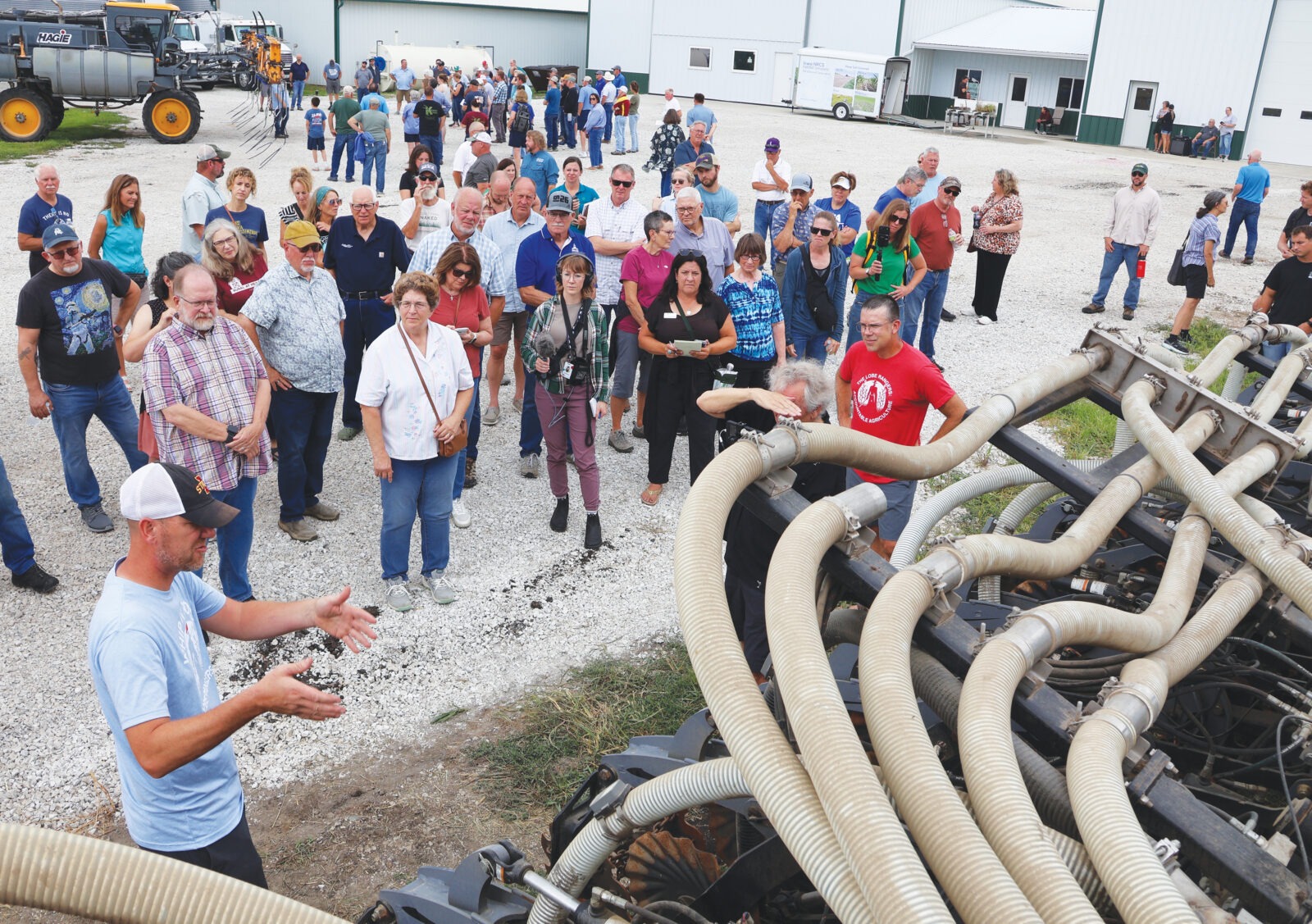
On a muggy, overcast July day in northwestern Iowa, Matt Bormann and Zack Smith were standing in front of a sophisticated piece of conservation tillage equipment that farmers like themselves use to keep soil in place while planting corn and soybeans. A few yards away, another farmer, James Hepp, was standing in front of a stork-like “high boy” sprayer, which is part of his system for precisely applying inputs in a way that protects water and saves money. Gathered around the two pieces of equipment were over 160 people, paying close attention to the farmers’ collective message: row crops can be raised in a way that doesn’t trash the soil and pollute the water.
“I’m just going to go ahead and say it,” said Bormann (this wouldn’t be the last time on this day he uttered a version of that phrase). “This stuff can be done. Once the public figures that out, they are going to demand that it be done.”
The irony of it is he was letting the conservation cat out of the bag in front of a crowd of folks that represent a wide cross-section of the public: farmers were present, but also members of environmental and sporting groups, government agency staffers, university researchers, journalists, and a few people running for office in this fall’s election. Perhaps most importantly, there were people from cities and suburbs downstream who made it clear during the field day that they are increasingly concerned about the safety of their drinking water.
One attendee was a woman named Lois who identified herself as a member of the baby boomer generation, and who grew up on an Iowa farm that prioritized conservation practices. She had made the two-hour drive up from West Des Moines because she’s concerned about the health impacts of consuming water containing excessive amounts of nitrates.
“How many more times are families like mine going to have to deal with cancer?” she asked at one point. “When is it enough?”
Nitrate is a form of nitrogen fertilizer that, as a special Senate hearing at the Minnesota Capitol made clear in April, is hazardous to human health. The past several years, levels of nitrates have been so high in the Des Moines River that the pricey machinery for removing the pollutant from the drinking water of that waterway’s namesake city has had to be activated numerous times, even in winter. Iowa has the nation’s second-highest cancer rate, and there are concerns it’s due to agrichemicals in the environment, including nitrates.
Like any farmers hosting a field day — the event was held on Hepp’s farm near Rockwell City — Bormann, Smith, and Hepp were happy to see other crop producers present. But it’s people like Lois they are trying to reach with what they see as a key message: farmers, commodity groups, input suppliers, and politicians must acknowledge the region’s water quality problem and get behind a proactive approach. And the non-farming public needs to apply pressure to these groups, even if that means utilizing a few sticks, rather than relying solely on voluntary carrots.
The Lobe Rangers
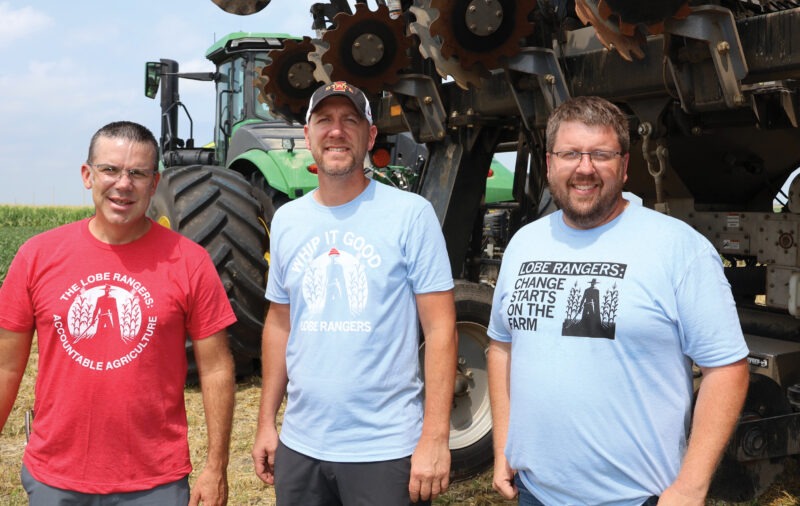
As was described in a previous Land Stewardship Project blog and a pair of LSP Ear to the Ground podcasts, Smith, Bormann, and Hepp are spreading this message far and wide under a kind of nom de plume: “The Lobe Rangers.” The Rangers’ founding principle: there is a direct connection between poor soil management, the economic devastation of rural communities, and polluted water.
“I know my daughters aren’t coming back to farm,” said a visibly emotional Smith during the opening session of the field day. “But I want them to live in Iowa.”
These northern Iowa farmers — they all raise corn and soybeans in watersheds that eventually send water to Des Moines — are part of a movement that’s centered around treating soil as a living ecosystem, rather than just dead dirt forced into production using chemicals and tillage. They utilize cover crops as well as soil-saving systems like no-till and strip till, and are believers in sophisticated “in-season” techniques for applying just the right amount of fertilizer crops need. Their conservation efforts have garnered public recognition, including from the ag-advocacy groups they criticize, such as the Iowa Farm Bureau.
They are excited these regenerative methods make money, and are proud they keep pollutants out of the water their family, neighbors, and folks downstream rely on. But they’ve grown frustrated with how few farmers have adopted soil healthy practices over the years, despite plenty of technical expertise available through places like Iowa State University and cost-share funding provided by the USDA’s Natural Resources Conservation Service. Only around 5% of U.S. crop acres are regularly cover cropped and less than 40% of corn acres are managed using no-till systems. The Minnesota Agricultural Water Quality Certification Program has utilized $32 million of public funds since 2013 to support farmer conservation practices. Nationally, the initiative is considered a groundbreaking way to voluntarily address water pollution. But last month, a report by the Minnesota Office of the Legislative Auditor found that there were concerns around the number of farmers who weren’t meeting the standards required to qualify for funds and regulatory relief.
For almost a year, the Rangers have been talking about the dysfunctional relationship between water and agriculture however and wherever they can: doing media interviews, launching a website, and growing their social media presence. They shoot YouTube videos from their fields and machine sheds, answering questions from the public and talking about how, for example, blaming suburban lawns for the nitrate problem is a distraction. This is not a partisan or urban-rural issue, they argue — we all need clean water, no matter where we live, how we make a living, or our voting record.
The July field day marked the first public event hosted by the three farmers under the Lobe Rangers banner, and it it was clear from the onset that this was no typical show-and-tell where farmers come together to share information on the latest techniques and technology. This was a concerted effort to, as Bormann put it, show the nonfarming public that water-friendly crop production is practical and profitable, and that the excuses for not adopting conservation techniques are running thin.
The day began in Hepp’s cavernous, air-conditioned machine shed. The first presentation made it clear that managing nitrogen pollution in farm country is a complex problem that will require a multi-pronged approach. Matthew Helmers, an Iowa State University agricultural engineer and director of the Iowa Nutrient Research Center, discussed the goals of the Iowa Nutrient Reduction Strategy, which was originally spawned by efforts to reduce the northern Gulf of Mexico’s hypoxic “dead zone” — a 1,332-square-mile region that has been devastated by fertilizer runoff from Corn Belt states like Iowa, Illinois, and Minnesota. The goal of the Iowa Nutrient Reduction Strategy is to reduce the amount of nitrates leaving the state by 45% — 41% of that reduction will need to come from non-point sources like agriculture, according to Helmers.
So what can be done? First, a little historical context: For the past 100 years, Iowa has consistently raised around 10 to 14 million acres of corn annually. For decades, the rest of the land was growing small grains like oats, as well as perennial pasture and hay forages. Today, corn and soybeans cover almost all of the 23 to 24 million acres of agricultural land in the state.

The problem with that, said Helmers, is that those two row crops cover the soil only a few months out of the year, leaving plenty of time for exposed fields to be vulnerable to sending nitrates and other contaminants into the environment, polluting water both nearby and downstream. The goal, he said, should be to create a landscape dominated by an “ABG” — always be growing — management regime. One way to do that is to reintroduce crops like oats into the corn-soybean rotation. Grazing of livestock such as cattle on perennial pastures could also play a key role in this ABG strategy.
“I think cattle and conservation go together,” said Helmers.
Research shows cover crops can cut nitrate runoff by up to 50%, and split applications of fertilizer — a strategy where nutrients are applied while plants are growing, rather than before the growing season — can produce a 20% reduction. “Bioreactors” — strategically-placed basins on farms that use wood chips or corn cobs to soak up excess nitrogen — can also play a key clean water role, along with running tile lines through vegetated buffers, said Helmers.
But, the engineer asked at one point, “what if I want to remove nitrates from a thousand acres?” He said research has shown that turning just 1% of a watershed’s acreage over to wetland habitat can result in a 50% reduction in nitrate runoff. Such an ecologically-based strategy has many side benefits, including providing flood control and wildlife habitat, said Helmers, adding that it can also provide a rural economic development benefit in the form of companies that help design and establish such landscape features.
The scientist’s overall message: yes, nitrate reduction and productive farming can go hand-in-hand, but there’s no one technical or geographical solution. “It’s a combination of things,” said Helmers. “We need to be doing something probably on all of those acres.”
One theme of the day was that reduction strategies can dovetail with farm profitability. At one point, soil scientist Jerry Hatfield talked about research showing that there are certain crop acres that, no matter how much nitrogen fertilizer is applied, simply won’t produce profitable yields. In fact, those poor-yielding acres often generate an outsized proportion of nitrate pollution If we switched those marginal acres to alternative land uses such as pasture, hay, small grains, or even wetlands, it would greatly reduce pollution while saving farmers money on fertilizer inputs, according to Hatfield.
“How do we look at this with connectivity to the bigger watershed all the way to the Gulf of Mexico?” the scientist asked.
Upstream-Downstream
The field day showcased the idea of connectivity during a panel discussion involving three people intimately involved with providing clean drinking water to Iowans: Amy Kahler, chief executive officer of the Des Moines Water Works; Erin Erickson, watershed coordinator for Cedar Rapids; and Catherine DeLong, a water quality expert at Iowa State who focuses on private wells. The panelists discussed the challenges of keeping pollutants out of both public and private water sources, and fielded questions from Smith, Bormann, and Hepp, as well as the audience. The Des Moines Water Works made national news in 2015 when it filed a lawsuit against three drainage districts in northwestern Iowa, charging that they were not doing enough to keep nitrates out of the water. In fact, one of the counties involved in the lawsuit, Calhoun, is home to the Hepp farm.
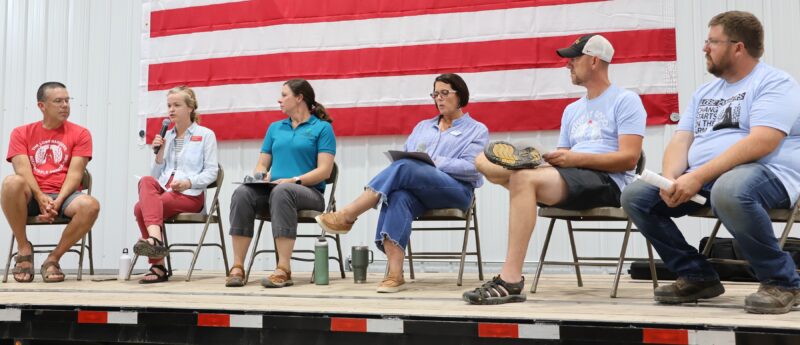
The lawsuit was eventually dismissed by a federal court, but the problem of nitrates in drinking water hasn’t gone away for Kahler’s 600,000 customers. The Des Moines water treatment plant frequently has to turn on its equipment for removing nitrates to keep drinking water safe, and that costs big money. Since the Water Works started tracking nitrate levels in 1974, levels have been on an “incline upwards,” said Kahler. She was not at the Water Works when the 2015 lawsuit was filed, and at one point Smith asked the CEO about the current relationship between agriculture and her employer. She conceded that a few years ago, “a Water Works car wouldn’t be welcome on a farm.” But she saw it as progress that she had been invited to this field day in a county that was named in the original litigation.
A man in the audience asked Kahler if it would actually be more economical to simply pay for removing nitrates from Des Moines’s water, rather than fund conservation efforts upstream.
“But that doesn’t help our rivers,” Kahler responded.
“Or our private wells,” DeLong chimed in.
The Regulation Dance
The “R” word, regulation, was brought up several times during the field day — by farmers, soil health experts, a journalist, and members of the general public. For example, there was a discussion about how Maryland officials use a carrot and stick approach to protect the Chesapeake Bay watershed: a flush tax imposed on residents provides funds to pay farmers to cover crop, but the state also restricts applications of anhydrous ammonia. The Lobe Rangers argue that, despite what groups like the Iowa Farm Bureau say, voluntary approaches to reducing nitrate pollution are not working. On the other hand, like many farmers the three are wary of heavy regulation of their industry. However, they see options such as taxing fall applications of anhydrous as a way to transition farmers (and non-operating landowners) into more regenerative practices. Whatever the approach, steps need to be taken soon — by farmers and their allies.
“We think regulations are coming, and it’s time we farmers get involved in shaping how they look,” Bormann said.
Rethinking Nitrogen
The Lobe Rangers’ efforts to put farmers out in front on the water quality issue is one of the driving forces behind LSP’s recently launched “Rethinking Nitrogen”campaign. This initiative’s goal is to build a farmer-led, public movement to show the power of nitrogen-reducing practices and create the political momentum needed to pass strong nutrient reduction policies during Minnesota’s 2027 legislative session. Through a survey and one-to-one conversations, LSP is identifying farmers interested in shaping outcomes, sharing their experiences, connecting with others, and helping build a stronger farmer-led movement for practical, common-sense solutions.
Branches of such a movement could begin in places like Calhoun County, Iowa, on a farm trying to do good by the land. During the equipment demonstrations, the non-farmers in the crowd were fascinated not only with how regenerative farming is carried out, but why people like Smith, Bormann, and Hepp are willing to go against the grain and speak out. Questions ranged from the cost of conservation cropping equipment and the learning curve involved with using it to cover cropping’s return on investment and what policies would help make soil-friendly practices more prevalent on the landscape.
Various versions of one question were asked by different people: “Why don’t more farmers do this?” At one point, Bormann offered a flip assessment: “Because they won’t do it.” It was a variation on a theme: these things can be done, and more farmers who are part of the soil health movement are proving it every day. “None of this is rocket surgery, and I met to say it that way,” he added. “But the public is starting to lose patience.”
Several heads in the crowd nodded in agreement.
LSP managing editor Brian DeVore can be contacted via e-mail.