
2026-2027 Farm Beginnings Class
LSP is now accepting applications for its 2026-2027 Farm Beginnings class session. The application deadline is Sept. 1. For details, click here.
♦ ♦ ♦
It was the winter of 2024-2025, and Frances Kelliher wasn’t exactly in the mood to sit in a room with a lot of idealistic agrarians. She was participating in her first few sessions of the Land Stewardship Project’s Farm Beginnings course, hearing about all the great plans her classmates had for building their own farming futures. At that point, Kelliher had been working on livestock and vegetable farms in Minnesota and Wisconsin for around five years — some of that experience had been not as positive as she’d hoped. In fact, a stretch on one cooperative farm had left her finances in a mess and wondering if she would even keep the small flock of ewes she’d built up through sweat equity. Getting consistent access to good grazing land was a challenge and she had to scramble just to scare up transportation for her flock.
“I definitely went into the class feeling really burnt out and cynical. I remember the first few sessions I was like, ‘Wow, everybody’s really dreamy, but like, do they know about flystrike? Do they know what it’s like to pull a lamb or deal with a prolapse?’ I definitely was a curmudgeon,” recalls Kelliher with a laugh on a sunny morning in April.
But as she’s relating this story, the farmer is preparing for another lambing season, a sign that the course didn’t totally sour her on agriculture. And it isn’t just because the class was able to impart some valuable practical skills when it comes to financial management and goal-setting. It turns out being around idealistic energy can sometimes be a cure for the curmudgeon condition.
“The class did open me up to a little more dreaminess,” Kelliher concedes. “I do think it’s good to be around people who are excited about the future.”
Now, in the midst of her second season grazing sheep on her family’s farm near Mankato, Minn., Kelliher is feeling positive enough to move forward with a pretty ambitious dream: utilizing regenerative livestock production to rebuild the relationship between people, the land, and the water in the Minnesota River Valley.
It All Connects
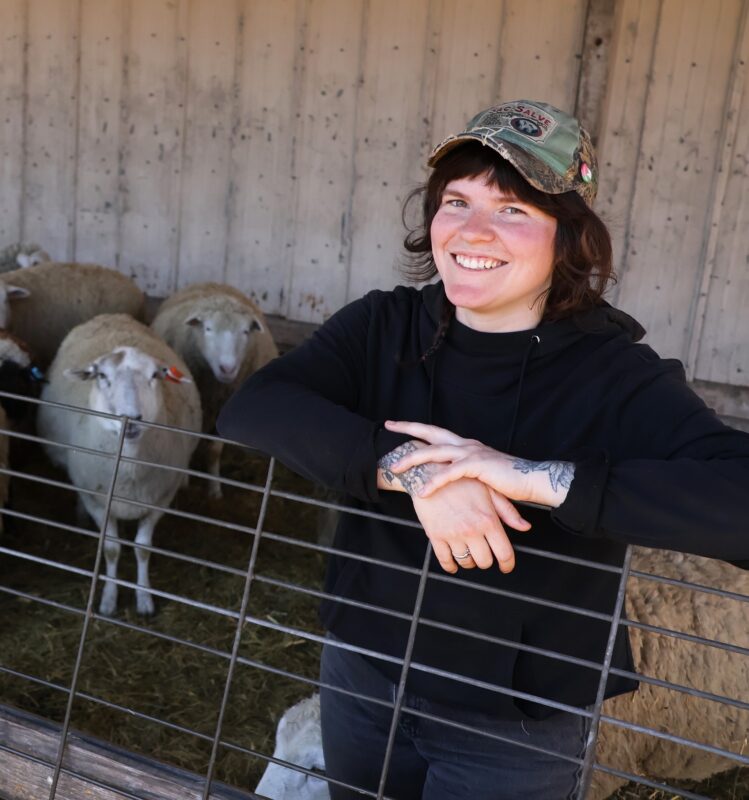
Kelliher, 28, grew up in Minneapolis and got interested in farming and food while taking public health classes in college. She says a life-changing experience was reading What Does Justice Look Like? In that book, Wahpetunwan Dakota scholar and activist Waziyatawin of Pezihutazizi Otunwe describes the generations of genocide and broken treaties that have marked the relationship between Indigenous people in the region, white settlers, and the government. The book struck home for Kelliher, given that her family had long farmed in the Minnesota River Valley near Mankato, where, in 1862, 38 Dakota men were hung in the largest mass execution in history.
The Anderson family farm, which was a dairy at one time, sits on the bottom of a steeply sloping dead-end road, just across a tree line from the Minnesota River. The farm also borders Minneopa State Park (a mill in the park was built by a great, great, great grandfather of Kelliher’s).
Frances refers to the 46 acres that remain of the family land as the “belly of the valley.” Such a location makes for a scenic setting, but comes with downsides. The Minnesota River flows through one of the most intensely cropped regions in the country and has long suffered from erosion and agrichemical runoff.
At one point Kelliher’s mother, who grew up on the farm, was diagnosed with breast cancer without genetic markers. Then a cousin who grew up in the area got the same diagnosis. Kelliher wondered: was there a connection between the farming methods that dominate the watershed and the cancers? She started thinking a lot about abuse of the land and of the people, and the connections to environmental and human health. She admits to spending a lot of time feeling shame and guilt, and overwhelmed about what to do.
“In What Does Justice Look Like? Waziyatawin talks about land back to Indigenous people on the part of the state and institutions, but she also talks about settler responsibility to heal land,” recalls Kelliher. “And one of the things that really stuck with me was settlers’ responsibility to heal land and not just give land back and wash your hands and be free of the guilt and the shame and the damage. But how do we actively move toward building relationship with land, healing the damage that we’ve done?”
Kelliher had always been a self-described “animal person,” and was fascinated with the role regenerative grazing could play in rebuilding soil health and reclaiming natural grassland habitats. After college, she learned as much as she could about rotationally grazing sheep by working on farms and networking with mentors such as Hannah Bernhardt, a veteran grazier in northeastern Minnesota. She also worked for a time with Josie Trople and Arlo Hark, whose Cannon Valley Graziers enterprise has carved out a business niche using rotational grazing of sheep to control vegetation beneath solar arrays in the region.
Kelliher is interested in cooperative farming models and has long felt she wouldn’t want to own her own farming operation in order to produce food and fiber. But about the time the grazier’s experience with cooperative farming didn’t go as planned, her grandmother, Elaine Anderson, died, and the family invited Kelliher to use Anderson’s farm near the Minnesota River as a home base for her operation.
It was starting to look like being an entrepreneurial farmer could perhaps be in the cards for Frances after all. And to do that, she realized she would need some background in financial management. Kelliher says she benefited immensely from time she spent working on Little Big Sky Farm in Henderson, Minn., where the owners regularly opened up their books and allowed her to take a look at what it takes financially to run an agricultural operation.
“That experience helped me realize if I was going to do this as my own business, I needed financial planning training,” the beginning farmer recalls.
Bernhardt, Hark, and Trople are all Farm Beginnings grads, and encouraged Kelliher to take the class, which provides training in, among other things, financial planning and goal-setting. So, that’s how Kelliher found herself sitting in a classroom with a bunch of idealistic wannabe farmers. The financial literacy she gained through the class was invaluable, she says, and she ended up taking an extra Farm Beginnings-sponsored workshop on Holistic Financial Management.
And, given her attitude going into Farm Beginnings, Kelliher says she was pleasantly surprised by how much she got out of an aspect of the class that at first glance wouldn’t appear to have as many “practical” applications. Participants are asked to write down what values drive them and to plan what kinds of farming enterprises and methods might help them stay true to those values.
“One of the things that kind of surprised me and has really helped is the work around values and kind of dreaming and accessing some things that I’ve been feeling really pessimistic and burnt out about,” Frances says.
Going through the values exercise helped anchor and guide her as she worked through that first growing season on her family’s farm. In the end, Kelliher decided to keep her flock and take advantage of the shot she had to farm and live on family land. Why not? She could always reassess after a year, given that she doesn’t have a lot of money invested in expensive infrastructure.
“It’s one of the reasons I think sheep are so great to start out with, because the investment is electronet fencing, a solar energizer, my veterinary supplies, and two dogs,” she says. “I can be scrappy with the sheep and have these pretty low investments.”
Also in 2025, Kelliher added aluminum panels she can make corrals with and a used pickup truck she picked up at a state government auction so that she could move the sheep to other grazing areas in the neighborhood. The farmer admits that she’s so close to the bone financially that paying $500 for a solar charger hurts, but she’s been able to apply for regenerative livestock production grants, which have helped alleviate the costs of doing business.
Keeping the farm relatively mobile is an important consideration given that the current location of Kelliher’s enterprise, the Anderson farm, is in flux — six extended family members own the property, and it’s not clear if river bottom land is the best place to raise sheep. Her flock has already gone through a serious bout of flystrike, a condition where parasitic blowflies lay eggs in wool or open wounds; it tends to thrive in areas like river bottoms where wool has a hard time getting properly dried out.
The Land Responds
Almost a year to the day since Kelliher brought livestock back to a farm that hadn’t seen domesticated hooves in some three decades, she walks past a former dairy barn and silo to inspect a low-lying meadow between a railroad track and the river. The farmer reflects on the past year and lets herself dream a little bit about the future.
In 2025, she sold out the grass-fed meat her Riverbed Lamb enterprise produces, and she’d like to expand her flock of 20 ewes to meet the demand.
“I think sometimes I get a little, ‘Oh, marketing, whatever. I don’t like doing that part.’ But I actually do like the customer connection part of all this,” Kelliher concedes. “Getting pictures throughout the year of what people have cooked and getting to be part of people’s lives is a really joyful part of this work. I’m so excited to get more lamb to more people this year.”
Her main source of income is through work as a personal care attendant, and for now, although it’s more than a fulltime gig, farming doesn’t provide enough income to preclude a town job. Even so, she’s excited about the prospect of doing contract grazing on other people’s land. Frances likes the idea of using animals to improve soil health and grassland habitat in the community, and also sees this approach as a way to increase cash flow while staying nimble.
But perhaps the ultimate sign that the self-described pessimist sees some future in farming is that she’s agreed to serve as a mentor to another beginning farmer via a Women, Food, and Agriculture Network (WFAN) program. Kelliher says she benefited tremendously from being mentored by Bernhardt through a similar program administered through Food Animal Concerns Trust (FACT). Such an arrangement provides exposure to the practical skills — building fence, vet care, dealing with pests, setting up watering systems, etc. — needed to run a viable livestock operation. Kelliher particularly liked that through the FACT arrangement, Bernhardt was getting paid. The WFAN program also pays mentors.
“Because I knew Hannah was getting paid for her time, I felt a lot more comfortable asking for help,” says Frances.
Walking through the former dairy meadow on this spring morning, she’s thrilled to see green shoots of vegetation poking up. She explains that for years a thick thatch of dead vegetation seemed to smother all new growth, creating an unpalatable mat.
“It has been interesting already this spring to see the difference grazing can make,” she says. “You can see the lines where I’ve grazed and just in the last week it’s really popping.”
It’s a sign that regenerative grazing can help the beginning farmer make connections between good treatment of the land, the people, and healthy food.
“I’m here for some amount of time and I’d like to leave it better if I can,” Kelliher says as she walks back to the farmstead.
This profile originally appeared in the No. 1, 2026, edition of the Land Stewardship Letter.