
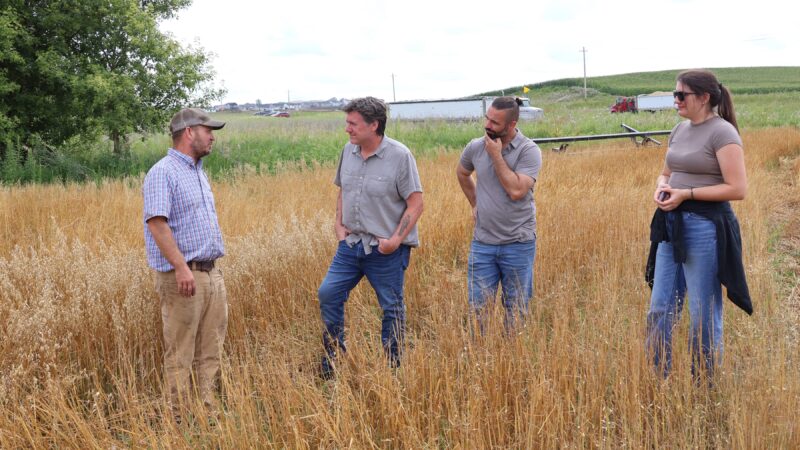
On a recent July afternoon, southeastern Minnesota farmer Martin Larsen stopped his Gleaner R-62 combine in the middle of oat harvest, climbed down the ladder, and walked a hundred yards or so to where the Chair of the Minnesota Senate Agriculture Committee was standing at the edge of the field.
Larsen then described to Sen. Aric Putnam how he was facing a classic farmer dilemma: he was harvesting a bumper crop here on the northern edge of Rochester, but his marketing options were limited. It was especially frustrating given that there’s strong consumer demand for oats, but it turns out major processors in the region are importing most of their raw product from Canada. To top things off, research Larsen and others have done in the karst region of southeastern Minnesota shows getting a small grain like oats into the rotation dramatically reduces the amount of nitrate pollution that makes its way into the groundwater.
Larsen also works for the Olmsted County Soil and Water Conservation District, which coordinates the Groundwater Protection and Soil Health Program, an initiative that incentivizes area farmers to diversify their rotations in the name of building soil health and protecting water quality.
“It’s good for the economy, it’s good for water quality, but we can’t sell them,” Larsen said of the oats he and other members of the Oat Mafia have begun working into their rotations in recent years.
Larsen’s field was one stop on a three-farm tour the Land Stewardship Project recently coordinated in southeastern Minnesota as a way to give a legislative ag leaders a firsthand look at the challenges farmers face. Sen. Torrey Westrom, the Ranking Minority Leader of the Senate Agriculture Committee, also participated in the tour, which began at the Myron Sylling farm near Spring Grove, and which made a stop at the Bonnie and Vance Haugen operation near Canton, before wrapping up in Larsen’s oat field. I, along with LSP soil health organizers Alex Romano and Shea-Lynn Ramthun, helped coordinate the tour.
During the regular legislative session, which starts in the winter and runs into late May, LSP benefits greatly from having farmer-members travel to the Capitol in Saint Paul to tell their stories, either by meeting directly with lawmakers or by testifying before committees. But nothing beats getting legislators out onto farms to see challenges and opportunities firsthand. Having a corn-soybean farmer like Sylling stand next to one of his fields and explain how he is using conservation practices like cover cropping and no-till to build soil health profitably while cutting erosion is much more impactful than even the most colorful set of PowerPoint slides shown in a Capitol hearing room. Sylling also was able to show off equipment recently purchased from the Minnesota Department of Agriculture’s Soil Health Financial Assistance Program, which has helped farmers across the state further their soil health practices.
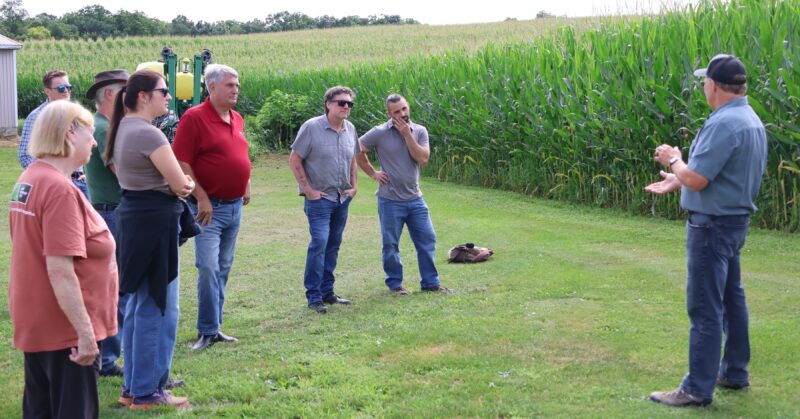
Sylling explained to the Senators the importance of having access to not only public cost-share funds to try out various soil-friendly practices, but also technical expertise and support to make them viable in the long-term.
“Once they see you can do this, people will try it,” Sylling said of practices such as cover cropping. “But you need to tie education to these payments.”
The tour of the Haugen farm helped put a human face on the crisis dairy farming is facing throughout the Midwest, as small and medium-sized milk producers go out of business at a record pace. The Haugens bought this hilly farm in 1993 and started producing milk utilizing managed rotational grazing because it was economical and helped keep soil in place. Their son, Olaf, took over the dairy herd a few years ago, but as mega-dairies swamped the markets, it became difficult to find a processor that would pick up the milk and pay them a good, consistent price. Three years ago they sold the dairy herd and transitioned into raising beef cattle.
When the Haugens started farming in the early 1990s, there were 14 farms in the neighborhood.
“How many dairies do you see in the neighborhood now? We were the last one,” Vance told the Senators.
The Haugens conceded that now is a good time financially to be in the beef business, but that for a local economy, there’s nothing quite like having several small and medium- sized dairies in the community, given the various services such operations require. Bonnie said no matter what kind of cattle they raise, they are committed to utilizing managed rotational grazing. Such a system provides a low-cost way to produce meat or milk, while supporting the kind of deep-rooted perennial pastures that build soil and protect the groundwater in an area that’s particularly prone to contamination from nitrates and other ag pollutants.
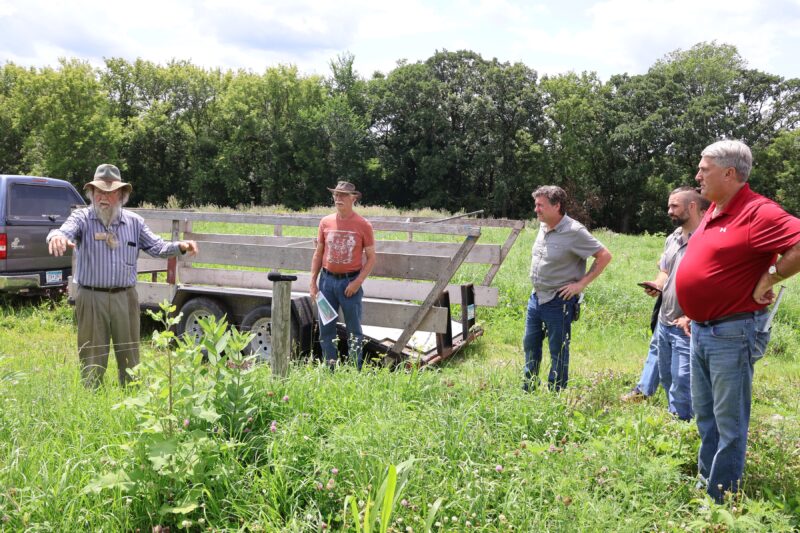
“Truly keeping cover on this ground year-round can affect things for the good,” said Bonnie before Vance loaded the Senators onto a trailer and took them out to one of the farm’s lush grazing paddocks. The impromptu pasture walk prompted a discussion by Westrom and Putnam about ways to support legislation that would provide funding for farmers looking to install managed rotational grazing infrastructure.
Hopefully, such mini-tours help paint a “real world” picture for lawmakers that stays with them long after they head back to Saint Paul and begin discussing what agricultural legislation should take priority during the 2027 session.
If you’re interested in hosting a lawmaker on your farm, or even traveling to the Capitol to share your story, contact me via e-mail. More information on LSP’s state policy work is available here.
LSP government relations director Laura Schreiber can be contacted via e-mail.