
The Land Stewardship Project’s annual Family Farm Breakfast and Lobby Day serves as a prime opportunity for our members to get together with lawmakers and discuss the issues they most care about. As the lead organizer focusing on issues related to land access, it’s my job during the day to facilitate meetings between beginning farmers and legislators, where discussions about such issues as land access can take place.
Here’s how LSP’s Lobby Day usually goes: typically, members from around the state come to the Capitol to meet with their legislators to discuss two or three bills that LSP prioritizes. Folks usually have 15 minutes to meet with their legislator and in that short time start building a relationship, share stories, and deliver talking points. These critical meetings teach legislators what LSP members care deeply about and how they can support important priorities. The meetings can also be frustrating if the legislator has to cancel last minute, is not receptive to our issues, or doesn’t serve on committees most relevant to moving our bills.
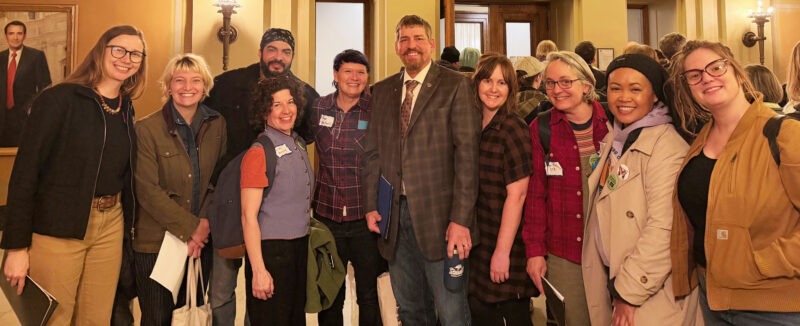
In 2025 and 2026, we tried a different strategy. Instead of members meeting separately with their own district legislators, we had a large, statewide group of farmers/advocates directly impacted by land access come together and meet with lawmakers who serve on the House and Senate Agriculture Committees. These legislators have the most direct decision-making impact on programs that affect land access. This strength in numbers approach is for the sake of impact and for the safety of our members, especially in a year when immigrant populations are being targeted with violence and hateful rhetoric.
A Land Access Helping Hand
In recent years, including 2026, the focus of our lobbying has been to make improvements to the Farmland Down Payment Assistance Program, which is administered by the Minnesota Department of Agriculture. This initiative was launched in 2022 by the Minnesota Legislature as a way to provide financial assistance to beginning and “emerging farmers” who are seeking to purchase their first farm. For clarity’s sake, “emerging farmers” are defined by the Minnesota Department of Agriculture as agricultural producers who face barriers to education, land, and resources. The term typically encompasses young, BIPOC (Black, Indigenous, and people of color), female, veteran, LGBTQIA+, and urban farmers, along with individuals with disabilities. Working with groups such as the Midwest Farmers of Color Collective, LSP supported the creation of this program. It’s turned out to be wildly popular. In just three years of implementation, 112 beginning farmers have utilized this grant to buy their first farm. However, the demand for the program far outstrips the resources available, and many applicants are turned away each year. The Minnesota Legislature appropriated $500,000 for a first round of Down Payment Assistance Grants. In 2023, the application opened online for the first time and grant requests exceeded available funding in less than 10 minutes.
So, during the past few legislative sessions, we’ve worked with our allies to fight for increased funding for this program and to make policy tweaks that prioritize emerging farmers and support beginning farmers who are growing food for their communities. We’ve met with some success. In 2024 the grant’s overall funding was increased to $1 million and in 2025 to $1.25 million.
In 2026, LSP’s Land Access/Emerging Farmer committee worked to push legislation that would provide the farmers with more time to spend the grant money, craft readiness requirements that would filter the lottery-based award to those who have farm experience and are committed to using the land for a farm business, and set aside a small portion of the funds for people who already had purchase agreements in hand so they wouldn’t have to participate in the lottery system.
Sharing Their Stories
To say the least, during this year’s Family Farm Breakfast and Lobby Day in March, we had a lot to talk about. We recruited impacted farmers from around the state and prepared and trained them to talk with the decision-makers. We expanded our Land Access/Emerging Farmer Committee to include those who work directly on land access, including staff from Renewing the Countryside, the Commons Land Trust, and the Latino Economic Development Center. We hosted two virtual land access lobby training sessions so that people could better understand the legislation being promoted, practice their stories, and learn how to be an ally of impacted farmers. Folks from Sharing Our Roots, Big River Farms, and Kilimo joined our lobbying efforts — these three farms are incubators or collectives that provide critical paths for emerging farmers who are seeking land access and other means of support.
By the time of the Lobby Day, 16 farmers and allies came ready to meet with eight legislators serving on either the House or Senate Agriculture Committees. Just days before, many of our meetings were rescheduled, leaving us with having three meetings at the same time. We pivoted at the last minute by parsing out who would go where, and two core committee members, Lizzy Haywood and Taylor Olsen, along with LSP organizer Robin Moore, took the lead on getting folks where they needed to go, making sure they felt supported and were ready to jump in on details of the legislation.
Our first meeting of the day was held right in the middle of the chaos that exists just off the Rotunda in the Capitol building. It was loud and crowded with other groups and legislators, and many LSP members wanted to get the ear of Rep. Rick Hansen, co-chair of the House Ag Committee. Vegetable farmer Lilian Mboss shared the challenge she faced when she received a Down Payment Assistance Grant but ended up not being able to use it in time to meet the program’s deadline. (She learned that others got extensions, but none were offered to her.) Farm Beginnings graduate Tessa Parks, a livestock producer who rents her grazing land, addressed how critical land access is to her business stability. Derek Ellis, a Farm Beginnings grad and successful down payment assistance grant awardee, thanked Hansen for his support on the bill.
Another group of farmers met with Sen. Aric Putnam, chair of the Senate Agriculture Committee, while others met with Rep. Paul Anderson, co-chair of the House Agriculture Committee, and Rep. Fue Lee, who serves on that Ag Committee. Urban farmer and Farm Beginnings graduate Elyssa Eull spoke on the economic feasibility of growing food on small acreages, while vegetable farmer and farm mentor Moses Momanyi addressed how Minnesota is a leader in supporting emerging farmers and should continue supporting the state’s growing population of immigrant farmers. Mboss and Ellis highlighted the barriers facing farmers of color when they are buying farmland outside of the Twin Cities Metropolitan Area and how potential sales often fall through when they realize a Black person is the wannabe buyer. Ka Zhoua Berry of Big River Farms spoke about small farmers’ needs and secure land access’s critical role in success. Sina War of Midwest Farmers of Color Collective spoke to the needs of beginning farmers and brought an emerging farmer for her first Lobby Day to share the challenges that she has faced.
Our Impact
During the 2026 legislative session, the proposal that would improve the Down Payment Assistance Program came up for discussion five times between House and Senate hearings, making it a top bill for the committees. Eull, Berry, and LSP government relations director Laura Schreiber testified in favor of the legislation, and we had conversations and meetings with legislators, Minnesota Department of Agriculture staffers, and partners at the Minnesota Farmers Union to hammer out details. We received bipartisan support on our amendments, were able to strike down or alter unfriendly amendments, and our bill passed in the House and Senate. We got to a place of bipartisan support for the bill with more empowered members/partners, stronger relationships, and new champions.
We’re proud of the process we engaged in, but unfortunately no Agriculture Bill was passed, so the majority of these proposals did not go anywhere. One bright spot was that the cap for the Beginning Farmer Tax Credit was lifted for one year. For details, see our legislative wrap-up blog.
In the end, our strategy of “flooding the zone” with emerging farmers paid off.
Pam Hartwell is an LSP policy organizer leading the organization’s work on land access and emerging farmer issues. Interested in joining the Land Access/Emerging Farmer Committee? Contact Hartwell at phartwell@landstewardshipproject.org or 507-307-7435.