
2026-2027 Farm Beginnings Class
LSP is now accepting applications for its 2026-2027 Farm Beginnings class session. The application deadline is Sept. 1. For details, click here.
♦ ♦ ♦
The phrase “Perfect is the enemy of good” is often attributed to the French Enlightenment writer and historian Voltaire. His actual quote is, “The best is the enemy of the good.” But you get the point. Either way, to Jane Marynik, the pursuit of perfection could have stood in the way of succeeding at a career that is inherently adverse to having everything go as planned.
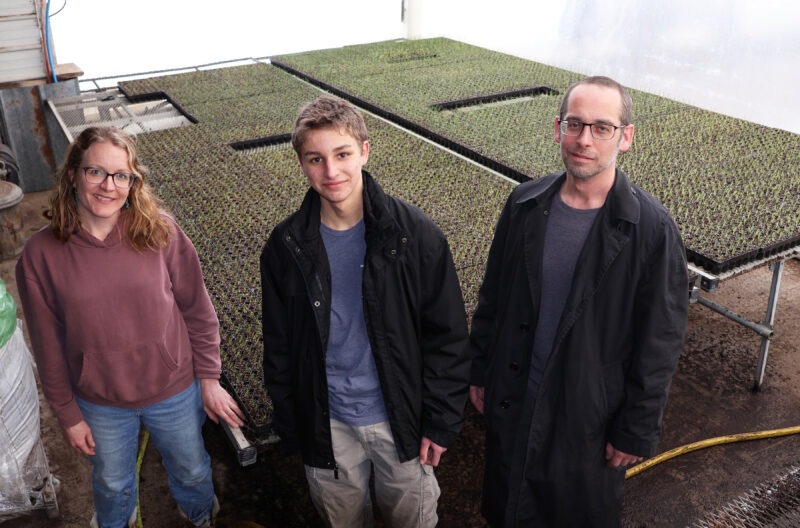
“I would say that I definitely was over the top with perfectionism, and farming has really helped calm that down a little bit,” she says while sitting in a shed at Food Farm in northeastern Minnesota with her partner, Craig, and Grady, their 15-year-old son. As she’s talking, the late March sun outside is liquefying snow at a fast pace in the North Country, and the next growing season is obviously on Marynik’s mind. “I can read all the things and know all the products to use and know all these different things, but it doesn’t work when the weather doesn’t cooperate or the machinery doesn’t cooperate or you have an injury or whatever,” she adds.
Marynik has come to terms with her sometimes fraught relationship with imperfection thanks in part to the real-world experience she’s received while working on vegetable farms in the Lake Superior region of northeastern Minnesota during the past few years. After all, if Voltaire were farming today, he might rephrase his famous quote to say, “Perfect is the enemy of getting it done before the final killing frost.”
Marynik also benefited from her experience taking the Land Stewardship Project’s Farm Beginnings course, which, among other things, provides students grounding in balancing quality of life with productive farming. Such training is particularly important to someone who came to farming at a relatively late stage in life. Marynik is 45, and underwent hip replacement surgery last November.
“I can’t pretend that I’m 30 anymore,” says the former marathon runner. “I’ve got to take care of myself and be aware — making sure I’m using the right tools and not lifting the 60-pound thing by myself.”
Commuter Ag
Around a dozen years ago, while studying biology and sustainability at the University of Minnesota-Duluth, Marynik got interested in the role farming could play in not only providing healthy food, but supporting a resilient natural environment. She began working on the university’s student-run farm, where she learned the basics of raising produce in an area that has a short growing season and less than optimal soil conditions. Jane went on to get other farming experience, and today she manages the seasonal crew at Food Farm, a large organic vegetable operation just outside of Wrenshall, Minn. Food Farm, which was launched by John and Jane Fisher-Merritt in the early 70s, has a long tradition of utilizing innovative production and storage techniques to provide food to local Community Supported Agriculture (CSA) and wholesale customers. The operation, which today is owned and operated by the Fisher-Merrits’ son, Janaki, along with his wife, Annie Dugan, also has a reputation for launching other farming careers in the region.
So, it’s no surprise Marynik is using her experience on Food Farm to get her own farm dream established via an operation she calls Four Beans Farm in honor of her and Craig’s four children. Besides utilizing some of the larger-operation’s vegetable plots to grow her own product, Jane has started farming at her home within the city limits of Superior, Wis., which is about a 20-minute drive northeast of Food Farm. She and Craig have tilled up part of their yard, as well as a neighboring property they purchased. They even have a small Wayfair greenhouse that’s attached to one side of a garage, and Grady is managing a small chicken enterprise.
“It’s so amazing — a pet that gives you eggs,” quips the teenager.
Jane says farming in two different locations has its advantages. For one, since Superior is right on its namesake lake, it has a microclimate that makes for a longer growing season than what Food Farm has. By commuting between the two farms, Marynik is getting experience not only with different weather and soil conditions, but contrasting models of running a vegetable business: a backyard operation versus a larger farm with lots of infrastructure and a number of employees.
Farming in a residential neighborhood in Superior also has the added benefit of showing people in the city that vegetables can indeed be grown this far north.
“It’s on a pretty public sidewalk and there’s an elementary school on the other side, so you get a lot of kids walking by, and I think it’s nice for them to actually see that,” says Jane of her city veggie operation. “One year the garlic was coming up, it was pretty tall, and a guy walking by was like, ‘Is that corn?’ So, there’s an education piece too.”
That kind of education is important to the beginning farmer given her commitment to supporting a local food infrastructure. “Why do we eat lettuce from California? It’s like you’re just importing water,” she says with a laugh. “We have water, they don’t.”
Sincere Sustenance
Jane feels she’s well on her way to having the agronomic skills needed to grow a variety of foods, including her specialty — numerous varieties of edible beans. And it turns out there is a big demand for locally produced food in this part of the North Country. Besides selling through a farmers’ market, a food co-op, and a few restaurants, Jane is also part of something called Twin Ports REKO, which uses Facebook as a platform through which eaters can order food from local farmers. (The REKO model, which originated in Finland, translates to “real or sincere consumption.”)
Jane has been so happy with her agricultural progress that she and her family have begun looking for land in a rural area where they can set up shop permanently. But she realized a few years ago that before she jumped into farming as a full-fledged entrepreneur, she’d need some background in business management. Jane sought out various organizations that offered basic courses on running a business, but none of them were geared specifically towards making a living raising food.
So, with the encouragement of Janaki, Jane and Craig took LSP’s Farm Beginnings course during the winter of 2024 and 2025. Farm Beginnings is a training program that focuses on the goal-setting, marketing, and financial skills needed to establish a successful farm business. A major part of the course consists of training in Holistic Financial Management, which focuses on “big picture” decision-making and goal-setting processes. In a Holistic Management system, a farmer’s quality of life is put on the same level as the health of the soil or the operation’s economic viability.
Jane says the financial management training she got through Farm Beginnings was critical. She also benefited greatly from presentations given by established farmers who talked about the challenges, as well as opportunities, involved in this career path.
“I don’t care what kind of farming other people are doing — I feel like there’s always something you can take away from their story on how they started,” she says.
True Balance
But of particular benefit for Jane was the focus on how to holistically balance work with quality of life issues. She’s mindful that, unlike a 20-something farmer, putting in endless hours of hard labor in vegetable plots, high tunnels, and greenhouses is not an option. Managing a farm (and life) holistically has provided the beginning farmer with the ability to step back and take care of herself and leave room for things like attending her kids’ cross-country meets. It’s also helped her get over the drive to have everything go perfectly.
But Jane makes it clear not pushing oneself to the limit doesn’t mean neglecting to make big plans. Once the family finds a permanent, rural home for their farm, she’d like to focus on raising specialty crops for local markets. She’s especially excited about leaning into raising edible beans. Jane’s fascination with that food crop began when she was in college and someone handed her a packet of bean seeds. She was impressed with the many types of beans that could be raised in the region, and began planting varieties that were not only striking in appearance, but had colorful names: Calypso, Marfax, Lina Sisco Bird Egg, Jacob’s Cattle Gold, Tiger’s Eye, Dakota Bumble, Kenearly Yellow Eye, Hidatsa Red, Barbunya, Haudenosaunee Skunk, Hidatsa Shield, and Eclipse.
“It was like, whoa, look at that. It wasn’t just a black bean or a kidney bean or whatever,” recalls Jane. “So I just became obsessed with them because they were pretty. But I think it’s also a good thing to have up here because for people who want to eat local and they need that protein source but don’t eat meat, it’s a good option.”
On this March day, Jane, Craig, and Grady check out a Food Farm greenhouse sprouting trays of onion seedlings. As they head back to the farm’s equipment shed, Jane talks about another benefit of working on the operation: it’s given her a glimpse of what kind of farming she’d prefer to be doing on her own: big enough to make a dent in the local food system, but small enough that she wouldn’t need to manage a lot of employees and run big equipment.
It’s all part of her plan to keep that pursuit of perfection at bay. Like running a marathon, it’s one step at time. Jane describes one wet fall day when she was looking to harvest a few more pounds of beans from a plot at Food Farm.
“The weather was just garbage, and I was thinking to myself, ‘This is the last day I can do this,’ ” the farmer recalls.
But she had plans to go to a cross-country meet and there was no way to get those last beans brought in before the end of the day anyway. As she drove away, Jane knew in the future there would be other seasons, other fields, and other harvests.
“I used to hate that saying, ‘good enough,’ ” she says. “But truly, good enough. It’s good enough.”
This profile originally appeared in the No. 1, 2026, edition of the Land Stewardship Letter.