2026-2027 Farm Beginnings Class
LSP is now accepting applications for its 2026-2027 Farm Beginnings class session. The application deadline is Sept. 1. For details, click here.
♦ ♦ ♦
Sometimes a shot of reality can inject a sense of urgency into an educational experience. Roughly half-way through their participation in the 2024-2025 winter session of the Land Stewardship Project’s Farm Beginnings course, Emily and Ryan Kjesbo-Johnson purchased a 14-acre farm in Minnesota’s Sogn Valley, a little less than an hour’s drive from where they were living at the time in Saint Paul’s Frogtown Neighborhood. The couple had thought finding the right farm would take longer, so, suddenly, the course’s exercises, discussions, and homework around how to fit the right enterprises onto the right piece of land were no longer academic. Once the ground thawed, the Kjesbo-Johnsons would transition from urban backyard gardeners to rural farmers. It was show time.
“Before, it was all hypothetical, but it took on a different impact when we got the land and were picturing this community, this growing space,” recalls Emily while sitting in the kitchen of their farm on a stormy April morning.
Fortunately, the class helped the couple fortify what values would guide them in this new endeavor, no matter where they were farming or what they were raising.
The Glue of Life
A life well-lived requires adherence to some sort of connectivity that keeps things on track through good times and bad, surety and doubt. For the Kjesbo-Johnsons, who are both 40, that north star has always been crystal clear.
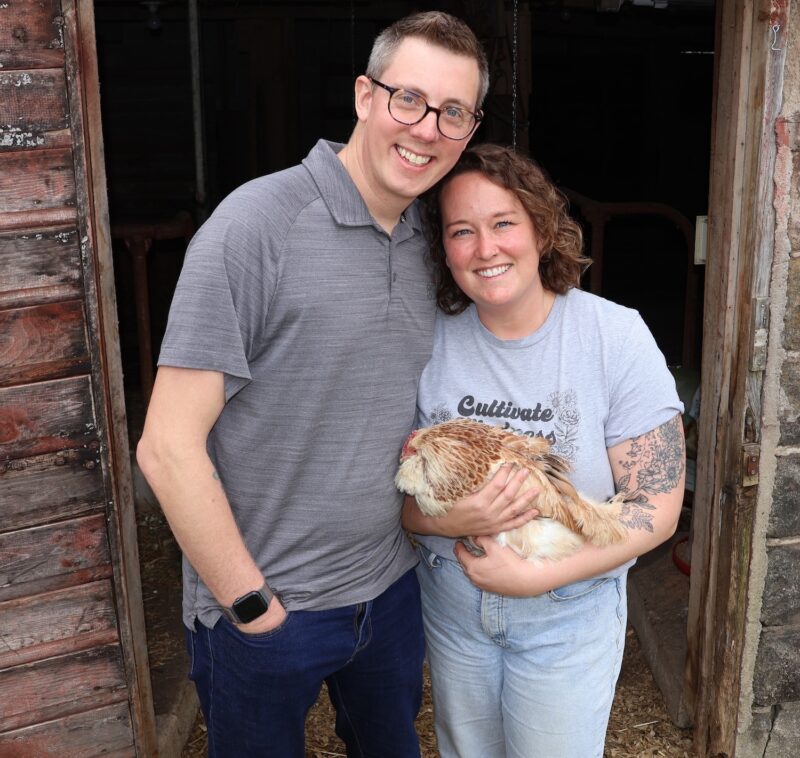
“Community connections were definitely the throughline of our careers,” says Ryan.
The couple adhered to that value while they were volunteering for various causes in college back in the early 2000s, and later when they served in both AmeriCorps and Peace Corps. That commitment to community continued while they lived in Frogtown, raising two adopted children there and working in education (Emily) and nonprofit IT support (Ryan). Their Peace Corps experience in Uganda sparked a passion for raising fresh, healthy food, and figuring out how to get it to people in the community. They fed that passion while living in Saint Paul by using raised beds to grow vegetables in their yard. And once their children were launched, the Kjesbo-Johnsons began looking for a way to take that passion to the next level.
So, when they decided a few years ago to shift gears and become full-fledged rural agrarians, they enrolled in the Farm Beginnings course. A major part of the Farm Beginnings program is Holistic Financial Management, which focuses on “big picture” decision-making and goal-setting processes.
Ryan and Emily say the portion of the course where they were prompted to think about and write down what values guide them was particularly valuable. Through that exercise, it became even clearer to them that the main goal they shared as a couple was to have a farm that not only produced food utilizing regenerative, soil-friendly methods, but was a welcoming space where folks could come and connect with the land and each other.
Key portions of the Farm Beginnings course are the presentations given by established farmers representing a variety of enterprises, sizes, and methods used. Emily’s family background is that her grandparents had a large conventional farm in southwestern Minnesota, so she says an added benefit of the class was being able to connect with farmers whose operations varied widely when it came to size, as well as types of practices used and foods produced.
“When I think, ‘farm,’ I think hundreds of acres and big combines and the whole deal,” she says. “So, it was powerful to hear from people who were growing on half-an-acre, an acre, two acres. Wow, you can do a lot even with a little bit of space.”
But, both Ryan and Emily say, just as important was the reality check the course provided; during the class, stories were shared of how difficult making a go of it in farming can be, and how at times the best decision for all involved is to step away from this particular career path. Ryan says another dose of reality the course offered was practical methods for dovetailing what they believe in with an economically viable way to raise food.
“How do you get insurance for something that’s your values? How do you budget for something that’s your values? It really connected those dots for us in a way that I don’t think we ever would have without Farm Beginnings,” he says.
Narrowing the Focus
Their operation, called Crowded Table Farm, is a mix of open fields and dense woods. There is also a patch of land that the former owner converted back to native prairie. Overall, the parcel has not been a working farm for at least three decades. But after a rainstorm passes on this April morning, Emily and Ryan provide a tour of the farm and show how its ag infrastructure, including a large barn and other sheds, has been kept up well. And then there’s the rich soil, something Ryan says he appreciates even more after participating in a Farm Beginnings session led by a soil scientist.
“Whoa, there’s so much more going on in the soil than we ever imagined,” he says. “When you have quality soil, it’s just amazing to see what vegetables can do.”
“And it makes us want to continue taking care of that soil, and developing and contributing to that even more,” adds Emily.
That first growing season, the couple settled on producing vegetables and eggs on a small scale and they marketed their production through a modest “friends and family” Community Supported Agriculture (CSA) enterprise. They’ve decided a lack of good fencing infrastructure precludes raising larger livestock for now, although they have an interest in raising goats eventually as part of a silvopasturing enterprise. Honey production occupied a spot in their pre-land ownership dreaming, but they’ve axed that plan given such an endeavor could interfere with a neighboring beekeeper’s operation. The farm is on a dead-end road, so selling produce through a roadside stand is out.
Making the transition from a few raised beds to long rows of vegetables grown on half-an-acre wasn’t without its trials. There was a learning curve to learning how to lay out the rows efficiently, and the Kjesbo-Johnsons, who are still working their city jobs remotely, found it to be a challenge to do everything from budget in time for washing and preparing produce for delivery to making sure they hadn’t misplaced a tool or used up all their packing boxes.
“The first year was just like a treasure trove of mistakes, honestly,” says Ryan with a laugh. “You have a narrow window from the time you close your laptop for work to the time the sun sets. So we really are thinking this year about how to streamline, how to improve our process. How do we ensure that we have the products going into the season now, so we’re not having to scrounge around things to pack later?”
But the 2025 growing season went well enough to give them confidence to double their CSA share offering to 20 members in 2026, and they’ve expanded their sales to a farmers’ market in Northfield, Minn. They’ve also established a Hip Camp spot as another way to share the scenic farm with a wider community. One thing that’s given the couple confidence to dream bigger is that there are other beginning farmers, including Farm Beginnings grads, making a go of it in the area.
“It’s like Farm Beginnings gave us a built-in community and network that we’re connecting with,” says Emily.
And, in-between working their day jobs, growing vegetables, and feeding people, the couple continues to take the measure of the land and figure out what’s best for it as well as themselves and their community, both locally as well as through the connections they still have back in Saint Paul.
Long-term goals include stewarding the woodland and prairie habitat present on the land, as well as creating a gathering space for other parents of adoptees. It’s no accident the farm is called Crowded Table: the moniker was inspired by a song by Brandi Carlile and the Highwaywomen, which talks about everyone being a little bit broken, and in need of a space to find belonging.
Says Emily, “That’s the space we’d like to create here.”
This profile originally appeared in the No. 1, 2026, edition of the Land Stewardship Letter.