
CUMBERLAND, Iowa — Here in southwestern Iowa, it’s the season of the white torpedo. Once it seemed spring wasn’t fake news, pickup trucks began towing to winter-dormant fields tubular tanks of gaseous anhydrous ammonia fertilizer here and in the rest of the Corn Belt. These white cylinders are the harbingers of a new planting season — tillage and seed placement will follow. They are a reminder of how reliant on this form of nitrogen fertilizer the dominant crop is. And the region’s economy, in turn, depends on that crop. “Corn Grows Iowa” crowed radio ads during recent March Madness coverage, when Iowa college basketball was still a factor in the tournament.
Those packets of productive power flowing past my family’s farm are also a reminder of the environmental price Corn Belt states pay for being so dependent on a form of fertility that’s difficult to keep in place long enough to be used by growing plants; in the U.S. on average over 34 pounds of nitrogen is lost on each cultivated crop acre per year (the average Midwestern corn grower annually applies roughly 150 pounds of nitrogen per acre). In Minnesota, 70% of nitrogen pollution comes from commercial fertilizer escaping cropland.
Levels of nitrate, a form of nitrogen that, as a recent hearing at the Minnesota Capitol made clear, is hazardous to human health, were so high in the Des Moines River a few months ago that the pricey machinery for removing the pollutant from the drinking water of that river’s namesake city had to be activated. Central Iowa residents are accustomed to this system being switched on during spring planting, but this winter activation was an alarming indicator of how much excess fertility is present in the environment year-round. Almost exactly two years ago, just a few miles from where I am writing this, a massive nitrogen fertilizer spill on the East Nishnabotna River killed over 749,000 fish along some 50 miles of the waterway, almost all the way to the Missouri River. Iowa has the second-highest cancer rate in the country, and there are concerns it’s due to agrichemicals in the water, including nitrates. In February, a poll taken in Iowa showed the majority of respondents see water quality as a “very serious” issue and would more likely vote for someone who prioritizes controlling agricultural pollution.
Meanwhile, agricultural heavyweights like the Iowa Farm Bureau appear to be in denial. Last year that group issued a statement saying the nitrate pollution situation in Iowa is improving, despite scientific evidence to the contrary. The Bureau also worked successfully to get the Des Moines and Racoon rivers, along with other stretches of Iowa waterways, removed from the EPA’s impaired waters list. This undermines efforts to clean up these waterways and tells farmers to continue business as usual.
Iowa farmer Zack Smith isn’t buying this narrative.
“They’re being intellectually dishonest with the facts,” he told me during a recording of the Land Stewardship Project’s Ear to the Ground podcast, referring to efforts on the part of the Farm Bureau and other groups to greenwash the problem.
As he said this, Smith and I were sitting in a windswept machine shed just a few miles from the East Branch of the Des Moines River in north-central Iowa. Fellow farmer Matt Bormann was our host, and another farmer, James Hepp, was also present. They both nodded emphatically in agreement to Smith’s blunt assessment.
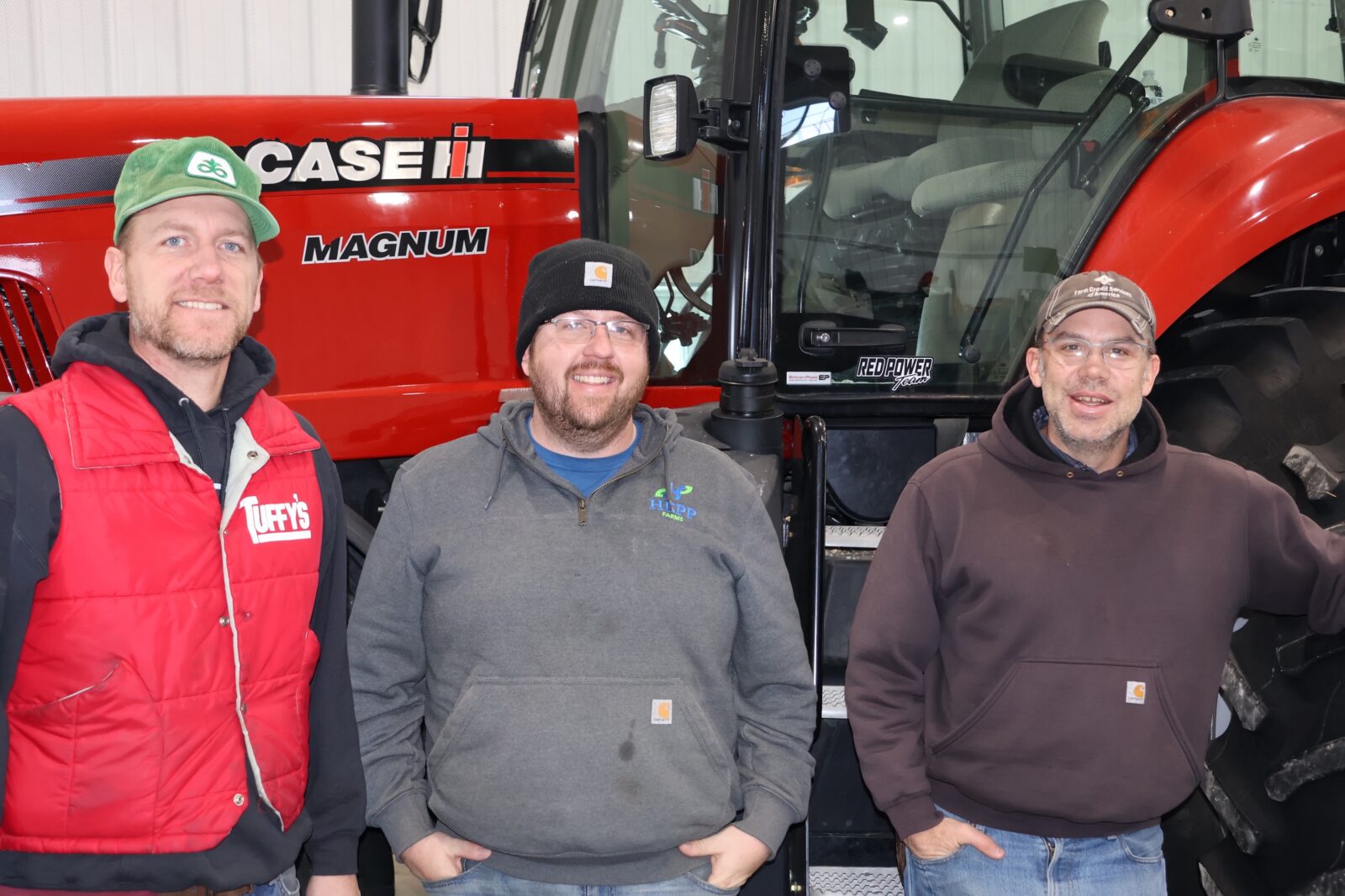
These three aren’t environmental experts, water scientists, or even health-conscious suburbanites. They are fulltime farmers who raise conventional corn, the crop that’s responsible for all this mischief. They each farm around a thousand acres; Hepp is 35 and Bormann and Smith are in their 40s. They all studied agriculture in college and have been active in mainstream ag groups like the Farm Bureau. Smith worked for a time selling chemicals and seed. In other words, they check a lot of Midwestern agrarian boxes.
But these farmers are part of a movement that’s centered around treating soil as a living ecosystem, rather than just dead dirt forced into production using chemicals and tillage. They utilize cover crops as well as soil-saving systems like no-till and strip till, and are believers in sophisticated “in-season” techniques for applying just the right amount of fertilizer crops need. Their conservation efforts have garnered public recognition, including from the ag-advocacy groups they criticize. They are excited these regenerative methods make money, and are proud they keep pollutants out of the water their family, neighbors, and folks downstream rely on; cover cropping alone can reduce nitrate leaching by half.
These three farmers have created a moniker for themselves that acknowledges the region they farm: “The Lobe Rangers.” The Des Moines Lobe is a landform that was created when the last glaciers receded from north-central Iowa, leaving behind some of the richest soil in the world. As one farmer from the region once told me in more graphic terms: “The last glacier took a dump on my land.”
The Rangers’ founding principle: there is a direct connection between poor soil management, the economic devastation of rural communities, and polluted water. Because they aren’t afraid to speak publicly about farming’s dysfunctional relationship to water, they represent an important voice that’s too often missing from the debate.
Over the past three decades, I’ve spoken privately to hundreds of farmers who are frustrated when it comes to the lack of conservation present on the landscape and how the ag industry, the government, politicians, our land grant institutions, and mainstream commodity groups are not tackling the problem in an effective way. But few are willing to go public; a majority are hesitant to even try a practice that might be seen as an acknowledgement current cropping systems are flawed agronomically and environmentally.
“Peer pressure is probably one of the biggest things with change in agriculture,” Hepp told me. “I’ll have a lot of guys tell me in the corner room, ‘I like what you’re doing, makes sense, but I can’t do that because they’ll make fun of me.’ ”
Groups like the Farm Bureau and National Corn Growers Association emphasize that a “voluntary” approach to conservation is the solution to pollution. However, despite advances in conservation farming techniques, countless workshops, and a ton of public money directed at paying farmers to establish soil-friendly practices, only around 5% of U.S. crop acres are regularly cover cropped and less than 40% of corn acres are managed using no-till systems. Meanwhile, waterways like the Des Moines get dirtier.
“Show me the data that suggests that the voluntary approach is working,” said Smith. He and his fellow Rangers are particularly upset with how farmers like them are used as “poster children” for conservation by commodity groups hoping to virtue signal and score PR points with the public.
The ultimate solution would be to diversify agriculture in a way that it’s not so reliant on an input-intensive crop like corn. Bormann, Hepp, and Smith are excited about a new farmer-owned plant in southern Minnesota that is scheduled to begin buying food-grade oats from growers in August. But for now, King Corn dominates and in the near-term we need to figure out how to make that particular crop more sustainable, they say. Although it pains them as conservative, independent-minded farmers to admit it, these three see the solution involving government policy, and yes, that may even mean a regulatory approach.
“I am a Republican,” said Bormann. “I always thought being a Republican met less government. We have a Republican President right now and I’ve got more government involvement in my farm than I’ve ever seen.”
If agriculture is going to continue its dance with D.C., then the taxpayer needs to see something in return for all that public support, argue Bormann and the others. Something like cleaner water. Consider anhydrous ammonia, for example. As I’m seeing this month, its application anchors spring field work. But many farmers apply anhydrous after harvest in the fall to save time during the following spring.
There was a time when farmers wouldn’t even think of applying anhydrous before mid-November since biological activity in warmer soils can lead to loss of nitrogen before freeze-up. But farmers are now pushing application dates well into October, increasing the chances that much of that fertility escapes the fields. Frontloading anhydrous is like getting ready for a trip by pumping gas until it slops onto the ground. That wasted fuel will not get you further down the road, and it makes a mess. And these days, fertilizer, like fuel, is becoming too expensive to waste.
An outright ban on fall fertilizer application would be regulatory overreach, say Bormann, Hepp, and Smith; one reason farmers voted for Trump is his promise to cut regulations. But, wonders Smith, what if we placed a tax on applying fertilizer too early? If such a tax could be implemented over a period of years, it would provide farmers an opportunity to transition into regenerative practices. An added bonus to having fewer nitrates in our water: farmers seeking ways to manage fertility utilizing practices like cover cropping, in-season applications, and conservation tillage would find their soil’s health improving, paying dividends in the form of a decreased reliance on inputs. At last week’s Minnesota Senate oversight hearing on nitrates, one point of discussion was the idea of making fertilizer dealers somehow cover the cost of having too much nitrogen in the environment. After all, as The Lobe Rangers point out, farmers often take their cue about how much and when to apply from these businesses.
Another idea these three farmers are batting around is to tax the absentee landowners who are allowing heavy tillage and over-application of fertilizer to take place on acres they rent out.
“There are people in Des Moines that own land in my area, and they’re the ones complaining about water,” said Hepp. “I’m like, ‘You share in the blame too.’ I’ve said that to a few people and they didn’t really like that, but it’s true. I mean, you own the land. Yeah you rent it, but you have a say in how it’s farmed.”
Whether a tax or some other government-related “smart regulation” action is the solution is almost beside the point, say the Rangers. They see such ideas as conversation starters, a way of, as Smith put it, making “accountability” a part of the discussion around agriculture’s relationship to water. So, they are talking about the issue whenever and wherever they can: doing interviews, launching a website, and growing their social media presence. The Rangers shoot YouTube videos from their pickup cabs and machine sheds, talking about everything from how blaming lawns for the nitrate problem is a distraction to the history of the Des Moines Lobe. Their message: farmers, commodity groups, input suppliers, and agri-politicians must acknowledge there’s a problem and get behind a proactive approach. And the non-farming public needs to apply pressure.
This is not a partisan or urban-rural issue, they argue. We all need clean water, no matter where we live, how we make a living, or our voting record. They’re hoping to influence the debate driving this fall’s elections, which will result in a new Iowa governor and commissioner of ag, among other leaders. The Lobe Rangers have been talking to candidates in both parties and jump at chances to speak to citizen groups — even, or especially if, an organization has an environmental bent to it.
Perhaps the biggest contribution these three are making is their willingness to speak out in the first place, and not just reveal the reality of the situation but offer a brighter view of a future rooted in regenerative ag and healthy soil. Who better to deliver such a message? As Midwestern farmers struggle with weather, mercurial markets, and unpredictable policy, they rely on that most critical of motivators: optimism that the next growing season will be better.
“This is what gets me really excited,” Bormann told me at one point. “What would our state look like if we really, really went out and did this?”
LSP managing editor Brian DeVore can be reached via e-mail.