
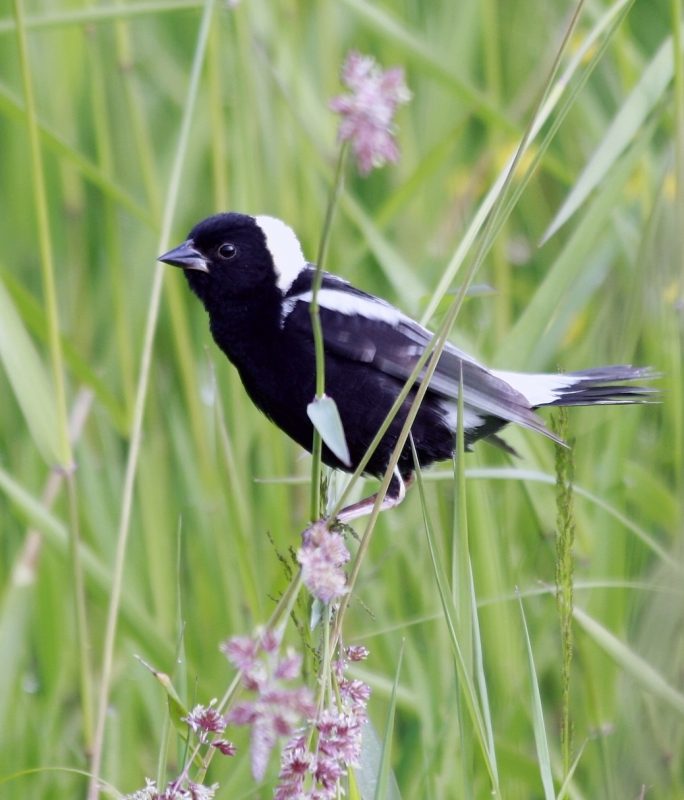
Birds are in trouble, and nowhere is that more evident than in farm country. A study published in the journal Science earlier this year found that while bird populations are declining precipitously all across the United States, areas of intensive agricultural production in particular were “hot spots” for avian drop-offs. “What we found is that any metric of agricultural intensity was always the best predictor of acceleration of the decline” in birds, the lead author of the study told The New York Times. And birds that rely on diverse, healthy stands of grasslands to survive and thrive have suffered the most. During the past 50 years, this country has lost over half of its grassland songbirds — think bobolinks, meadowlarks, dickcissels, and savannah sparrows.
This may not come as a surprise to anyone who’s spent any time driving through the Corn Belt — over the decades deep-rooted tallgrass prairie has been plowed up to make way for plantings of annual crops like corn and soybeans. Besides not having much wildlife cover available, these crops are reliant on heavy dosages of pesticides, which indiscriminately kill off insects, including beneficial bugs and the ones that birds rely on to survive.
The decline of birds doesn’t just mean less color in the skies and quieter mornings — it’s an indicator of how healthy the landscape is.
“Birds are a fantastic indicator species,” says Krysten Zummo, a grassland ecologist with the National Audubon Society’s Upper Mississippi River office. No bobolinks means there are no pollinators or other insects. No insects goes hand-in-hand with a lack of the kind of deep-rooted grass and forb habitat that can sequester carbon, build biology, and keep contaminants out of the water.
The good news is that here in the Midwest an increasing number of scientists and natural resource professionals are seeing agriculture’s potential for slowing this downward trajectory, or, as Zummo puts it, “bending the bird curve.” They see regenerative practices that rely on managed rotational grazing of perennials and diverse crop rotations as tools for supporting wildlife habitat, including areas grassland birds rely on.
Traditionally, wildlife ecologists have had a negative view of the relationship between birds and working farmland. For good reason: overgrazing, for example, can have a devastating impact on nesting success. However, advancements in managed rotational grazing, also known as regenerative grazing, have helped make it possible to balance profitable livestock production with healthy habitat.
During the 1990s, a group of Minnesota livestock graziers, scientists, natural resource professionals, and others — working collectively as the “Monitoring Team” — made direct connections between regenerative grazing and healthy grassland bird habitat. What the farmer-members of the Land Stewardship Project-led Monitoring Team learned was that the more grassland songbirds they saw on their land, the higher the probability that they were managing it in a way that grassland habitats were thriving. And the more high-quality grasslands they had, the better their livestock did.
This and other research has helped convince groups such as the Audubon Society of the value of utilizing livestock to regenerate the soil universe and the habitat it supports.
“Grasslands, if they’re going to remain as grasslands, have to have some kind of disturbance,” says Zummo.
Below are five snapshots from the field on recent connections farmers and ecologists are making between the avian and the agricultural. These stories show that birds not only can serve as pest controllers, indicators of a farm’s productivity, and ecological bellwethers — they can also help make farming an enjoyable way to make a living.
1) Sounds of Success
On a muggy September day in north-central Wisconsin, Kevin Mahalko moved a strand of polywire fencing so a group of his dairy heifers could crowd their way into a new grazing paddock. As the bovines tucked into the bright green stand of forage, the farmer listened for signs of success. Sure enough, there was the satisfying thrum of the ruminants chomping away. But Mahalko also had his ears tuned into other indications that the managed rotational grazing system he’s been utilizing for the past three decades is working for the land, the animals, and his bottom line.
“Listen to the insects,” he said. Yep, the electric buzz of bees and other pollinators as they cruised from plant-to-plant in the diverse pasture could be heard.
In a sense, it was a cascading auditory effect showing the interconnection of grass, cows, and insects. And the entities that had a final say, so to speak, on the quality of this habitat were giving their two cents as well: meadowlarks, killdeer, and other grassland species could be heard calling in this and other grazing paddocks.
“The catalog of bird calls every time we’re moving animals or working out in the field is pretty rewarding,” said the farmer.
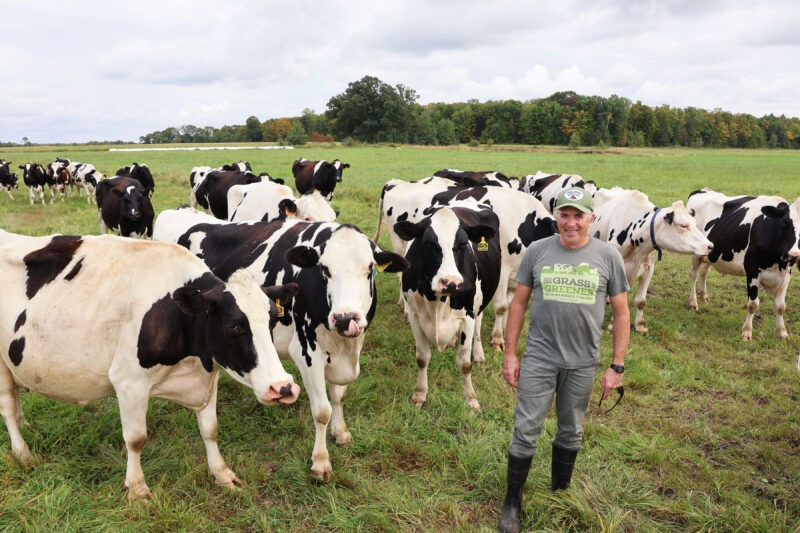
Mahalko studied wildlife and natural resources, as well as business, in college. This sparked an interest in how to produce food in a way that supported natural habitat. When he returned to the family farm, he was struck at how pioneering rotational graziers in the region were using livestock to build soil health and keep the land covered year-round, all while producing meat and milk at a low cost. So, in the mid-1990s, he started transitioning the farm into a grass-based system. Today his 45-head herd of Holstein cows is supplying 100% forage-based milk to Organic Valley Cooperative for its “Grassmilk” label.
Mahalko sees community building as a key part of sustaining a regenerative farming system. He has hosted school groups on the farm and nursing students and even college ornithology class members have hiked the operation’s pastures and woods to see firsthand the relationship between regenerative livestock production, biologically-active soil, wildlife habitat, and healthy food.
No matter who’s visiting, one thing Mahalko always makes certain to show off is the part of the farm where two bald eagle nests are perched in giant white pines that are separated by about 100 yards of grazing paddocks. On this September day, he rode his four-wheeler to that spot and watched as a giant eagle wheeled over the nest closest to the farmer and settled in the further one. When the raptor swooped over that first nest, a hidden eagle crouched down amongst stacked sticks gave out a call.
“That’s what I was waiting for,” Mahalko said with a smile as he fired up the four-wheeler and headed back across his pastures.
2) Return of the Bird
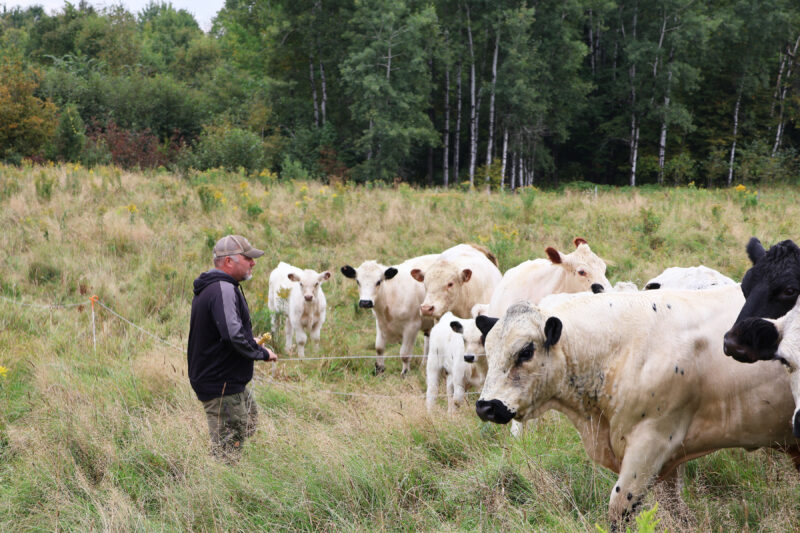
Ashly Steinke guided his Polaris side-by-side through a diverse stand of grasses and forbs in north-central Wisconsin one morning in early fall. As he parked the vehicle near a paddock where his beef cow herd was grazing, he described the very day when he realized his efforts to re-perennialize the land were paying off. When his family bought this 340-acre farm in 2014, it was virtually all corn and soybeans, and had, as Steinke puts it, “zero grassland birds.” He went to work seeding it down to pasture species, set up a fencing and watering system, and began rotationally grazing cattle on it. By 2017, the entire farm was in grass.
“I remember the first bobolink, and I actually took a picture of it sitting on the barbed wire fence along the gravel road here,” Steinke said. “It was really an eye-opener of what a difference little changes on the landscape can make.”
He might be understating it when saying converting the farm from annual row crops to perennial grasslands is a “little” change, but there’s no doubt it’s produced big results. A 2024 bird survey on the farm identified 28 male bobolinks, 14 male eastern meadowlarks, and a couple dozen savannah sparrows — all species that require high quality grassland habitat to do well. “So it can be done — grassland birds can colonize an area,” said the farmer.
It’s clear such a transformation thrills Steinke, who, besides being a beef producer, is trained in wildlife biology. And since he began working for the National Audubon Society a few years ago as a grassland ecologist, he’s been helping other farmers share in this experience of blending ag and ecology. In that role, his primary job is to work with farmers and other landowners in expanding the growth of the organization’s wildlife certification program. Called Audubon Conservation Ranching, this initiative certifies livestock producers who are utilizing managed grazing systems that are considered “bird friendly” — in other words they are rotating their animals in a way that they are contributing to a diverse mosaic of grass-based wildlife habitat.
Previously, the certification and habitat restoration program had its biggest presence in the Western U.S., but in recent years Audubon has started working with Midwestern producers in states like Wisconsin, Minnesota, and Iowa. Nationally, there are 155 Audubon Certified Bird-Friendly livestock operations, and they account for some 4.5 million acres of grassland habitat.
Such a program is an acknowledgement by a major environmental group that regenerative livestock production can play a key role in wildlife conservation. It’s hoped that farmers and ranchers can utilize the certification to, for example, market their beef to eaters who value having more grassland birds on the land.
And finding a way to viably return soil-friendly perennial forages to the landscape isn’t just good news for the birds. Steinke farms in the Yellow River watershed, which drains into the Chippewa, which eventually dumps its aquatic load into the Mississippi. Having deep-rooted perennials growing in areas like this can play a major role in keeping nitrates and other agricultural pollutants out of water downstream.
While his cow herd bellowed impatiently for him to move them to a new paddock — which the farmer eventually did with a quick relocation of a strand of wire— Steinke talked about how in much of the Upper Midwest and the Great Plains, recognizing and encouraging good management of agricultural grasslands is critical to supporting perennial habitat and all of the ecological benefits it can provide.
“Much of this land is owned by families who are farming and ranching it — a lot of it’s working landscapes,” he said. “If we’re going to make a difference, we can’t rely on just publicly managed lands.”
3) Earning Their Keep
Any doubt that the owners of Keewaydin Farms see birds as an integral part of their agricultural enterprise flutters away once you pull into their driveway. There, rising above the former milking parlor that now serves as a vegetable packing shed is a concrete silo sporting a colorful mural featuring an eastern meadowlark, a barn swallow, and an orchard oriole. And behind the silo is a birding trail that winds its way through the rugged Driftless Region terrain here in southwestern Wisconsin.
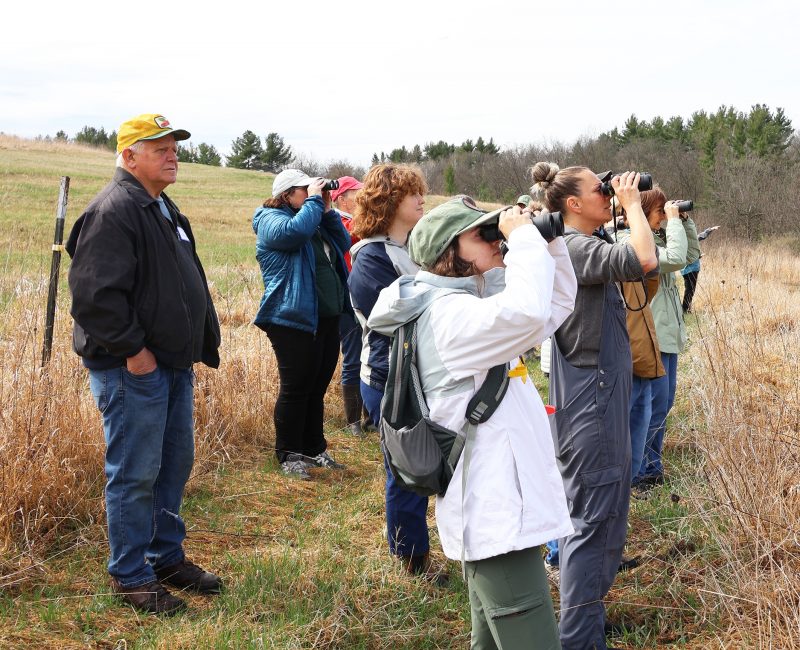
On a rainy April morning, Keewaydin’s owners, Joy Miller and Rufus Haucke, were able to show a couple dozen visitors firsthand the inspirations for that mural. As they hiked on the birding trail, the visitors spied a northern harrier, an eastern meadowlark, various sparrow species, a goldfinch, and a ruby-crowned kinglet, among others. At one point, Miller literally yelled out in delight when an eastern bluebird emerged from one of the nesting boxes that the farmers have erected along the trail.
Keewaydin Farms has been in the Haucke family since 1976, when Rufus’s parents started a dairy operation there. In the early 2000s, Rufus came back to the farm and started a certified organic vegetable operation. He and Miller now raise vegetables on four acres of the 200-acre parcel, which is a combination of grassland, hay ground, and woods. A recent addition to the farm is a flock of sheep, which helps them add value to the perennial forages that have replaced row crops over the years.
“After 20 years of organic farming and having a lot of diversity, the birds just showed up,” said Miller. “Those are the things that tell us, ‘You’re doing something right, you’re a good steward of the land.’ ”
The April tour of Keewaydin Farms was being sponsored by the Wild Farm Alliance, a nonprofit that works to help farmers balance wildlife habitat restoration with profitable food and fiber production. The event featured presentations on building nesting boxes, the role birds can play in controlling pests, and what governmental and nongovernmental programs are available to establish and support habitat.
Miller and Haucke made it clear during the day that the mere presence of birds lifts their spirits as they work in the vegetable plots. But besides providing a sense of wellbeing, the birds play key practical roles on an organic operation like theirs.
“We see how often they are taking insects back to their nests,” Miller said of species such as bluebirds. “When you don’t have the tools of the chemical side, you have to lean on the natural side. They are our natural pest control.”
The bird trail hike wrapped up near where the sheep herd was being kept, which prompted a discussion about recent research showing that barn swallows can play a major role in controlling fly infestations in livestock by creating a “landscape of fear” for the pests. In fact, a University of Milan researcher recently documented a correlation between healthy sheep and higher barn swallow populations at Keewaydin. The farmers partially credit the presence of swallows with warding off flystrike, a devastating condition where parasitic blowflies lay eggs in wool or open wounds.
“It’s a cool symbiosis to see evolve in the flock — a flock of birds and a flock of sheep,” quipped Miller.
4) Boundary Busting
On a sunny May morning, a ribbon- cutting ceremony highlighted what happens when a farmer blurs the boundaries between the wild and the tame. “We will now trespass onto the birds’ sanctuary,” said the farmer in question, Phil Specht, as a couple dozen people passed through a gate, binoculars in hand. But this sanctuary is not only a home to birds, it’s also a working part of his farm. The ceremony was marking a special agreement Specht’s family developed with the Iowa Natural Heritage Foundation and the USDA’s Natural Resources Conservation Service.
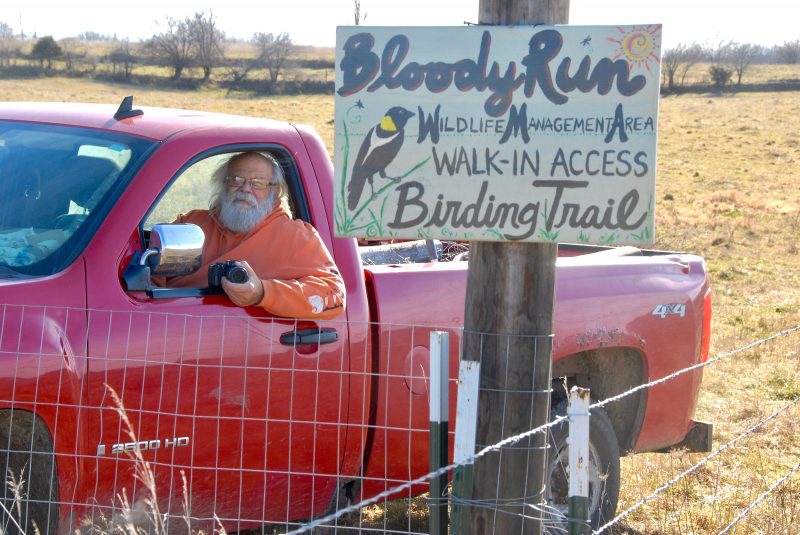
A lifetime agricultural easement has been placed on this 244 acres of rolling grassland and trees just up the hill from the Mississippi River town of Marquette in northeastern Iowa. That means that the land can never be put into subdivisions or similar development. Just as importantly, it can never be tilled or row-cropped. What can occur on this land is that it can be grazed by livestock. To the wildlife experts who have hiked and studied the Specht farm, that last allowance is not a compromise. In fact, it’s because of the decades of managed rotational grazing that’s taken place on these acres that this is prime bird habitat.
“The more I carefully managed the cattle for the birds, everything else got healthier,” Specht said.
Indeed, during a tour of the “Grassland Bird Sanctuary,” Paul Skrade, a biology professor at Upper Iowa University, pointed out the numerous eastern bluebirds and kingbirds that were perched on fence lines. And flitting around the edge area where the pasture grass met a thick stand of timber were woodland-centric species such as rose breasted grosbeaks, Baltimore orioles, red eyed vireos, pileated woodpeckers, and indigo buntings.
But the star of the day was the bobolink, that flashy black-and-white grassland bird that had just arrived in the area after winging thousands of miles from South America. Skrade explained that because for decades Specht has utilized a grazing system that moves cattle frequently and thus leaves plenty of vegetation behind, it produces not only healthy feed for livestock, but the kind of heterogeneous habitat that grassland birds such as bobolinks need to thrive.
And this farmland is sitting in the midst of a National Audubon Society Globally Important Bird Area and the Effigy Mounds-Yellow River Forest Bird Conservation Area. The Iowa Department of Natural Resources’ Bloody Run Wildlife Management Area is adjacent to the farm. Ecologists argue that isolated islands of habitat are not enough for birds and other wildlife if they are to have healthy, sustainable populations. In agricultural areas, the ideal situation is to have nature reserves bordering working farmland being managed in a regenerative manner, thus extending environmental benefits across a broad swath of the landscape.
“You usually picture wilderness for wildlife,” said Skrade. But, he added, the Specht property shows that working lands and natural habitat can coexist and even be mutually beneficial. “Honestly, it really does bring my heart joy when I go onto that property.”
5) Attracting the Future
How does one make a farm attractive to the next generation? That was a point of discussion on a soft June evening near the southeastern Minnesota community of Lake City. Beef and crop producers Paul and Delores Moechnig were hosting half-a-dozen other farmers for a Land Stewardship Project Soil Health Hub gathering. Such gatherings give farmers who are utilizing regenerative production methods like managed rotational grazing, cover cropping, or conservation tillage a chance to get together and share ideas, frustrations, and in general offer each other support.
Topics of discussion on this particular evening centered around pasture improvement, ways of reducing a reliance on expensive inputs like fuel and fertilizer, marketing challenges, and pasture watering systems. Oh yeah, and what the future holds for farms like this.
The Moechnigs sold their dairy herd in 2020 and since then have focused on raising beef cattle utilizing managed rotational grazing. They have their own cow herd, and also do custom grazing. Everything grown on the farm — grass, corn, hay forages — is fed through the cattle, creating a tight nutrient cycle that’s economically efficient.
The Moechnigs are in their 70s, and starting to think about the future of their 160-acre operation. Paul feels that by tapping into practices that avoid intensive row-cropping, build soil health, and reduce a reliance on expensive equipment and inputs, he and Delores are making the farm something that is viable for the next generation to take on.
“We have to show the next generation there are alternatives to just corn and beans in this country,” he said.
As it happens, their son, Jim, who’s in the process of taking over the farm, participated in the Hub meeting. Along for the ride were his daughters, Eliza, 11, and Evelyn, 14.
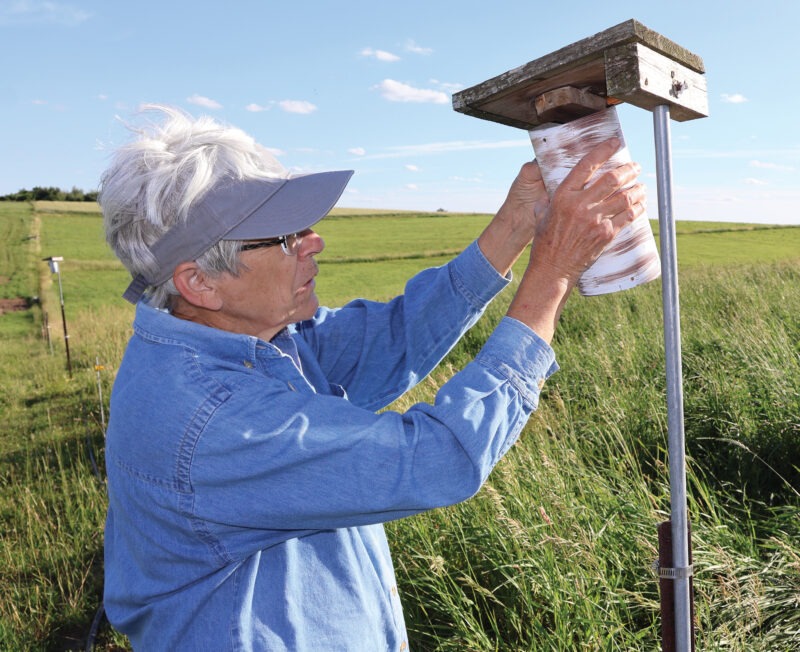
While Paul and the other Hub members checked out a herd of cattle grazing in a hilltop paddock, Delores walked a few yards away and took down a piece of PVC pipe mounted on a fence line. Three tree swallow chicks, all fluff and beaks, were tucked in the bottom. This “nesting station” is one of 12 the Moechnigs have set up around the farm to support swallows as well as bluebirds. The farmers have noticed that if they set up two nesting containers at each station, swallows will nest in one container, while bluebirds will take residence in the other.
“The bluebird won’t let another bluebird live close and the tree swallow won’t let another tree swallow live close,” Delores said. “But the bluebirds and swallows can live close to each other.”
Noting the nuances of bird behavior has gone hand-in-hand with the farmers’ adoption of managed rotational grazing 25 years ago. After all, the more time you spend in the grazing paddocks moving fence and doing other tasks, the more opportunity you have to observe your feathered neighbors. For example, bluebirds seldom use the houses made from PVC unless they don’t have any other choice (the Moechnigs also have traditional wooden nest boxes), swallow eggs are smaller, and wrens will kill baby bluebirds and build nests on top of existing ones, so mounting a nest box next to brushy wren habitat is not advisable.
Given that a livestock production practice like rotational grazing relies on close observations and making adjustments based on trial and error, it’s no surprise the Moechnigs have become adept at using their monitoring skills to make the farm a home for birds.
Besides bluebirds and tree swallows, their pastures now attract eastern meadowlarks, bobolinks, dickcissels, and ring-necked pheasants — all species that require diverse stands of grass to thrive. The farmers also have woods and windbreaks on their land, and such habitat brings in rose-breasted grosbeaks, purple finches, orioles, and various kinds of woodpeckers, including the red-headed woodpecker, which has experienced serious population losses in Minnesota over the years. “It’s just nice to know that they’re in the area and enjoy our farm,” said Delores of the birds that frequent their land. She conceded her favorite is the bluebird, with its sky-colored feathers and soft, whistle-like call. “They’re serenading us,” she said.
As the Soil Health Hub participants headed back to the farmstead at the conclusion of the pasture walk, dozens of tree swallows acrobatically swooped low over the grasses and forbs, their blue-green feathers flashing in the slanting rays of the summer evening as they snatched flies and other insects out of the air. Somewhere a bobolink called while Delores and Paul’s granddaughters marveled at the swallow chicks nestled at the bottom of the PVC nesting tube.
It turns out it’s not just agronomic and economic considerations that make a farm attractive to the next generation.
LSP managing editor Brian DeVore is the author of Wildly Successful Farming: Sustainability and the New Agricultural Land Ethic. This article was originally published in the No. 1, 2026, edition of the Land Stewardship Letter.
Avian Ag Resources
Interested in learning more about how to blend bird habitat and productive farming? Check out LSP’s Ear to the Ground podcast episode no. 372. It features a discussion of how the Wild Farm Alliance helps farmers and other rural landowners build and support good relationships with wildlife, including birds.
Avian Audio
Check put these LSP Ear to the Ground podcast episodes featuring farmers and ecologists discussing the relationship between regenerative farming and bird habitat: