
Land Stewardship Project

Land Stewardship Project
  • About Us
    • Our Mission
    • Long Range Plan
    • Staff Directory
    • Board of Directors
      • LSP Board Committees
    • LSP Steering Committees & Working Groups
    • Contact Us
    • Past LSP Projects
    • Employment & Volunteer Opportunities
    • LSP Publications
    • Financial Statements
  • The Latest
    • Community Care
    • Songs for the Soil
    • CSA Farm Directory
    • Upcoming Events
    • News
      • News Releases
      • Media Contacts
      • LSP in the News
    • Blog
    • Podcast
    • Land Stewardship Letter
    • LIVE-WIRE Sign-up
    • Myth Busters
    • Fact Sheets
    • Farm Crisis Resources
  • For Farmers & Landowners
    • Farmland Clearinghouse
    • New Farmers
      • Farm Beginnings Class
      • Journeyperson Course
      • Farm Dreams
      • Accessing Farmland
      • Farmland Clearinghouse
      • Beginning/Retiring Farmer Tax Credit
      • Beginning Farmer Profiles
      • Fresh Voices Podcast Series
    • Retiring Farmers & Landowners
      • Farmland Clearinghouse
      • Farm Transition Course 2026
      • Conservation Leases
      • Beginning/Retiring Farmer Tax Credit
      • Land Transition Tools
      • Transition Stories
    • Soil Health
      • Cover Crops
      • Grazing
      • No-till
      • Microbiology
      • Kernza
      • Soil Builders’ Network
      • Soil Builders’ E-Letters
      • Soil Health Steering Committee Members
      • Ear Dirt Soil Health Podcast Series
    • Cropping Systems Calculator
    • Conservation Leases
  • Creating Change
    • Community-Based Food Systems
      • Ear Bites Community-Based Food Podcast Series
    • Policy Campaigns
      • Soil Health & Climate Change
      • Healthcare
      • Factory Farms
        • Anti-Competitiveness & Price Gouging
      • Federal Policy
        • A Farm Bill For Us
      • State Policy
        • MN Farm, Food & Climate Funding
      • Developing Leadership
    • Justice & Stewardship
    • Organizational Stewardship
  • Get Involved
    • Your Membership Matters
    • Take Action!
    • Upcoming Events
    • Land Stewardship Action Fund
    • Connect with LSP
      • Stay Connected
      • Join, Donate, or Renew Today!
      • Shop
      • Employment & Volunteer Opportunities
      • Legacy Giving
    • Network with LSP Members
      • Farmland Clearinghouse
      • Soil Health
    • Farmland Clearinghouse
  • Join, Donate, or Renew Today!
  • Stay Connected
  • Contact Us
  • Shop
Search
More...

Breaking the Meat Processing Bottleneck

Endowed Chair Puts the Right People in the Right Place to Address a Critical Problem

By Brian DeVore
January 3, 2025

Share

  • Facebook
  • Pinterest
  • email

A cornerstone of creating a regenerative agricultural system in the Upper Midwest is reintegrating livestock onto the land in a way that farmers can add value to forages and grains while cycling nutrients in a manner that manure becomes a way to build soil biology, rather than a waste product to be disposed of. Over the years, the Land Stewardship Project has worked with numerous innovative farmers who are proving that such an environmentally sustainable system can be obtained via managed rotational grazing of cattle, sheep, and goats, as well as through deep straw production systems for hogs.
But it’s become clear that even the most innovative livestock production system is not sustainable in the long run unless farmers can find a way to receive a fair price for the meat and other animal products they produce. And a key way to make livestock an economically viable option on small and medium-sized farms is to provide rural communities with a consistent, quality local meat processing infrastructure.

That’s why the recent announcement that the new Endowed Chair in Agricultural Systems at the University of Minnesota will focus on local meat processing is such welcome news. And that the Endowed Chair will be occupied by three people who have extensive backgrounds in the meat industry is even more exciting. In December, the board of directors for the U of M’s Minnesota Institute for Sustainable Agriculture (MISA) announced that Tom Nuessmeier, Paul Sobocinski, and Julio Cesar Tena Soria will be serving in the Endowed Chair position. Additionally, through the Endowed Chair, funding will be provided to support Ryan Solberg, a graduate student within the public policy master’s program at the Humphrey School of Public Affairs.

The Endowed Chair was set up in 1995 to, according to the program’s website,  “provide a unique opportunity for leaders in the academic, business, farming, government, and nonprofit sectors of agriculture, rural development, and related fields to contribute to and help shape the future of rural Minnesota.” The program is managed by MISA, which is a unique partnership between the U of M’s College of Food, Agricultural and Natural Resource Sciences (CFANS) and U of M Extension, as well as the Sustainers’ Coalition, a group of nonprofit community organizations that includes LSP.

Being named to the Endowed Chair position means Nuessmeier, Sobocinski, and Tena will have the resources needed to dig into how we can support efforts to, among other things, develop apprenticeship opportunities for meat processing entrepreneurs wanting to enter the industry and own a business. As with family farmers, small meat processors are grappling with how to hand off their businesses as they near retirement. Faced with a dearth of younger people who are trained to take on a meat processing business, and lacking the basic legal and economic resources needed to make the transition, many local processors have simply closed shop permanently.

This has put farmers who direct-market meat in a precarious situation, which many having to reserve slaughtering slots more than a year in advance. They also find themselves spending several hours hauling animals to the few remaining processors, which cuts into the time they could be spending farming.

The diminishment of local options for processing animals comes at a time when the meatpacking industry in general has become consolidated at an unprecedented level. This is bad news not only for farmers hoping to direct-market what they raise, but for the rural economy in general, as well as the workers in processing plants, many of whom are people of color and new immigrants.

The COVID-19 pandemic revealed the dangers of relying on a handful of meat giants to process our nation’s livestock.  As the illness flourished in the tight confines of meat plants, processing capacity plummeted and in some cases farmers were forced to euthenize their animals. The few local processors remaining were overwhelmed with the demand, while plant workers were putting their own health at risk to the point that many died. Meanwhile, Big Meat carried on business as usual, making more money than ever.

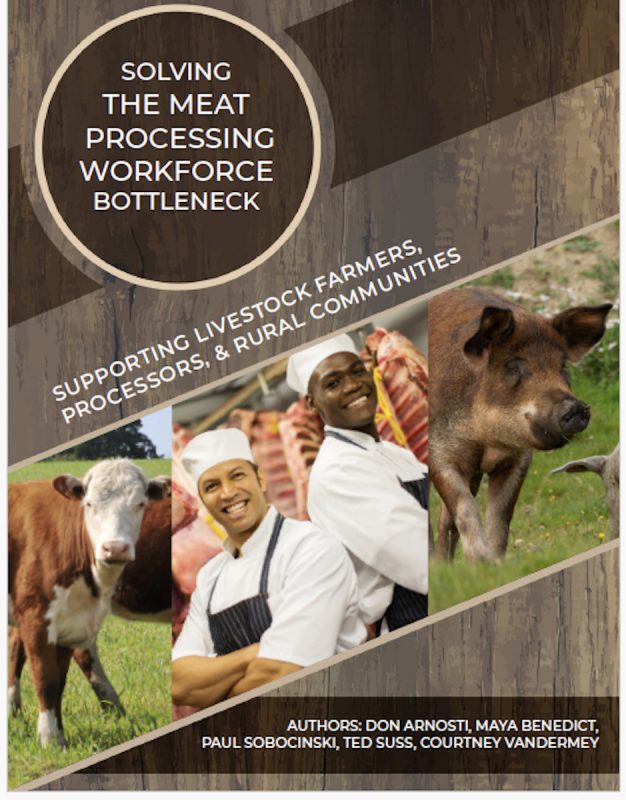
Nuessmeier, Sobocinski, and Tena serve as the directors of the Minnesota Farmers Union’s Solving the Local Meat Processing Bottleneck Project. A few years ago, an initial group of project leaders, including Sobocinski, interviewed 57 small meat processors and issued a report with several recommendations. Thanks to this report and the work of LSP, MFU, and our allies, the 2023 Legislature funded numerous initiatives that support small meat processors, including creating a Meat & Poultry Processing Liaison position at the Minnesota Department of Agriculture, providing $544,000 for small meat processor training and employee retention grants, and bolstering funding for the popular AGRI Meat, Poultry, Egg, and Dairy Processing Grant program. The AGRI grant program is instrumental in supporting small and mid-sized processors across the state and has a huge impact in supporting the development of regional food systems.

Having the Endowed Chair focus on local meat processing is good for both practical and symbolic reasons. On the practical side, these three people can help take local meat processing a step further in resolving the problem it has recruiting the next generation of workers and entrepreneurs. On the symbolic side, having a U of M institution recognize the need for a better local meat processing infrastructure is an acknowledgment that reintegrating livestock onto the land in a sustainable manner is something worth supporting with public resources. It’s a major contrast to how the land grant system often seems committed to promoting the consolidated, industrialized model of agriculture.

“Our board recognizes the real importance of small processors to sustainable livestock farmers and emerging farmers, and we look forward to the project’s effort to recruit a diverse workforce that is inclusive and will contribute to small processors’ resiliency, so vital for our rural communities,” Helene Murray, MISA’s executive director, said in a media statement announcing the awarding of the Endowed Chair.

And I can’t think of three people more qualified to pursue this work. Both Sobocinksi and Nuesmeier are hog farmers as well as former LSP organizers. In that latter role, they worked extensively on issues related to livestock consolidation and helping farmers fight to attain fair access to markets. (On an LSP Ear to the Ground podcast, Sobocinski talks about some of the results of that organizing.)  Tena began working with the Bottleneck Project in March 2024 and leads the group’s outreach to the Hispanic community.

I’m looking forward to seeing what this team comes up with in the coming year — this is an initiative involving the right people with the right priorities. And the timing couldn’t be better for tackling an issue that has impacts on our food supply, rural economies, farms, and the land. Breaking this particular bottleneck could generate beaucoup benefits.

LSP managing editor Brian DeVore can be contacted via e-mail.


Category: Blog
Tags: ag consolidation • livestock production • local meat processing • Minnesota Farmers Union • regenerative agriculture • reintegrating livestock • rural economic development

Upcoming Events

×

January 2026

Thursday January 1

All Day
Minnesota Beginning Farmer Tax Credit Applications
Thursday January 1
Minnesota Beginning Farmer Tax Credit Applications
Online

The Minnesota Department of Agriculture’s (MDA) Rural Finance Authority (RFA) will start accepting applications for the 2026 Beginning Farmer Tax Credit on Jan. 1. This is an annual program available to landlords and sellers (asset owners) who rent or sell farmland, equipment, livestock, and other agricultural assets to beginning farmers.
 
On Dec. 22, a webinar will provide basic information on the program and how to apply for it. To register, click here. 

Friday January 2

6:00 am – 12:00 am
Application Deadline for RSDP Farmer Climate Action Fund
Friday January 2
6:00 am – 12:00 am
Application Deadline for RSDP Farmer Climate Action Fund
Regional Sustainable Development Partnership

Are you a farmer in Greater Minnesota with an innovative idea to address climate change on your farm?

University of Minnesota Extension Regional Sustainable Development Partnerships (RSDP) invites farmers throughout Greater Minnesota to apply for funding for on-farm climate adaptation and mitigation projects through RSDP’s Farmer Climate Action Fund.  

Small grants will be awarded through a competitive process for ready-to-go, farmer-led projects, including but not limited to planting wildlife corridors, replacing fossil fuels with clean energy alternatives, implementing soil health practices that sequester carbon and incorporating agroforestry systems.

Priority will be given to projects that are shovel-ready and can be completed by December 31, 2026. 

The application portal is now open and you can apply until January 2, 2026, with awards announced in early February. 

Find more information and application materials on the RSDP website: https://z.umn.edu/FarmerFund.

Wednesday January 7

10:00 am – 3:00 pm
Organic Fruit Growers Climate Resilience Workshop
Wednesday January 7
10:00 am – 3:00 pm
Organic Fruit Growers Climate Resilience Workshop
La Crosse, Wis.

n December and January, the Organic Fruit Growers Association is offering a series of climate resilience workshops. Workshop goals are to learn about the changing climate in our region and the expected impacts on fruit farmers and to select climate resilience practices which are suited to your farm’s goals and values. The outcome of the workshops will be a written climate resilience plan with actionable steps to make your farm more resilient to changing climate. 
 
Workshops will be led by University of Minnesota extension educators Katie Black and Madeline Wimmer and include times for farmer-to-farmer discussion. This series includes the following four meetings. Expect to spend an additional 4-10 hours outside the meetings developing your farm’s climate resilience plan:

  • Wednesday Dec. 3, 9 a.m.-11:30 a.m. (online via Zoom)
  • Wednesday, Dec. 10, 9 a.m.-11:30 a.m. (online via Zoom)
  • Monday, Dec. 22, discussion (online via Zoom — optional but encouraged)
  • Wednesday, Jan. 7, 10 a.m.-3 p.m. (in-person workshop in La Crosse, Wis. Lunch provided, and you can be reimbursed for mileage traveling to and from the meeting.)

For details and to register, click here. 

Thursday January 8 – Friday January 9

Minnesota Organic Conference
Thursday January 8 – Friday January 9
Minnesota Organic Conference
River's Edge Convention Center, 10 4th Ave S, St Cloud, MN 56301, USA

Each year, the Minnesota Department of Agriculture hosts this conference and trade show for farmers and others interested in organic agriculture.

Minnesota Organic Conference Logo

Mark your calendars for January 8-9, 2026, when we’ll again feature:

  • Inspiring keynote speakers
  • Topical breakout sessions
  • An 80-booth trade show
  • Networking
  • And more!

Whether you’re an experienced producer or new to the field, don’t miss out on this valuable opportunity to connect with Minnesota’s thriving organic community!

Who should attend?

  • Organic farmers and those interested in transitioning to organic practices
  • Agricultural professionals
  • Buyers and makers looking to source or showcase organic products
  • Students and researchers
  • Organic farming advocates

For details, click here. 

Friday January 9 – Saturday January 10

Practical Farmers of Iowa Annual Conference
Friday January 9 – Saturday January 10
Practical Farmers of Iowa Annual Conference
Iowa Events Center, 730 3rd St, Des Moines, IA 50309, USA

For details, click here.

View Full Calendar

Recent Posts

  • Farm Aid Fridays: Bonnie & Vance Haugen, LeeAnn & Jim VanDerPol December 19, 2025
  • Land Line: Commodity Ag Regrets, Bailout Blues, Corn & Climate, USDA Regenerative Ag Pilot, Manure Monitoring, Conservation & Community, Farmer-to-Farmer December 16, 2025
  • Standing In Solidarity With Our Immigrant Neighbors December 4, 2025
  • Farm Aid Fridays: Hannah Bernhardt, Moses Momanyi & Lonah Onyancha Kilimo December 4, 2025
  • Growing New Grains for Better Bread December 3, 2025

Montevideo

111 North First Street
Montevideo, MN 56265

(320) 269-2105

Lewiston

180 E. Main Street
Lewiston, MN 55952

(507) 523-3366

Minneapolis

821 E. 35th Street #200
Minneapolis, MN 55407

(612) 722-6377

  • Privacy Policy

Copyright © 2025 Land Stewardship Project. All rights reserved.

https://landstewardshipproject.org/breaking-the-meat-processing-bottleneck

Please note--webstore orders and gift memberships will not be fulfilled until the end of LSP's Winter Break, Monday, January 5, 2026. Dismiss