
Search Results

Searched for: long range plan update

Land Line: Senate Budget Bill, Who Owns Land?, Nitrates, Conservation Cuts, Immigration, Drought When Wet, Judging Soil, Sea of Grass

Trump’s One Big Beautiful Bill Clears Senate, Sending it Back to House (7/1/25) Vice President JD Vance broke a 50-50 tie in the U.S. Senate today to pass President Donald Trump’s centerpiece legislation on tax cuts and spending, the 940-page “One Big Beautiful Bill,” reports Oklahoma Farm Report. In order to pay for spending on…  Read More

A Hub of Soil Health Activity

How Indiana is using cover cropping and early adopters as ‘gateways’ into a deeper understanding of sustainable soil management. It’s an overcast August morning in northeastern Indiana, and in a massive machine shed well stocked with the tools of a modern row crop operation, some 60 farmers are being reminded that growing corn and soybeans…  Read More

LSP Legislative Update: Proposals Related to Local Food, Land Access & Soil Health Moving Forward

Budget Issues Loom Large as Regular Session Heads into Final Weeks

As we pass a key date in the 2025 Minnesota legislative calendar, several initiatives supported by the Land Stewardship Project remain alive and are moving through the committee process. In order to be considered as part of an omnibus bill, the majority of proposed legislation had to be heard in both the House and Senate…  Read More

Update on LSP’s Leadership Transition

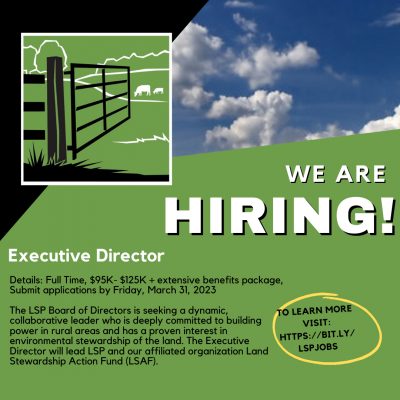
Spread the Word: We're Looking for a New ED!

As you may have heard, the Land Stewardship Project is currently searching for a new executive director as a result of the departure of Mike McMahon earlier this year. We’d like to provide a brief update on the hiring process and where LSP stands during this time of transition. First, let’s address the reality of…  Read More

A Beginning Farmer Legacy

Returning to the Classroom a Quarter Century Later

2025-2026 Farm Beginnings Class LSP is now accepting applications for its 2025-2026 Farm Beginnings class session. For details, click here. ♦ ♦ ♦ In a sense, when the brothers Andy and Ben Klein enrolled in the Land Stewardship Project’s Farm Beginnings course in 2023, it was a return engagement for at least one of them.…  Read More

Gene Goven & MN Ranchers: Planning for Change

In western Minnesota we live in what used to be a grassland habitat, where warm season perennials were king and the whole system depended on herds of buffalo and the occasional wildfire to break down the abundance of plant material. These days, it’s becoming clear leaving our remaining prairies untouched does not create a healthy…  Read More

Healthy Soil, Healthy Farms, Healthy Communities (2nd of 2 parts)

Talking about the importance of feeding soil microbes is fine. Speaking with your feet is even better. “Take a closer look—anything you tramp down is just carbon in the soil,” quips soil conservationist Jay Fuhrer on a Thursday afternoon in early September. As he says this, he’s beckoning some 120 farmers and others to follow…  Read More

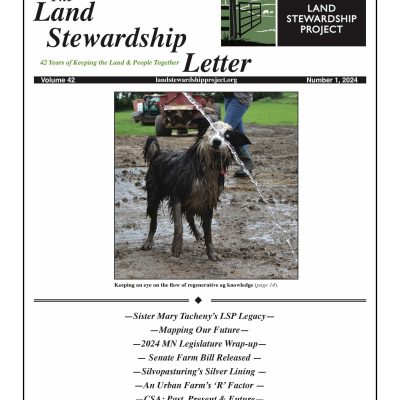
No. 1, 2024, Land Stewardship Letter

• An online version of the Land Stewardship Letter is here. • A downloadable pdf version is here. • Downloadable pdf back issues of the Land Stewardship Letter are here. • Interactive online back issues of the Land Stewardship Letter are here. • Paper copies are available by contacting Brian DeVore at 612-816-9342 or via e-mail. Table of Contents Stewardship…  Read More

State Policy Update: Time for Legislative Action on the Farm Crisis is Now

At the Land Stewardship Project, we know that we depend on each other to thrive and that our government, public institutions, and economy exist to serve each and every person, as well as our land, water. and air — no exceptions. That’s why hundreds of Land Stewardship Project members like you have been taking action…  Read More

Grazing as a Public Good

As a Nature Conservancy scientist based in a Midwestern state, Steve Chaplin thinks a lot about the impact agriculture has on ecological treasures such as native tallgrass prairie. “Other than plowing, grazing has probably been responsible for the degradation of more prairie than any other source,” says Chaplin, who is in the Conservancy’s Minnesota field…  Read More