
Land Stewardship Project

Land Stewardship Project
  • About Us
    • Our Mission
    • Long Range Plan
    • Staff Directory
    • Board of Directors
      • LSP Board Committees
    • LSP Steering Committees & Working Groups
    • Contact Us
    • Past LSP Projects
    • Employment & Volunteer Opportunities
    • LSP Publications
    • Financial Statements
  • The Latest
    • Community Care
    • Songs for the Soil
    • CSA Farm Directory
    • Upcoming Events
    • News
      • News Releases
      • Media Contacts
      • LSP in the News
    • Blog
    • Podcast
    • Land Stewardship Letter
    • LIVE-WIRE Sign-up
    • Myth Busters
    • Fact Sheets
    • Farm Crisis Resources
  • For Farmers & Landowners
    • Farmland Clearinghouse
    • New Farmers
      • Farm Beginnings Class
      • Journeyperson Course
      • Farm Dreams
      • Accessing Farmland
      • Farmland Clearinghouse
      • Beginning/Retiring Farmer Tax Credit
      • Beginning Farmer Profiles
      • Fresh Voices Podcast Series
    • Retiring Farmers & Landowners
      • Farmland Clearinghouse
      • Farm Transition Course 2026
      • Conservation Leases
      • Beginning/Retiring Farmer Tax Credit
      • Land Transition Tools
      • Transition Stories
    • Soil Health
      • Cover Crops
      • Grazing
      • No-till
      • Microbiology
      • Kernza
      • Soil Builders’ Network
      • Soil Builders’ E-Letters
      • Soil Health Steering Committee Members
      • Ear Dirt Soil Health Podcast Series
    • Cropping Systems Calculator
    • Conservation Leases
  • Creating Change
    • Community-Based Food Systems
      • Ear Bites Community-Based Food Podcast Series
    • Policy Campaigns
      • Soil Health & Climate Change
      • Healthcare
      • Factory Farms
        • Anti-Competitiveness & Price Gouging
      • Federal Policy
        • A Farm Bill For Us
      • State Policy
        • MN Farm, Food & Climate Funding
      • Developing Leadership
    • Justice & Stewardship
    • Organizational Stewardship
  • Get Involved
    • Your Membership Matters
    • Take Action!
    • Upcoming Events
    • Land Stewardship Action Fund
    • Connect with LSP
      • Stay Connected
      • Join, Donate, or Renew Today!
      • Shop
      • Employment & Volunteer Opportunities
      • Legacy Giving
    • Network with LSP Members
      • Farmland Clearinghouse
      • Soil Health
    • Farmland Clearinghouse
  • Join, Donate, or Renew Today!
  • Stay Connected
  • Contact Us
  • Shop
Search
More...

Soil Health Leadership

Share

  • Facebook
  • Pinterest
  • email

Leadership Opportunity:  Soil Health Steering Committee

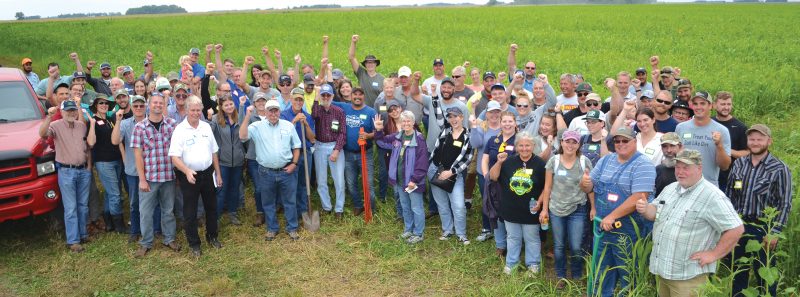
The Land Stewardship Project is looking for regional farmers to help lead our Soil Health Program in making positive, community-based change. We have open positions to fill on our steering committee that sets goals and strategies — within LSP’s mission — to build out an energetic and engaged network of crop and livestock farmers practicing land stewardship and public leadership.

The on-the-ground soil health work we do is geographically focused on a Soil Builders’ Network that stretches across southeastern Minnesota and northeastern Iowa. This committee occasionally interacts with our soil health-related policy work.  
Responsibilities of Soil Health Steering Committee Members 

Guidance, Vision, and Oversight 
  • Develop and refine a vision, specific outcomes, strategies to achieve those outcomes, and  principles to guide the work.
  • Use data to inform strategy development and learning.
  • Track and evaluate progress of work.
Leadership 
  • Listen with curiosity to the people engaged in our work.
  • Express joy for the work, keep an open mind, and bring others along. 
  • Be willing to take informed risks and learn from mistakes.
  • Think critically about soil health and its implications for our whole food and farming system.
  • Serve as a vocal champion of our efforts in your community.
  • Participate in one non-farmer-driven event (i.e. present to students at the public school, adult/community education class, rotary club, church group, college group) where you talk about the benefits of soil health in farming. 
  • Attend a minimum of one LSP soil health event per year.
  • Build relationships with like-minded groups, businesses, agencies, tribes who share LSP’s values and goals 
  • Take advantage of leadership development opportunities through LSP and partners.
Process
  • Participate in regularly scheduled in-person or online meetings (3-4/year). 
  • Keep on top of committee communications via phone/e-mail.
  • Review materials prior to meetings and come prepared for engaged discussion, active listening, and respectful dialogue.
  • Maintain active membership with the Land Stewardship Project.
  • Commit to 2-3 years of service on the Soil Health Steering Committee. 

Click here for our Soil Health Steering Committee Statement of Understanding, which details commitments and responsibilities of both committee members and LSP staff. 

Fulfilling the role of a public leader with the Land Stewardship Project will help you develop vision, knowledge, skills, and relationships needed for positive change in your community.  

Interested in Joining the Committee?

If you are interested in joining our Soil Health Steering Committee, fill out this online form. We will be closing applications by July 12, 2024. For questions, please contact Soil Health Department organizer Alex Romano at aromano@landstewardshipproject.org.

  • Apply to the Soil Health Steering Committee Here

Contact

Alex Romano, LSP soil health organizer, e-mail

Upcoming Events

×

January 2026

Wednesday January 7

10:00 am – 3:00 pm
Organic Fruit Growers Climate Resilience Workshop
Wednesday January 7
10:00 am – 3:00 pm
Organic Fruit Growers Climate Resilience Workshop
La Crosse, Wis.

n December and January, the Organic Fruit Growers Association is offering a series of climate resilience workshops. Workshop goals are to learn about the changing climate in our region and the expected impacts on fruit farmers and to select climate resilience practices which are suited to your farm’s goals and values. The outcome of the workshops will be a written climate resilience plan with actionable steps to make your farm more resilient to changing climate. 
 
Workshops will be led by University of Minnesota extension educators Katie Black and Madeline Wimmer and include times for farmer-to-farmer discussion. This series includes the following four meetings. Expect to spend an additional 4-10 hours outside the meetings developing your farm’s climate resilience plan:

  • Wednesday Dec. 3, 9 a.m.-11:30 a.m. (online via Zoom)
  • Wednesday, Dec. 10, 9 a.m.-11:30 a.m. (online via Zoom)
  • Monday, Dec. 22, discussion (online via Zoom — optional but encouraged)
  • Wednesday, Jan. 7, 10 a.m.-3 p.m. (in-person workshop in La Crosse, Wis. Lunch provided, and you can be reimbursed for mileage traveling to and from the meeting.)

For details and to register, click here. 

12:00 pm – 1:30 pm
Fruit & Vegetable Production Webinar Series Begins
Wednesday January 7
12:00 pm – 1:30 pm
Fruit & Vegetable Production Webinar Series Begins
Zoom Online

This webinar series will focus on the finer points of fruit and vegetable production. Each week we will cover a technical topic related to the successful management of fruit and vegetable crops, from planning to irrigating to managing pests. The target audience is small to medium-sized farmers, as well as aspiring farmers. 
 
Attend one or as many dates as desired
Recordings of the sessions will be available after the end of the series for those who register.

The cost is free. These webinars are led by University of Minnesota Extension educators, industry experts, and experienced farmers. Register at https://z.umn.edu/fvwinterwebinar.

Topics and dates:

  • Jan. 7: Finding and selling to new markets: restaurants, wholesale, and farm to school in 2026
  • Jan. 14: Crop planning to meet production goals
  • Jan. 21: Adding fruit to your farm
  • Jan. 28: Is a high tunnel right for your farm?
  • Feb. 11: Pumpkin IPM throughout the season
  • Feb. 18: Diagnosing and dealing with tomato problems
  • Feb. 25: Integrated weed management: Holistic Approaches for Organic Weed Management
  • March 11: Supporting pollinators on specialty crop farms
  • March 18: Vegetable plant disease basics
  • March 25: Understanding your soil test report
  • April 1: Pack sheds: new low-cost, non-permanent pack shed designs for small to mid-size farms
  • April 8: Pack sheds: fully or semi-enclosed pack shed ideas for larger farms
  • April 15: Post-harvest equipment: brush washers, barrel washers and wash tanks for food safety, efficiency and quality
  • April 22: Building coolers on the farm: Cool Bots and walk-in coolers 

Join with Google Meet: https://meet.google.com/oow-rabn-edt

Learn more about Meet at: https://support.google.com/a/users/answer/9282720

Thursday January 8 – Friday January 9

Minnesota Organic Conference
Thursday January 8 – Friday January 9
Minnesota Organic Conference
River's Edge Convention Center, 10 4th Ave S, St Cloud, MN 56301, USA

Each year, the Minnesota Department of Agriculture hosts this conference and trade show for farmers and others interested in organic agriculture.

Minnesota Organic Conference Logo

Mark your calendars for January 8-9, 2026, when we’ll again feature:

  • Inspiring keynote speakers
  • Topical breakout sessions
  • An 80-booth trade show
  • Networking
  • And more!

Whether you’re an experienced producer or new to the field, don’t miss out on this valuable opportunity to connect with Minnesota’s thriving organic community!

Who should attend?

  • Organic farmers and those interested in transitioning to organic practices
  • Agricultural professionals
  • Buyers and makers looking to source or showcase organic products
  • Students and researchers
  • Organic farming advocates

For details, click here. 

Friday January 9 – Saturday January 10

Practical Farmers of Iowa Annual Conference
Friday January 9 – Saturday January 10
Practical Farmers of Iowa Annual Conference
Iowa Events Center, 730 3rd St, Des Moines, IA 50309, USA

For details, click here.

Tuesday January 13

11:00 am – 12:00 pm
Birds on the Farm: Balancing Biodiversity and Food Safety
Tuesday January 13
11:00 am – 12:00 pm
Birds on the Farm: Balancing Biodiversity and Food Safety
Online

This 10-lesson Wild Farm Alliance virtual course teaches agricultural professionals and farmers how to support beneficial birds and manage pest birds on farms. By learning how to assess the farm’s avian needs and opportunities, farms can be designed to provide for a diversity of beneficial birds. 

If pest birds are a problem, they can be discouraged with specific practices during the shorter periods when they cause damage. The sessions cover the latest research, tools and resources, and are given by experts in avian pest control, entomology, ornithology and conservation. While many topics and species are specific to the Midwest, most of the principles discussed are applicable across regions. 

Continuing Education Credits have been requested and are expected to be approved from American Society of Agronomy.

For details and to register, click here. 

The Course Schedule:

LESSON 1

Why Birds Belong on the Farm: Biodiversity, Pest Control & A Thriving Landscape

Tuesday, September 23, 2 p.m. CT


LESSON 2

Birds as Pest Control Allies on the Farm

Tuesday, October 14, 11 a.m. CT


LESSON 3

Birds in the Balance: Pest Control Services Across Crop Types

Tuesday, November 4, 11 a.m. CT


LESSON 4

Integrating Habitat into Croplands: Prairie Strips and Bird Conservation

Tuesday, December 2, 11 a.m. CT


LESSON 5

Birds on the Farm: Balancing Biodiversity and Food Safety

Tuesday, January 13, 11 a.m. CT


LESSON 6

Beyond the Crop: Birds, Biodiversity, and the Power of Edge Habitat

Tuesday, February 3, 11 a.m. CT


LESSON 7

Bridging Forestry, Farming, and Habitat

Tuesday, February 24, 11 a.m. CT


LESSON 8

Perennial Pathways: Agroforestry for Birds and Biodiversity on Farms

Tuesday, March 17, 11 a.m. CT


LESSON 9

Birds on the Range: How Grazing Practices Shape Habitat for Grassland Species

Tuesday, April 7, 11 a.m. CT


LESSON 10

Birds at Risk: How Pesticides Shape Safety on Agricultural Lands

Tuesday, April 28, 11 a.m. CT

View Full Calendar

Recent Posts

  • Land Line: Food Monopolies, Soil Sisters, Bird Benefits, Soil Research Cuts, Farm Divorce, Agro-Environmentalist, China’s Soybean Supplier, Nebraska Nitrates December 31, 2025
  • Farm Aid Fridays: Bonnie & Vance Haugen, LeeAnn & Jim VanDerPol December 19, 2025
  • Land Line: Commodity Ag Regrets, Bailout Blues, Corn & Climate, USDA Regenerative Ag Pilot, Manure Monitoring, Conservation & Community, Farmer-to-Farmer December 16, 2025
  • Standing In Solidarity With Our Immigrant Neighbors December 4, 2025
  • Farm Aid Fridays: Hannah Bernhardt, Moses Momanyi & Lonah Onyancha Kilimo December 4, 2025

Montevideo

111 North First Street
Montevideo, MN 56265

(320) 269-2105

Lewiston

180 E. Main Street
Lewiston, MN 55952

(507) 523-3366

Minneapolis

821 E. 35th Street #200
Minneapolis, MN 55407

(612) 722-6377

  • Privacy Policy

Copyright © 2026 Land Stewardship Project. All rights reserved.

https://landstewardshipproject.org/soil-health-leadership