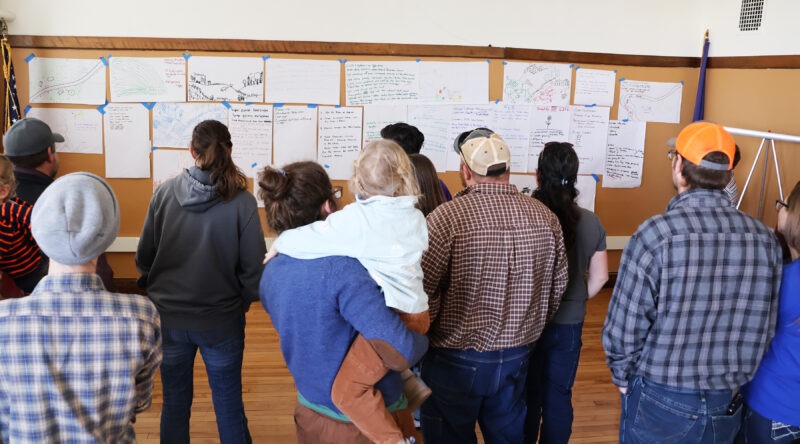
On a recent morning in late February, a couple dozen farmers stood in front of a wall of words and pictures, imagining what the future might look like. Just a few minutes before, the farmers had sat at tables in a sunny room of the Chatfield Center for the Arts in southeastern Minnesota, using felt-tipped markers to respond to a prompt from Land Stewardship Project soil health organizer Alex Romano:
“If you had it your way, what would the landscape look like as you drive across your region or state? What would you see as the norm? What crops would be growing, what livestock is being raised and how? What else? What do the local economies look like?”
As the farmers feverishly scribbled or sketched, it was clear they had a lot of opinions on this. No wonder: these were members of LSP’s Soil Health Hubs, a collection of four farmer-to-farmer networks representing three regions in southeastern Minnesota (Austin, Plainview, and Houston) and one in northeastern Iowa (Decorah).
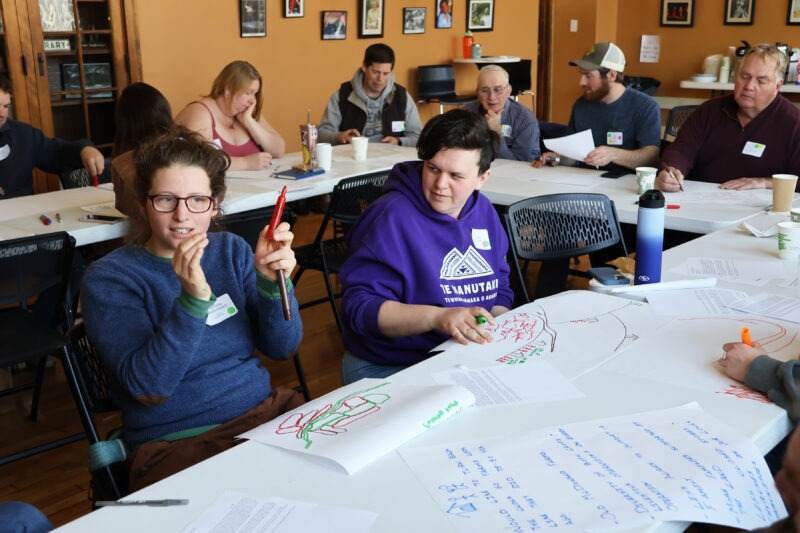
As we’ve described in this blog previously, these Hubs are opportunities for livestock and crop producers to take part in the kind of peer-to-peer learning required to step out of the mainstream and build a farming system based on living, biologically rich soil. As the current soil health revolution farming is in the midst of continues to evolve, it’s become clearer than ever that traditional methods of information transfer — educational and governmental “experts” handing down scientific knowledge from on-high — simply aren’t adequate to meet the needs of farmers seeking to take a different approach to food and fiber production.
Each LSP Soil Health Hub is kept small enough — around a dozen members or so — to make one-to-one connections possible as farmers take turns hosting hub meetings not as just a show-and-tell type exercise but as a way to address “burning questions” such as land access, water line placement, weed management, grazing herd profitability, marketing headaches, pasture and cover crop seed mixes, and ways of wintering livestock. The meeting in February was an opportunity to bring as many of the hub members together as possible to hear a few presentations on innovative farming practices, forge more relationships, and yes, work up a vision for what their communities and landscape might look like in the future if some of the regenerative practices they were utilizing and hoping to try became more the norm.
This was the first time LSP had brought all the Hub members together into one room, and some of the farmers had never met each other before. Around 30 of the 59 active hub members showed up at the Art Center, which is housed in a 110-year-old former schoolhouse. As soil health organizer Sarah Wescott described during the outset of the meeting, 39 Hub members are men, 20 are women. Fifty-one percent grow row crops, 39% small grains, and 66% graze livestock. It’s a mix of beginning, mid-career, and older farmers. At the Chatfield meeting, that demographic hodge-podge was pretty much represented, with a few toddlers skewing it to the younger end of the scale.
Planting Practicality
Visioning sessions have long been a big part of LSP meetings and workshops. One of the main players in the “Oat Mafia,” southeastern Minnesota farmer Martin Larsen, often mentions that he got his start diversifying his cropping rotation after drawing up a new vision for his farm at an LSP event (he admits he thought the exercise was a little “woo-woo” at first). Developing a vision for one’s farm (or future farm) is also a keystone of LSP’s Farm Beginnings, farmland transition, and land access educational offerings.
Perhaps the farmers participating in the recent Soil Health Hub visioning session felt a little more confident about dreaming big as a result of a couple of presentations given earlier in the day. Eric Heins gave a talk entitled “From Cash Cropping to Cash Grazing.” Heins, who was trained as an accountant, went through a set of charts that outlined the financials of transitioning his Winona County farm from a basic row crop operation into a diverse set of enterprises that includes grass-based beef production as its anchor, but also includes small grains.
“It’s all about connecting the dots for me,” he said at one point. “How can I make each acre generate income?”
Ben Klein, a beginning farmer and graduate of LSP’s Farm Beginnings course, described how his family’s Olmsted County crop and livestock operation is balancing organic production, diverse rotations, and direct-to-consumer marketing of meat and eggs. Part of the attraction of the Soil Health Hubs is that farmers feel comfortable sharing missteps as well as successes. Klein described how, in 2025, they tried to grow soybeans utilizing a no-till method based on planting the crop straight into a rye cover crop. Unfortunately, they couldn’t get the rye to lay down correctly and in the end weeds were a problem, resulting in a low soybean yield.
“It didn’t work,” Klein said with a wan smile.
On the plus-side, he said efforts to transition to organic a farm he and his brother, Andy, recently purchased are paying off as the soil, which had endured years of intensive row-cropping, comes back to life thanks to the use of regenerative practices.
A Gallery Walk & Talk
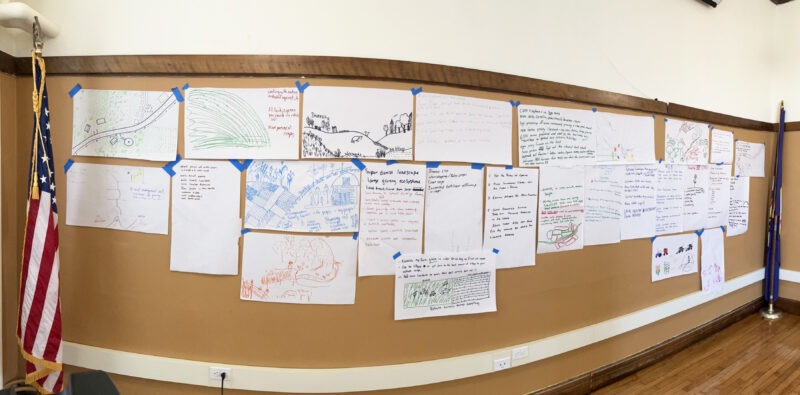
After the farmers had the big pieces of paper they’d been working on taped to the wall, they began what Wescott called a “gallery walk.” Indeed, like art patrons in a museum, they stood in front of the wall of wonder for a few silent minutes observing each other’s handiwork. Then they began talking about some common themes and ideas that emerged in both pictures and words:
- Diversity
- Less corn and soybeans
- More food crops
- Healthy food
- Perennial plants
- Green year-round (lots of green felt-tipped pens were sacrificed in the name of this sentiment)
- Livestock on the land
- Vibrant local businesses
- People and community
- Healthy soil
- Knowledge sharing
- Profits over maximum yield
- Not fearing being different from one’s neighbors
- Young farmers on the land
Beneath an illustration showing a diverse landscape with people on it, someone had written: “Independent family farms → for people → by people!” Someone else had written: “Working with nature instead of against it” on their poster. There was also a nicely done illustration showing what was not wanted on the landscape: a snow drift and snowman were stained with eroded soil and a giant “cancel circle” over the picture made it clear how the artist felt about snirting up the landscape.
The gallery show sparked a lively discussion amongst some of the younger farmers around how it’s easy to get carried away with having lots of diversity on the farm and getting burned out in the process. Folks also spoke about the importance of balancing idealism with financial reality. “It has to cashflow at the end of the day,” said a middle-aged crop farmer. “If we’re all broke, it doesn’t do anything.” After a pause, he added, “Some of this will work.”
An older farmer pointed out that it’s tough to make a living in an economy where the cost of inputs and land has skyrocketed, but the prices farmers receive for their production have stayed the same or dropped when compared to what they got decades ago. “If we are going to get more people on the land, we have to have a way for them to make a living on the land and not just provide them ways to get exercise,” he said, pointing out that three decades ago he and his wife made a good living milking 45 to 50 cows. These days, the average milking herd in Minnesota is round 280 cows, and even at that size farmers have a hard time competing financially against mega-operations that can number in the tens of thousands.
On that note, Romano wrapped up the discussion by putting all this visioning into a practical context. “When you think about a vision for the future, you’re thinking about the legacy you want to leave behind,” she said. “And that’s where you start to see values connect — values around family, values toward the land, towards your own community. That’s very evident in what you’ve done here.”
She went on to explain that LSP doesn’t just paint a rosy picture of the future — the organization likes to help farmers and other community members develop a practical roadmap for how to move forward successfully. Initiatives such as the Soil Health Hubs are part of that path-building. Romano added, “And you guys are doing this kind of work on your own farm every day — living and breathing these things, trying to figure them out.”
With that in mind, Romano, Wescott, and Shea-Lynn Ramthun (another LSP soil health organizer), finished up the day with that most practical of exercises: working with the farmers to plan the next round of on-the-farm Soil Health Hub meetings.
Brian DeVore is LSP’s managing editor and the producer of the Ear Dirt soil health podcast series. For more on LSP’s work to help farmers build soil health profitably, click here. For more on our Soil Health Hubs, contact Alex Romano, Sarah Wescott, or Shea-Lynn Ramthun.