
Note: LSP believes that a more sustainable food production system must be based on the kinds of farmer-to-farmer education networks that thrive at workshops, field days, and during informal conversations in the field and at the kitchen table. That’s why LSP is committed to building Soil Health Hubs and otherwise bringing farmers together to share knowledge and experience. In this blog, Starbuck, Minn., grain farmer Jenny Bredeken shares one result of this kind of networking. For more on LSP’s work to build farmer-to-farmer networks, click here. LSP’s 2026 winter soil health meeting will focus on how farmers can rebuild local markets by diversifying into small grains. It will be held Jan. 27 in Rochester. In addition, on Feb. 5, 12, and 19, LSP and U of M Extension will host a “Rotating into Resiliency” cohort for farmers who are interested in diversifying with small grains. For details on these events as they’re developed, watch our online calendar.
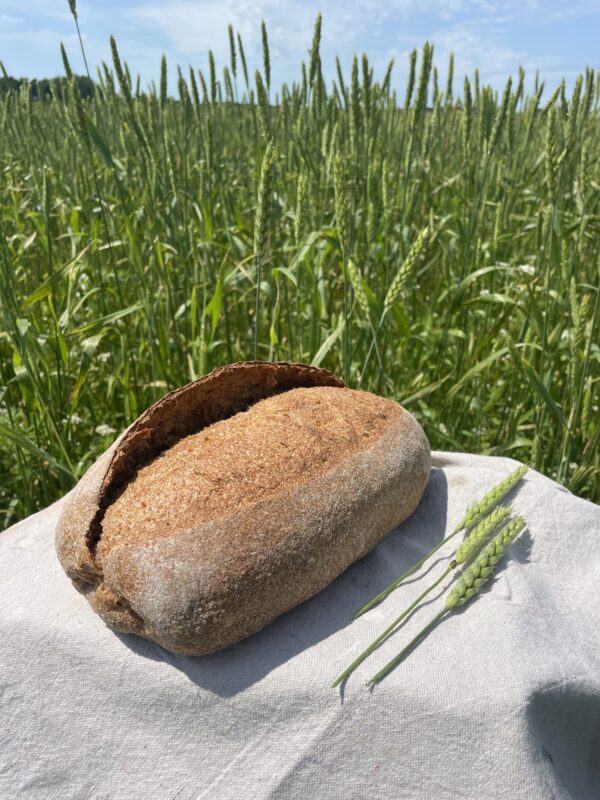
At Full Circle Farm, one of the most rewarding things about running a sourdough microbakery and growing our own flour is getting to try new grain varieties. There’s something especially satisfying about planting a seed and then, months later, baking with the flour that came from our own fields. This fall, my partner, Roscoe, planted two wheat varieties that were completely new to us: Bickford and Erisman. He first learned about them at a small grains meeting hosted by the Land Stewardship Project in early August, and he came home excited to give them a try.
Bickford Hard Red Winter Wheat
Bickford is a hard red winter wheat variety developed through a collaborative effort between Cornell University, University of Wisconsin–Madison, the Artisan Grain Collaborative, and a network of farmers, bakers, and grain advocates across the region.
From what the trials show, Bickford stands strong in the field, performs beautifully on organic and low-input farms, and produces both abundant yields and versatile flour. It works well for everything from flakey pastries to hearty, flavorful loaves.
The Bickford name honors the late Paul Bickford, an organic farmer and mentor whose decades of work in organic systems and on-farm innovation influenced so many growers in the Upper Midwest. We’ve been milling it fresh and giving it a simple hand-sift. The pancakes we made with it were unreal — warm, aromatic, and naturally sweet. I asked Roscoe if he added cinnamon to the recipe — to my surprise, he did not!
Erisman Soft Red Wheat: A Variety Rooted in Organic Agriculture
Erisman also carries its own legacy. It was developed by the University of Illinois for organic producers and was named after Jack Erisman, a long-time organic grower who spent decades proving that diverse rotations, soil health, and chemical-free systems could not only work, but thrive. His farm in east-central Illinois was and still is a touchstone for many organic farmers.
Early maturing and high yielding, Erisman wheat performed exceptionally well in trials with excellent resistance to fusarium head blight and stripe rust. It has strong standability and wide adaptability across soil types. It is known for very good winter hardiness and reliable germination, which is what we have experienced. Its grain has very good milling characteristics and excellent baking quality for a soft red wheat, producing flavorful, aromatic flour well-suited for pastries, cookies, biscuits, crackers, and blended-flour sourdough breads.
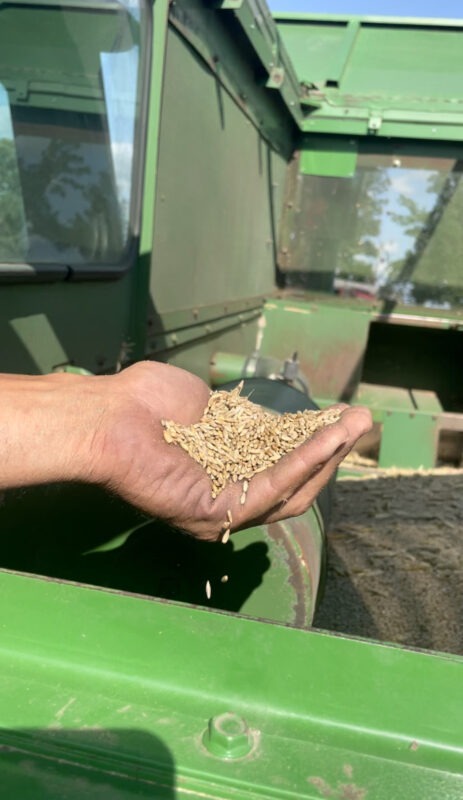
Our First Time Fall-Planting Wheat
This was our first year fall-planting winter wheat, and it comes with its own learning curve. In Minnesota, the rule of thumb is to plant about 10 days before the first killing frost. We seeded in late September. For a while, temperatures barely dipped below freezing, which had us wondering how things would balance out.
With winter wheat, the goal is to plant early enough for survival, but not so much that the plant burns through its sugars or becomes prone to snow mold.
And then, thankfully, we got exactly what we needed: a perfect snowpack this past week. A consistent, insulating blanket of snow is winter wheat’s best friend as temperatures drop and the winds pick up. It’s a huge relief, and we’re grateful it arrived right on time before the typical subzero temps and high winds.
Now the wheat can settle in for the winter and rest until spring.
Why We Share This
As we scale up our grain growing, flour milling, and sourdough baking operation, varieties like these are exactly the direction we want to move toward.
All of this is new to us, and we’re learning right alongside other small grains growers. Part of why we are sharing this is to help rebuild a regional grain culture; one where farmers, millers, and bakers exchange knowledge and learn from one another. We recently became members of the Artisan Grain Collaborative, which has been incredibly supportive of us in gaining more knowledge when it comes to small grains.
Heritage grains and organic-minded breeding programs offer so much: flavor, diversity, resilience, and a deeper connection to food and where it comes from. Growing them, milling them, and baking with them feels like returning to something that’s been missing for a long time.
If you’ve curious about these varieties, we plan on continuing the conversation once harvest rolls around. Feel free to reach out to ask questions or start a conversation. We love learning from others and sharing what we’re learning.
About Full Circle Farm
We’re a fifth-generation, vertically integrated small-grains farm, flour mill, and sourdough microbakery in rural Starbuck, Minn. We’re dedicated to reviving regional grain economies and rebuilding the connection between soil, farmer, miller, and loaf. We grow wheat, rye, and other specialty grains on 33 acres using regenerative practices — no synthetic fertilizers, no fungicides, and a heavy emphasis on cover cropping, soil biology, and biodiversity. All of our grains are milled fresh then baked into naturally leavened sourdough breads, offering a true farm-to-table sourdough. As former microbakery owners in Honolulu, we bring together deep baking expertise and seed stewardship to offer our community nutrient-dense flour, fresh bread, and a rural food hub. Our mission is simple: grow good grain, nourish our community, and prove that small family farms can thrive again. More information on Full Circle Farm is here.