
Land Stewardship Project

Land Stewardship Project
  • About Us
    • Our Mission
    • Long Range Plan
    • Staff Directory
    • Board of Directors
      • LSP Board Committees
    • LSP Steering Committees & Working Groups
    • Contact Us
    • Past LSP Projects
    • Employment & Volunteer Opportunities
    • LSP Publications
    • Financial Statements
  • The Latest
    • Community Care
    • Songs for the Soil
    • CSA Farm Directory
    • Upcoming Events
    • News
      • News Releases
      • Media Contacts
      • LSP in the News
    • Blog
    • Podcast
    • Land Stewardship Letter
    • LIVE-WIRE Sign-up
    • Myth Busters
    • Fact Sheets
    • Farm Crisis Resources
  • For Farmers & Landowners
    • Farmland Clearinghouse
    • New Farmers
      • Farm Beginnings Class
      • Journeyperson Course
      • Farm Dreams
      • Accessing Farmland
      • Farmland Clearinghouse
      • Beginning/Retiring Farmer Tax Credit
      • Beginning Farmer Profiles
      • Fresh Voices Podcast Series
    • Retiring Farmers & Landowners
      • Farmland Clearinghouse
      • Farm Transition Course 2026
      • Conservation Leases
      • Beginning/Retiring Farmer Tax Credit
      • Land Transition Tools
      • Transition Stories
    • Soil Health
      • Cover Crops
      • Grazing
      • No-till
      • Microbiology
      • Kernza
      • Soil Builders’ Network
      • Soil Builders’ E-Letters
      • Soil Health Steering Committee Members
      • Ear Dirt Soil Health Podcast Series
    • Cropping Systems Calculator
    • Conservation Leases
  • Creating Change
    • Community-Based Food Systems
      • Ear Bites Community-Based Food Podcast Series
    • Policy Campaigns
      • Soil Health & Climate Change
      • Healthcare
      • Factory Farms
        • Anti-Competitiveness & Price Gouging
      • Federal Policy
        • A Farm Bill For Us
      • State Policy
        • MN Farm, Food & Climate Funding
      • Developing Leadership
    • Justice & Stewardship
    • Organizational Stewardship
  • Get Involved
    • Your Membership Matters
    • Take Action!
    • Upcoming Events
    • Land Stewardship Action Fund
    • Connect with LSP
      • Stay Connected
      • Join, Donate, or Renew Today!
      • Shop
      • Employment & Volunteer Opportunities
      • Legacy Giving
    • Network with LSP Members
      • Farmland Clearinghouse
      • Soil Health
    • Farmland Clearinghouse
  • Join, Donate, or Renew Today!
  • Stay Connected
  • Contact Us
  • Shop
Search
More...

Rolling Out the Welcome Mat for New Neighbors

LSP Members Use 'May Day Baskets' to Show Support for Immigrants in their Communities

By Clara Sanders
May 30, 2025

Share

  • Facebook
  • Pinterest
  • email

The Land Stewardship Project is an organization that believes we will not have a truly sustainable farm and food system until it is sustainable for everyone. That point was reinforced recently when we gathered input from our members and allies while putting together our current long range plan. That’s one reason LSP is working closely with partners who are on the ground in immigrant communities. One way we’re doing this is by being a member of the Immigrant Defense Network (IDN), a coalition of more than 90 Minnesota groups formed to protect the rights of immigrants and to make sure accurate information is being circulated in those communities. This work includes co-facilitating the Greater Minnesota caucus of IDN with COPAL-Minnesota.

In a socio-political landscape of false, harmful narratives about immigrants and brazen arrests with no due process conducted by U.S. Immigration and Customs Enforcement (ICE) agents, LSP members are joining with our allies to speak up for those who are often scapegoated and targeted.

For example, at the beginning of the month LSP members participated in May Day gatherings in Montevideo, Mankato, and Rochester, organized by the Immigrant Defense Network. Volunteers packed “May Day Baskets” full of information about immigrant rights and what to do if ICE approaches a place of work. Participants then delivered the baskets to local businesses with immigrant employees, engaging managers in conversations about how they can care for their workers.

Theresa Zeman, Kathy Florin, and James Kanne were among the LSP members who attended a May Day action, and a highlight for each of them was connecting with lots of other people from their regions who care about immigrant rights and want to make their communities welcoming and thriving.
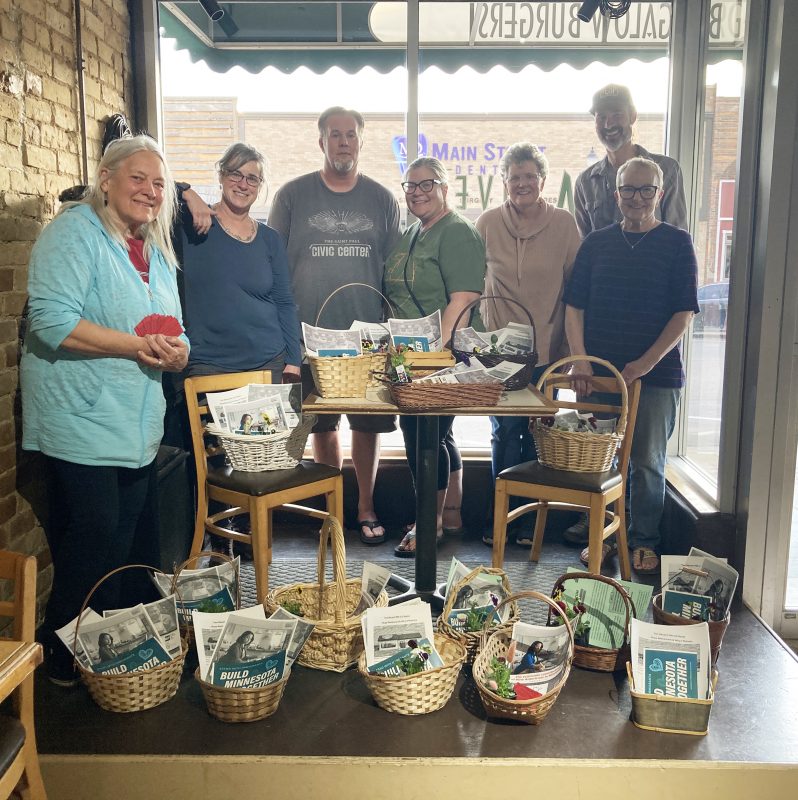
 

LSP members in Montevideo, Minn., distributed “May Day baskets” to immigrants in the community recently.


“Immigrants of any ‘status’ are keeping small towns in southwest Minnesota alive,” says Theresa, who grew up on a small diversified farm and has lived in towns across southern Minnesota, from Winona to Saint James to Madison. “They keep the schools open, and many of them work on farms or in the food processing plants that farmers need in order to get their products to market.”

As Ryan Perez, the director of organizing for COPAL, explains in a recent LSP Ear to the Ground podcast, immigrants have long been a vital part of the food system in the Upper Midwest. The early sugar beet industry started employing many Latino immigrants in the 1920s, and in the 1940s, Mexican laborers came to the region under the “Bracero” program to ease the shortage of agricultural workers. Immigrants from Latin America and beyond make up a high percentage of employees at meatpacking and food processing plants in rural Midwestern communities.

Many rural and small-town people are excited to welcome newcomers to their communities and want to support their transition, and they have the motivation and resourcefulness to find ways to support their new neighbors. For example, the volunteer-run Afghan Support Network in Winona is based on a community-supported model pioneered in Canada, designed when traditional refugee resettlement agencies were overwhelmed.

Kathy, who attended the May Day event in Rochester and grew up in the Driftless Region, is a volunteer with the Afghan Support Network, helping to connect recently resettled refugees from Afghanistan with resources and community.

“It’s important for LSP to be involved with this work because everything is connected,” she says. “Climate change, access to land, and clean water, armed conflicts, movement of people — these aren’t isolated issues!”

James has been involved with Land Stewardship Project for decades, and now that he has retired from dairy farming, he works as an LSP organizer.

“I am really happy to see that LSP is reaching into this space,” he says. “We are now getting to the point where we are establishing relationships, getting those ideas out there, working with people as allies. If all we are doing is trying to keep what European settlers took, that isn’t sustainable. The farm and food system of the future is about being together on the land, not perpetuating the white establishment.”

Through their volunteer work and connections via farm mentorship, Kathy, James, and Theresa each personally know new Americans who are affected by the increased threat of deportation without due process as well as false narratives around issues like race, crime, and the role they play in the job market and the economy. So they were grateful for the opportunity to talk with businesses and employers about how they could care for their workers and clients.

“I talked to a manager at an assisted living home that employs a lot of student or first-generation immigrants,” says James, “and he was really grateful for the resources and wanted to learn more.”

A couple years ago, Kathy went on a trip to Brownsville, Texas, to support new arrivals to the U.S., talk with those in Mexico waiting for their asylum appointments, and learn from the stories of people immigrating across the southern border.

“There’s this ‘free and easy’ narrative, but just getting to the southern border is an intense and harrowing experience,” she says. “What strikes me most from the stories I heard is the incredible resilience of these people and the commitment to their families and communities.”

“The time is now,” says Theresa, who is a retired nurse and passionate about healthy communities. “We see what is happening, and we know what we want and need. When there is a threat to our neighbors, those of us who aren’t under threat should show up.”

While gathering with so many other people committed to supporting new Americans was heartening for all three of these LSP members, they know that there is still work to do when it comes to shifting the narrative about immigration in their communities.

“Most of my neighbors will always defend the people who work for them,” says James. “But one person’s worker is another person’s ‘illegal immigrant.’ We have to help folks overcome this disconnect and see that we are stronger together.”

“They are our neighbors,” says Theresa.

“These are the people I want for my neighbors,” affirms James. “These are the people I want for my friends.”

“Everything is connected,” says Kathy. “If we are going to take care of the land, we have to take care of the people.”

LSP membership organizer Clara Sanders can be reached via e-mail. LSP’s Immigrant Community Care Resource Page has links to information on supporting the immigrant community.

Category: Blog
Tags: Afghan Support Network • COPAL Minnesota • Immigrant Defense Network • immigration • racial justice • rural economic development

Upcoming Events

×

January 2026

Tuesday January 20

5:00 pm – 8:00 pm
Making the Most of Each Acre: Integrating Livestock onto Cropland
Tuesday January 20
5:00 pm – 8:00 pm
Making the Most of Each Acre: Integrating Livestock onto Cropland
680 Byron Main Ct. NE Byron, MN 55920

In this interactive workshop, farmers will learn about important soil, finance, crop, and livestock concepts related to crop and livestock integration. In addition to presentations by Extension educators, participants will engage in activities to put their newfound knowledge to the test. Participants will gain knowledge, new connections, and a personalized plan for integrating crops and livestock on their farm.
 
For details and to register, click here. 

Wednesday January 21

5:00 pm – 7:00 pm
Farm Aid Farmer Listening Session
Wednesday January 21
5:00 pm – 7:00 pm
Farm Aid Farmer Listening Session
Zoom online

What’s your story?

Farm Aid wants to hear from farmers about what they experienced in 2025 and what concerns they have heading into the 2026 season. Farm Aid will use the information and stories we hear during this listening session to make sure that our advocacy and policy work is grounded in the needs and experiences of family farmers right now.

Come learn more about Farm Aid’s policy and advocacy work, share your story with the Farm Aid community, and hear from farmers around the country about what they’re experiencing.

For more information and to register, click here. 

If you can’t make it to this listening session, share your story with us by filling out this form. 

Thursday January 22 – Saturday January 24

GrassWorks Grazing Conference
Thursday January 22 – Saturday January 24
GrassWorks Grazing Conference
La Crosse Center, 300 Harborview Plaza, La Crosse, WI 54601, USA

The 34th Annual GrassWorks Grazing Conference will take place Jan. 22–24 at the La Crosse Center in La Crosse, Wis.

The 2026 conference will be centered on the theme: “Pastures to Prosperity: Building financially smart grazing systems for today’s land stewards.” This year’s focus highlights practical, innovative, and profitable approaches to grass-based livestock production, equipping farmers with tools to strengthen both environmental and economic sustainability.

GrassWorks is excited to welcome two nationally recognized keynote speakers:

  • Melinda Sims, Wyoming cattle rancher and Ranching for Profit instructor, known for her expertise in financial decision-making and resilient ranch business models.
  • Dwayne Estes, Executive Director of the Southeastern Grasslands Institute, a leading voice in grassland restoration, regenerative grazing, and agricultural landscape resilience.

Conference highlights include:

  • More than 60 expert speakers from across the grazing and agricultural sectors
  • Over 45 industry exhibitors featuring the latest in grazing tools, technology, and services.
  • Workshops for beginning, expanding, and experienced graziers
  • Panel discussions on farm profitability, land stewardship, and long-term business resilience.
  • Robust networking opportunities with farmers, technical service providers, and industry partners.

The GrassWorks Grazing Conference draws farmers, agricultural professionals, educators, and conservation partners from across the Midwest and beyond. Attendees can expect practical education, actionable strategies, and meaningful connections.

Registration information can be found at https://grassworks.org/events/grazing-conference.

Tuesday January 27

9:00 am – 3:00 pm
'Beyond Exports: Rebuilding Local Markets' LSP Soil Health Workshop
Tuesday January 27
9:00 am – 3:00 pm
'Beyond Exports: Rebuilding Local Markets' LSP Soil Health Workshop
Rochester International Event Center, 7333 Airport View Dr SW, Rochester, MN 55902, USA

On Tuesday, January 27 join Land Stewardship Project for our signature winter workshop. This year’s theme is “Beyond Exports: Rebuilding Local Markets”.

The workshop will be held from 9am to 3pm at the Rochester International Event Center (73333 Airport View Dr SW, Rochester, MN 55902).  Our featured keynote speaker is Martin Larsen, a farmer who is a founding member of the “Oat Mafia” in south-central Minnesota.  In the morning session, Martin will highlight the challenges and opportunities facing all farmers as they look beyond export load-out at the elevator and instead look to recreate the local markets that once served our farmers and consumers.  He will share his journey establishing food grade oats and founding the “oat mafia” and the agronomic, economic, and market impacts it has made for his farm.

After the keynote, attendees will have the option to choose two of three breakout sessions with local experts:

Session 1: Economics of Diversifying Your Rotations
Session 2: Marketing Your Alternative Crops
Session 3: Derisking Diversifying Your Rotations

Breakfast and a catered lunch will be provided.  

For details and to register, click here.
 
You may also contact event organizer Shea-Lynn Ramthun at 651-301-1897 or slramthun@landstewardshipproject.org. 

5:30 pm – 8:00 pm
LSP Farm Transition Planning Course
Tuesday January 27
5:30 pm – 8:00 pm
LSP Farm Transition Planning Course
Zoom Online

The Land Stewardship Project’s long-running course for farmers and other landowners looking to transition their agricultural operations to the next generation is expanding into South Dakota in 2026. The Land Stewardship Project (LSP) Winter Farm Transition Planning Course, which enters its 10th session in 2026, provides a holistic opportunity to dig into important topics and learn from experienced farmers and professionals about the options that farmers and landowners have when looking to pass their farm on.

The standard Zoom online LSP course will be held on seven Tuesday evenings starting on January 27 and running through March 10. The sessions build on one another, so attendance at all sessions ensures the greatest understanding and planning opportunities. The course fee is $250 per family, and registration is open through Jan. 9 at https://landstewardshipproject.org/transition2026.

New this year is an expanded course offering for South Dakota attendees as part of a partnership LSP has formed with Dakota Rural Action and Rural Revival.

The South Dakota course, led by Dakota Rural Action and Rural Revival and using the LSP curriculum, includes seven weekly in-person sessions, with a full-day Saturday kick-off session, and another full-day session to close the training. Sessions two through six will take place on Tuesday evenings for two-and-a-half hours. The dates are: Jan. 31, Feb. 3, Feb. 10,  Feb. 17, Feb. 24, March 3 and March 14. As with the fully online course, the course fee is $250 per family, and the registration deadline is Jan. 9. To register for the South Dakota course, visit https://qrco.de/farmtransitions2026.

Presenters at both workshops will include other area farmers who are implementing farm transition plans, as well as professionals representing the legal and financial fields as they relate to agricultural businesses. Workshop participants will have an opportunity to begin engaging in the planning process as well as to learn about resources for continuing the process after the workshop has ended.

View Full Calendar

Recent Posts

  • Tell Congress Farmers Need Real Relief & Real Solutions January 18, 2026
  • LSP Stands With Immigrant Neighbors in Rural Minnesota  January 12, 2026
  • ‘Beyond Exports’ Focus of Jan. 27 Crop Diversification Meeting in Rochester January 11, 2026
  • Why LSP Stands With Our Immigrant Neighbors January 8, 2026
  • Priorities for 2026 Legislature: Soil, Water, Land Access, Consolidation, Farm to School January 8, 2026

Montevideo

111 North First Street
Montevideo, MN 56265

(320) 269-2105

Lewiston

180 E. Main Street
Lewiston, MN 55952

(507) 523-3366

Minneapolis

821 E. 35th Street #200
Minneapolis, MN 55407

(612) 722-6377

  • Privacy Policy

Copyright © 2026 Land Stewardship Project. All rights reserved.

https://landstewardshipproject.org/rolling-out-the-welcome-mat-for-new-neighbors