
Note: The Land Stewardship Project’s Ear to the Ground podcast recently featured an interview with Marvin Johnson, a Minnesota farmer and president of the Alumni Association for the School of Agriculture at the University of Minnesota. Johnson discussed the history and the future of the Endowed Chair in Agricultural Systems. For three decades, the Endowed Chair has supported placing farmers, scientists, and others in a rotating research and outreach position at the U of M. This program has resulted in numerous advancements in supporting a more sustainable, family-farm based form of agriculture in Minnesota. However, at the time this interview was recorded, the Endowed Chair initiative faced possible elimination at the hands of University of Minnesota administrators. Below is a transcript of that interview with Johnson. To listen to Ear to the Ground episode 398 and for more information on this issue, click here.
••••••••••••••••••••••••••
Brian DeVore: “Welcome to the 398th installment of Ear to the Ground, the Land Stewardship Project’s podcast on family farming, regenerative agriculture, community food systems, and local democracy. I’m Brian DeVore, editor of the Land Stewardship Letter.
“When the Land Stewardship Project and other members of the Sustainers Coalition launched the Minnesota Institute for Sustainable Agriculture in the early 1990s, our goal was to provide a way for farmers and other members of the public to influence what kind of research and outreach takes place at their land-grant university. The thinking then was that the University of Minnesota, like many public agricultural institutions across the country, had become too narrowly focused on doing the kind of science and education that supported an industrialized form of farming that was emptying our rural communities of people while harming the land and water. As public funding continues to dwindle, large corporations are increasingly providing money for university laboratories, test plots, researcher salaries, and other land-grant infrastructure, providing them outsized influence over the future of agriculture.
“Over the years, the Minnesota Institute for Sustainable Agriculture, also known as MISA, has produced an array of publications on sustainable agriculture topics, fostered student programs in sustainable agriculture, supported the Alternative Swine Program, and provided support for the Regional Sustainable Development Partnerships. That latter entity works across the state to support community-driven projects in agriculture and food systems, clean energy, natural resources, and resilient communities. MISA has also been closely aligned with the growth of the Forever Green Initiative, which was started in 2012 by the late Don Wyse, a plant scientist who was MISA’s first director.
“Forever Green has become nationally known for conducting cutting-edge research on cropping systems that depart from the corn-soybean duo culture. Research into Kernza, the world’s first commercially viable perennial grain, is one area Forever Green has led on. MISA and its work to get more continuous living cover on the landscape also served as the foundation for Green Lands Blue Waters, an initiative launched in 2004 by various land-grant institutions, along with environmental and agricultural organizations such as LSP.
“One initiative MISA has been involved in has done an exemplary job of pumping fresh, regenerative ideas into the land-grant ecosystem. Since 1995, the Endowed Chair in Agricultural Systems has supported placing farmers, scientists, and others in a rotating research and outreach position at the U of M. During their time serving as the Endowed Chair, individuals have an opportunity to study and develop resources related to a more sustainable approach to agriculture.
“It’s a way to gain access to a public institution that can, ironically, seem at times not so welcoming to members of the public. Scanning the descriptions of dozens of current and past Endowed Chairs provides an expansive view of the development of sustainable agriculture in Minnesota during the past three decades. Everything from alternative livestock production and marketing of new crops to climate change, soil health, and community development have been worked on by Endowed Chairs.
“The seeds of the Midwest Farmers of Color Collective were germinated while Sophia Benrud and Zoe Holloman occupied the chair. And numerous land access initiatives have received a boost as a result of this program. Two former executive directors of LSP, Ron Kroese and George Boody, have served as endowed chairs. Current endowed chair projects include supporting a localized meat processing infrastructure, developing a specialty grains hub, and helping tell the story of how farmers and other community members have spent the past 35 years pushing the U of M to fulfill its land-grant mission.
“Entities like MISA and the endowed chair are needed now more than ever as Midwestern farming grapples with market consolidation, stress, and other mental health challenges, climate change, creating a more resilient food system, and providing opportunities for emerging farmers. That’s why it was so disheartening when the dean of the University of Minnesota’s College of Food, Agriculture, and Natural Resource Sciences announced last year that he was discontinuing funding for MISA.
“Just as troubling, the dean, Brian Buhr, proposed disbanding the Endowed Chair and distributing its funding elsewhere within the university. It should be noted that financial resources for the endowed chair were initially jump-started by the Minnesota Legislature, and over the years, donors, many of them alumni of the School of Agriculture, have helped build its funding up to roughly $3 million. That money is used to support people during the time they serve in the Endowed Chair position. These farmers and others often don’t have the financial backing of a big institution or corporation, so the Endowed Chair’s financial support can be critical. In recent months, a group of community members calling itself Friends of MISA has been working hard to save both the Institute and the Endowed Chair, and keep them part of the University of Minnesota.
“As this podcast was being recorded, discussions between the citizens’ group and University officials were still ongoing, and the fate of both MISA and the endowed chair was up in the air. After a recent conversation with Marvin Johnson, I’m more troubled than ever that public gems like MISA and the endowed chair in agricultural systems could possibly be eliminated with a stroke of an administrator’s pen. Marvin is the president of the Alumni Association for the School of Agriculture at the University of Minnesota. In 1888, the School of Agriculture was established on the Saint Paul campus to provide rural Minnesotans a post-high school education. Besides providing basic college classes, the school also gave students training in community leadership. Before it closed in 1960, the school graduated several notable leaders in agriculture, including many lawmakers. The late Bob Berglund, who was the U.S. Secretary of Agriculture from 1977 to 1981, was a School of Agriculture alum.
“Marvin, who graduated from the school in 1955, also went on to become a leader in his community and in agriculture in general. After serving in the military, he returned to his family’s farm near Independence, west of the Twin Cities, where he raised livestock and crops. He’s now 90 and still lives in the house he was born in. Over the decades, he’s served numerous leadership roles in his community and the state. In fact, he just recently retired as the mayor of Independence, a position he held for 45 years.
“Marvin has also served an important role in the partnership that formed between MISA and the Endowed Chair. As he explained to me, the Endowed Chair was created by the School of Agriculture Alumni Association as a way to continue the school’s legacy as a seedbed for innovative ideas and agricultural leadership in Minnesota.
“Making it a rotating chair was a strategic decision. That way, fresh ideas were constantly being discussed and researched, allowing the initiative to remain relevant in the ever-changing world of agriculture. Marvin says MISA has served as a critical partner in managing the Endowed Chair program, and he’s enjoyed working with both the late Don Wyse and the current MISA director, Helene Murray. As a farmer, community leader, and big believer in the land-grant mission, Marvin is adamant in his assertion that the U of M should stay true to the intentions of the Endowed Chair’s founders and donors, that the money should be used to support a rotating group of innovators, many of whom are from outside the university system. He also would like to see MISA continue as a partner of the Endowed Chair initiative.
“I met with Marvin at the Independence City Hall, where we discussed how the Endowed Chair has served such a crucial role in developing Minnesota’s sustainable agriculture community and how programs like it can help universities adhere to the land-grant mission to serve the public. Marvin started our conversation describing the School of Agriculture itself and how his experience as a student there helped shape his life.”
••••••••••••••••••••••••••
Marvin Johnson: “It was a post-secondary program. It was our pre-vocational schools that we have around the state now. I don’t know, they must have had a curriculum of classes that you could take from it, but they were the regular college classes. But one of the things that was emphasized was agricultural leadership. What they wanted was people to go to the School of Agriculture, go back to their home farms, and become leaders in the community. That was kind of one of the mission statements, although I would say we probably didn’t call it a mission statement then.
“So they taught a lot on leadership. We learned parliamentary procedure. That was kind of a must when you were at Ag School. And then they had organizations like Toastmasters Club and so forth. But you literally had the same instructors that were teaching in the College of Agriculture. So there were choices there, and you could kind of emphasize animal agriculture or other programs. And I kind of took a general agriculture background. In fact, I even took a class of shorthand at the school because I had taken shorthand in high school because I knew I was going to be drafted into the military. And so, I wanted a kind of refresher course from high school. So you pretty much had an opportunity to take any kind of class that you wanted to on the Saint Paul campus. I don’t know of anybody that went to the Minneapolis campus, but the course included in the school was the nursing program. And that was to encourage nurses to go into rural hospitals and work in the rural area. And so that’s why many of the women that were at School of Ag were part of that program.”
Brian DeVore: “The course instruction in leadership really took with you because I know, besides being president of the Alumni Association, you, I think, correct me if I’m wrong, you were until recently the mayor of Independence for, was it 40 years?”
Marvin Johnson: “It was 45 years. Supposedly, I was the longest serving mayor ever in Minnesota. It wasn’t intended. I never dreamed of being in politics in the first place, but just everything kind of seemed to fall in my lap. And when I was first appointed to the council, I hadn’t even been attending council meetings, and a guy resigned. They voted me in without even asking me if I would serve, and I was called the next morning, and I had to say yes or no, and the clerk treasurer twisted my arm, and I said yes, and that was the beginning of a long tenure in government.”
Brian DeVore: “I’d say so. Well, they must have seen something there that they really liked. And I understand maybe you got that call when you were in the milking parlor or something?”
Marvin Johnson: “I was milking. It was about 7 o ‘clock in the morning, and we had a phone in the barn. My dad had passed away. I was living with my mother, and I knew she would have been asleep at that time, and I quick ran for the phone. Who’s calling at 7 o ‘clock in the morning? And that was it. And he told me, he said, ‘I want to swear you in this morning.’ And I says, I’ve got to think about this.’ Well, he let me think about five minutes, and I said yes. And so he came at a quarter to eight and swore me in in the milkhouse.”
Brian DeVore: “When they call that early, it’s either good news or bad news. And I think for the City of Independence, it sounds like it was good news. So, congratulations on that. That’s really impressive. And talking about leadership, I know at the School of Agriculture a lot of alum went into leadership. There were, I think, Secretaries of Agriculture that came out of that?”
Marvin Johnson: “Yes. I don’t know how many, but, well, we had Bob Berglund, who was American Secretary of Agriculture. And then, of course, there were several people that had been in the Legislature that had School of Agriculture ties. I’m still a director at farm Mutual Insurance Company. At one time when we had state conventions, there were five of us who were School of Ag alumni that were Mutual directors across Minnesota. So, when we had a statewide meeting, we had kind of a school reunion at the same time.”
Brian DeVore: “That’s cool. You know, the other thing that struck me was you were probably a little bit isolated on the farm here, but you got to meet farm kids from all over the state through that program, which I think would add to the experience a little bit. So, speaking of legacy, the School of Agriculture, I think it ran for about — gosh, it was over 70 years, it might have been 72 years, something like that. And then you got involved with the Alumni Association, and it sounds like you and some of the other alumni really were committed to seeing that legacy continue. It had been such a benefit to your life, and you’d seen how it benefited the agricultural community and even policy and leadership in government circles, that kind of thing. So it sounds like you really wanted to see, even though the School of Agriculture wasn’t in existence anymore, you wanted to see the legacy continue somehow. And what you came up with was this Endowed Chair. And I was wondering if you could talk about what was some of the original thinking that went into that? What made you think of this idea of an Endowed Chair? Was that a good way to continue that legacy, I guess?”
Marvin Johnson: “I don’t know if I can answer that very good, but I think part of it was in our discussion of realizing that the life of the organization wasn’t going to go on forever. But we had Dr. Jerry McKay, who was with the University of Minnesota, that was one of our alumni as well, and Dr. Gertrude Esteros, who worked actually in the kind of the home economics section and had also graduated from the School of Ag. They were on our board of directors for the School of Ag Alumni Association.
“Because of many of our discussions, realizing that we were, you know, not adding membership to the School of Agriculture alumni association and so forth, somehow or another, that may have set the tone to begin with to talk to somebody about something like the Endowed Chair. The concept had already kind of been put together, and then we were asked, ‘What do we think about this kind of stuff?’ And we all just kind of agreed that this is a wonderful thing, but we wanted it to be something that was just kind of alive and moving all the time. And we didn’t want one person to sit in the Endowed Chair. We wanted a variety of ideas. And so, we kind of worked with Don Wyse at that time. Then the Legislature had to act, I think, on what was put together.”
Brian DeVore: “How was it funded? Was there some legislative money and then also money from the Alumni Association, or how did that work?”
Marvin Johnson: “Well, and I don’t know the exact dollar amount — I think it was $75,000 or something to start out with that the Legislature put into the fund to get it started. And that’s why it’s so concerning that the money could go away because we realize that this was established through the Legislature, money designated on behalf of the School of Ag, that it’s important to keep it. And then every time we had a school reunion, we emphasized to people, you know, this is our legacy if you’d like to make a donation. And so that’s how money kept flowing into it. I’m not sure how many people donated, but it was understood that it was going to be a legacy and only the interest from the money that was donated could be used for a person sitting on the bench.”
Brian DeVore: “I wanted to go back a little bit to this original idea of a rotating chair. And so people who may be familiar with endowed chairs at universities, it’s often you put, say, a professor into that endowed chair, and they’re there for years and years and years, and it’s named after a corporation or whoever funded it, that type of thing. This is a little different. And I was going through, before this interview, the long list. It’s a couple dozen or several dozen people who served in the Endowed Chair position. I think it’s over 40 people who have served in the endowed chair over the years. And it varies. Some are just for a couple years. Some are maybe more like three years or more.
“I guess what struck me was the diversity of projects that were involved. Everything from meat processing, kind of setting up local meat processing, to organic marketing, to emerging farmers, land access. Community development, which is very much part of the legacy of the School of Agriculture. That was such a big part of that. I think that was genius on your part to make this into a rotating chair so that it could pivot and kind of respond to what’s happening in agriculture at any given moment and kind of get fresh ideas in there and say, ‘Oh, we’re dealing with a shortage of local meat processing, for example. Let’s get somebody in there who can look at this in the short term.’ That’s a good approach, rather than somebody who’s got an interest in something and is doing it for decades and isn’t able to pivot. That must have been conscious, something that you really thought about.”
Marvin Johnson: “And I don’t know if that just surfaced right off the bat, but we didn’t want just one person sitting in the chair. But, you know, when you think of how agriculture has changed from the time that I was in school to what’s happening today — I’ve got a nephew that farms my sister’s farm down in Iowa, and who would have ever dreamed that you could put collars on cows now and use it for rotating pastures on a daily basis? I mean, something like that is intriguing, and yet it’s time-saving and efficient, and those things have got to be taught along the way somehow or another, and I think this is what is in our background. We knew new ideas were going to keep surfacing all the time, and of course we know that our communities have changed tremendously too, and even with organizations, mergers that we’ve seen along the way, and the leadership there. It just made sense. We wanted different people there.”
Brian DeVore: “You mentioned communities changing. You’ve seen your community of Independence change. I’m sure it’s grown quite a bit in the 45 years you were even mayor.”
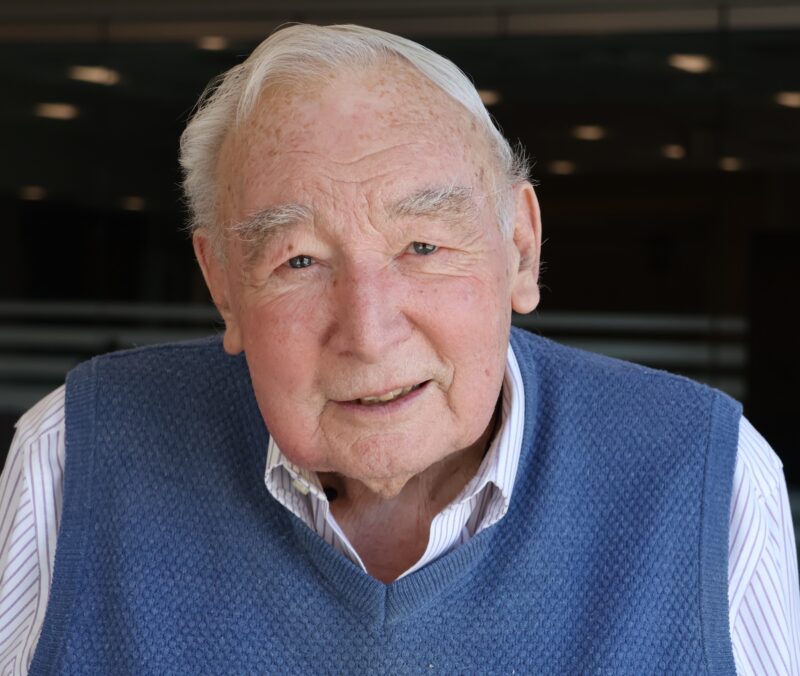
Marvin Johnson: “Yes, and you get further out and it’s gone the other direction, which is kind of sad to see, but as a result of that, things change too. Organizations have to adapt to the changing climate, and I think it’s intriguing to know that we’ve covered so many different areas of studies through the Endowed Chair, and they haven’t all been Minnesota people either that have applied for the job, so we’ve probably influenced agriculture throughout the United States because of the people we’ve had there.”
Brian DeVore: “Yeah, I can vouch for that. I mean, I’ve seen that research being used nationally so again that was a brilliant way to approach that. And it’s, to me, a good combination of you’re continuing the legacy of the School of Ag, but you’re also being able to be innovative and respond to the changes in agriculture.”
Marvin Johnson: “If it’s a new person in the Endowed Chair position, they may not have the foggiest idea of what the School of Ag meant, but I’m sure that Helene and Don, the ones that have been involved, say, ‘This is your background and don’t be afraid to share that as you’re trying to share what you’re studying or emphasizing.’ ”
Brian DeVore: “Like you said, you had talked to Don Wyse, and he welcomed having that part of MISA, the Minnesota Institute for Sustainable Agriculture. How important has that partnership been over the years?”
Marvin Johnson: “They’ve actually done the hard work because they’ve advertised for the program, read the applications, done the interviews. I think they’ve probably helped the people who are in the Endowed Chair steer what they’re doing. I think it’s been vital to have somebody that understands what the original purpose was, and then to work very closely with the people who are selected.”
Brian DeVore: “It’s fitting that maybe MISA and the Endowed Chair have been part of MISA and it’s been this partnership over the years because the Land Stewardship Project was a member of the original Sustainers Coalition that helped found MISA. And the goal there at the time, and it continues to be the goal of MISA, is it’s this kind of an entryway for farmers who are doing something a little different, maybe doing sustainable ag or regenerative ag, whatever you want to call it, to kind of get a foot in the door at the University, and get some of their research priorities looked at and outreach priorities looked at through Extension. They might not have that entryway otherwise. So I think it’s really fitting that the Endowed Chair has been kind of another way to open that door a little further.”
Marvin Johnson: “No question about that. And I’m sure these people have been available for answering questions long after they’ve been in the Chair too, which is why it’s important that that history stays put and people can do the research.”
Brian DeVore: “I just recently was looking at the background information on the Endowed Chair, and one of the things that really struck me was kind of a, it’s almost a mission statement for the Endowed Chair, and I’m going to read this to you. So it says its vision for sustainable agriculture is threefold: ‘A healthy environment, profitable farms, and thriving communities.’ I mean, how do you feel about that over the years since that thing got started? It’s been three decades, I think, at least. And looking at the list of all the different folks that have done the different things, has it kind of fulfilled that mission as far as you can tell?”
Marvin Johnson: “I think it’s done it well. I’m glad that we’re kind of still using some terms that are very common today. I mean, you hear about thriving communities all the time, and that’s part of communities like my community changing, increasing in population and others going the other direction. We all want to be thriving but it’s different things that are happening in the process, so I think that mission statement was well thought out at that time. I’m proud of it. It’s great when a mission statement is still relevant 30 years after it was created because that doesn’t always happen. What was the words that we were thinking of at that time?”
Brian DeVore: “Well, it was obvious you were thinking of your background as a farmer, as a community leader with being the mayor here, and then also just seeing how the School of Ag could develop leadership and that type of thing.”
Marvin Johnson: “Right, and then, of course, we started out with some kind of basic agriculture things. One of our first Endowed Chairs involved growing pigs with Carmen Fernholz, farrowing and that kind of stuff. So things vary over the years.”
Brian DeVore: “It’s funny to look at that list. It’s like Carmen Fernholtz, Jim VanDerPol, George Boody, Ron Kroese. It’s kind of a who’s-who of innovative, sustainable ideas. I think what’s exciting about the Endowed Chair and some of the work MISA has done is there’s a lot of questions these days around whether land-grant universities are fulfilling, speaking of mission, kind of fulfilling their overall mission of serving the people. Kind of doing research and outreach that’s for the public good. And it’s a big debate right now, especially as maybe we see bigger ag corporations kind of step in there and maybe control a little bit what is researched and what is being developed at these universities. This is still a kind of an entryway for getting a foot in the door for folks, who can say, ‘Hey, what about research and outreach that really supports us and helps you be true to your land-grant mission?’ ”
Marvin Johnson: “Yeah, I agree with you, and I don’t know how else you would do it if a person’s got a major idea they want to get emphasized. I mean, a private corporation generally isn’t going to open the door. So, you know, I think the University or some organization has still got to be out there so that people can speak up somehow or another.”
Brian DeVore: “Yeah, I mean, the example I think of is, let’s say JBS, the biggest meatpacker in the world — I don’t think they’re going to fund research on how to set up local meat processing.”
Marvin Johnson: “No, I don’t think so. And for local farmers to be doing it anymore, that’s kind of a thing of the past. I personally wouldn’t know where to start, and yet I know that that was done in the home years ago, before my time.”
Brian DeVore: “There’s kind of some bad news or a downside related to some of these issues right now and talking about the land-grant mission and all that. In the last year or so, there has been talk by the current dean of the Agriculture School there at the University of Minnesota, Brian Buhr, to basically do away with MISA and then take the Endowed Chair money and kind of distribute it out through the rest of the Ag College and really, for all intents and purposes, not have an Endowed Chair anymore.
“So there’s a group of folks, friends of MISA, and some other folks who have been involved and people who have been in that Endowed Chair position too have been in contact with the dean and with other officials at the University and have written letters expressing concerns and trying to find maybe an alternative home for the Endowed Chair and for MISA, that type of thing. But what did you think when you first heard that, that after all these years and all these great projects that have been accomplished through the Endowed Chair, that it just might be kind of thrown away? Any money that was there would be absorbed kind of into the bigger University community?”
Marvin Johnson: “I was upset. I think I first heard about it when Helene Murray sent an e-mail out saying what was possibly going to happen, and I called her up immediately to say, ‘They can’t do this. This has been established by the Legislature. You don’t just up and take something that’s been designated.’ My personal feeling right off the bat was all these people have given money over the years with the intent that this is a legacy of the School of Agriculture and that money that was given was intended to draw interest payments for the Endowed Chair. That’s got to be taken very seriously and kept in one pot. We can still establish maybe something different, but we can’t just take the money for something else. I just didn’t think that was right at all.”
Brian DeVore: “I know that one of the arguments that the officials at the Ag School, particularly, I guess, the dean, have made is that, well, the original goal was to get more sustainable activity within the University and to get more research related to sustainable ag at the University. Their argument is that over the years we have integrated sustainability into the Ag School and we are doing that kind of thing so we don’t need a separate entity to promote that. What do you think about that argument?”
Marvin Johnson: “Well, my thought right there was as I said earlier new innovations don’t just start at the University. They start on local farms and with individuals. And I think the Endowed Chair is just another one of the approaches that we need to keep to allow people that are interested in doing research on a topic that they are trying to dream of. I don’t think we’ve ever arrived. You know, there’s always going to be a continuous thing. There may be a slowdown for a period of time, but my youngest brother is an engineer, and he was just telling me about a new thing that he’s making with his company now that has just mushroomed as far as the work that he’s got to do. And it’s developing little springs that are running in your veins and so forth. It’s hard to explain. But anyway, he’s making these little springs that are used in putting in stints and all that kind of stuff. In agriculture, there’s always new innovations. So, no, I think that was a terrible mistake to say that we’ve kind of arrived, but we haven’t. We never will. It’s a continuum. I mean, it really is. That’s the definition of sustainable ag. We’re always working toward that.”
Brian DeVore: “And I like that idea that you brought up, too, of that kind of thinking being a little bit insular when you say all the new ideas are going to come from within the University community. Again, it’s that idea of letting some new ideas in through the door.”
Marvin Johnson: “Yeah, I agree. The mission statement is almost a promise to the people of Minnesota, I feel like, and the agricultural community specifically.”
Brian DeVore: “That’s really what gives land-grant University programs strength, I think, is this idea that they’re always going to be there and we can take some chances, do some research that maybe won’t always work out, but we can be innovative and maybe be allowed to fail sometimes, and sometimes we succeed.”
Marvin Johnson: “Well, it doesn’t mean that you have to spend all the money each year. I mean, as long as you’ve got the Endowed Chair, you can still add to it and use the interest payments, build up the interest until you’ve got good applicants because I’m sure when the people are reviewing the applications for it, they’re pretty careful to not just give it out to somebody that is looking for a job or something, but to somebody who is really taking a new approach or whatever. So I think it’s important to keep that there. Like I said, we don’t have to spend all the money each year.”
Brian DeVore: “This is an unfair question, you don’t have to answer if you don’t want to. But if some of the University officials from the Ag School were in this room right now, what would you say to them? What kind of a pitch would you give them or what would you — and I know you’ve been in communication through some of these letters folks have been sending out — but what would you say to them face-to-face about this? About what they’re trying to do with the money?”
Marvin Johnson: “Yes, I’d say they’re breaking the law. In fact, we’ve got a former regent that lives close to me, and I visited with him. He says, ‘They can’t do that.’ And that’s the reaction I get, is that money was designated for the Endowed Chair. They can’t take it and use it for something else. I mean, 100% of people say it’s got to stay. You know, basically none of the money that’s in the Chair program has been used for any administrative work. I can see where that change should happen because you can’t expect somebody else to bear the costs of all the administration and that kind of stuff. So, I can see changes there. But as far as changing it, as far as keeping the principal amount and using the interest it still works the same way. You can use a certain percentage of the interest for administration, but still use it for the Endowed Chair. That seems super short-sighted to just end the program.”
Brian DeVore: “So $3 million is a lot of money and it has really had outsized impacts over the years. And to absorb that into the big University, the Ag School, in one year, it just won’t have the same impact. I’m sorry. It just won’t.”
Marvin Johnson: “No, no, no way. No way. Yeah, no. I was surprised when I took this matter as a resolution before the Farm Bureau, our farm organization here, and I started at the county level and then I was a delegate at the state convention. And here I was surprised that when somebody asked a question about it, somebody else popped up about this issue that I had no idea they were going to do that. But they said, ‘This is not right.’ And they were laying out that this was designated for a certain item, a certain job. And so, the resolution carried unanimously that we need to keep it.”
Brian DeVore: “Last night, I printed out the current Endowed Chairs, which, there are three of them, and then all of the past Endowed Chairs. And when I printed it out, it’s single space, and it’s small type. It’s one, two, three, four, five, six, seven, eight, nine, 10, 11, 12, 13 pages, almost 13 pages. And I counted them up and there were 40 Endowed Chairs over the years. I think I’m probably missing a couple. But when you see them all in one place, and again, I’m going to go back to the variety of projects. It wasn’t just like everybody was looking at organics, organic cropping, or marketing. It was a variety of things. And everything from kind of really hardcore research into a certain practice to more of the community-wide benefits. Rural sociology is something a couple people have looked at. Marketing, which is so important. I mean, when LSP was over 40 years ago starting to promote sustainable ag practices, farmers came back to us and said, ‘Great, but we need to get paid for it.’
“So it’s so cool to see some of the economics and economists being part of this and folks looking at this on the farm level as well. The other thing I really like is it’s a combination of folks who are, like you said, researchers at the U or, you know, they’re on faculty at the U or other schools across the country. But also there is a fair number of farmers represented. That, I think, is really important. When you consider that, maybe you didn’t quite know where this thing was going to go 30-years-ago. You must be kind of proud and it must be kind of cool.”
Marvin Johnson: “Well, it is. And what surprises me is that there is enough interest from the fund that we can sometimes have three or four Endowed Chairs in a given year. Because early on, you know, we were kind of looking at one, maybe two, people working in a given year on a different subject and so forth. And we have had several of these people come to our alumni reunion and actually share what they’ve done and say thank you to the people who are graduates of the School of Ag. So, there was a good rapport there from some of the early-on representatives who participated.”
Brian DeVore: “You know what strikes me, Marvin, just talking to you and knowing about your background is you have seen a lot of changes in agriculture and in your community and honestly I’ve talked to folks who have been through the same situation you have and seen agriculture change over the decades and they’re a little bit like, ‘Oh boy, I wish we could go back to the old days’ and really pining for what it was like. I do that too, just even as a farm kid growing up. But they kind of get fixated on, ‘It’ll never be as good as it was, or it’ll never be a positive thing.’ You seem to be a good combination of, hey, there were some good ideas that we were doing back in those days, and we can adopt them as we go forward. And there’s some innovations I haven’t even thought of that are out there and we just need to kind of create that Petri dish or that kind of a system to allow those innovations to grow, that there is a future for agriculture, whatever it may be.”
Marvin Johnson: “Well, yeah, I’ve seen a lot of changes. In fact, when we were growing up here, everybody was a dairy farmer in the local, well, in Hennepin County in the farming area. And now there’s probably only one or two dairy farms left in Hennepin County. And I kind of miss that. That community of comradeship, I guess it would be, of agriculture people in the area. I don’t know as I’d want to go back to where it was, but you just have to adapt with the situations.”