Land Stewardship Project

Land Stewardship Project
  • About Us
    • Our Mission
    • Long Range Plan
    • Staff Directory
    • Board of Directors
      • LSP Board Committees
    • LSP Steering Committees & Working Groups
    • Contact Us
    • Past LSP Projects
    • Employment & Volunteer Opportunities
    • LSP Publications
    • Financial Statements
  • The Latest
    • Community Care
    • Songs for the Soil
    • CSA Farm Directory
    • Upcoming Events
    • News
      • News Releases
      • Media Contacts
      • LSP in the News
    • Blog
    • Podcast
    • Land Stewardship Letter
    • LIVE-WIRE Sign-up
    • Myth Busters
    • Fact Sheets
    • Farm Crisis Resources
  • For Farmers & Landowners
    • Farmland Clearinghouse
    • New Farmers
      • Farm Beginnings Class
      • Journeyperson Course
      • Farm Dreams
      • Accessing Farmland
      • Farmland Clearinghouse
      • Beginning/Retiring Farmer Tax Credit
      • Beginning Farmer Profiles
      • Fresh Voices Podcast Series
    • Retiring Farmers & Landowners
      • Farmland Clearinghouse
      • Farm Transition Course 2026
      • Conservation Leases
      • Beginning/Retiring Farmer Tax Credit
      • Land Transition Tools
      • Transition Stories
    • Soil Health
      • Cover Crops
      • Grazing
      • No-till
      • Microbiology
      • Kernza
      • Soil Builders’ Network
      • Soil Builders’ E-Letters
      • Soil Health Steering Committee Members
      • Ear Dirt Soil Health Podcast Series
    • Cropping Systems Calculator
    • Conservation Leases
  • Creating Change
    • Community-Based Food Systems
      • Ear Bites Community-Based Food Podcast Series
    • Policy Campaigns
      • Soil Health & Climate Change
      • Healthcare
      • Factory Farms
        • Anti-Competitiveness & Price Gouging
      • Federal Policy
        • A Farm Bill For Us
      • State Policy
        • MN Farm, Food & Climate Funding
      • Developing Leadership
    • Justice & Stewardship
    • Organizational Stewardship
  • Get Involved
    • Your Membership Matters
    • Take Action!
    • Upcoming Events
    • Land Stewardship Action Fund
    • Connect with LSP
      • Stay Connected
      • Join, Donate, or Renew Today!
      • Shop
      • Employment & Volunteer Opportunities
      • Legacy Giving
    • Network with LSP Members
      • Farmland Clearinghouse
      • Soil Health
    • Farmland Clearinghouse
  • Join, Donate, or Renew Today!
  • Stay Connected
  • Contact Us
  • Shop
Search
More...

Area Farmers Share Land Access & Marketing Concerns with Legislators From 9 States

Pre Farm-Aid SIX Tour Highlights Environmental, Health Benefits Provided by Cannon Falls & Rochester Farmers 

September 23, 2025

Share

  • Facebook
  • Pinterest
  • email

CANNON FALLS, Minn. — Shea-Lynn Ramthun stood in a recently harvested oat field on her family’s farm near Cannon Falls last week and described to a couple dozen lawmakers a dilemma that’s all-too-common in the agriculture business: she had just successfully raised a bumper crop, only to run into the brick wall of not having access to buyers who will pay a good price.

“As a farmer, I want to produce really sustainable, healthy food for my family and community,” said the sixth-generation crop and livestock producer. “But farmers need to be able to have access to markets.”
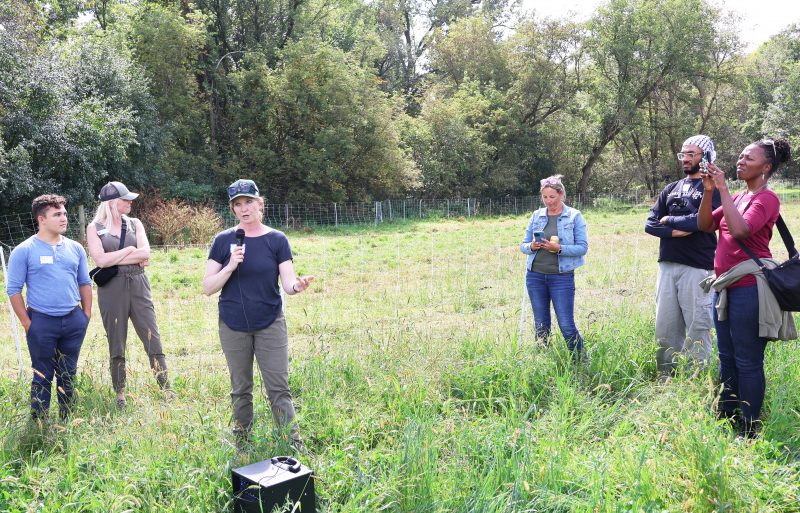
During a recent tour, Shea-Lynn Ramthun of Flying J Farm near Cannon Falls described to lawmakers how integrating oats into her rotation is building soil health.


Ramthun’s Flying J Farm was one stop on a legislative tour sponsored by State Innovation Exchange (SIX), a group that works with state lawmakers across the country to connect and strategize together on how to move public policy that prioritizes the health of communities and climate action, among other things. Last week, 23 lawmakers from nine states — Minnesota, Iowa, Wisconsin, South Dakota, Michigan, Tennessee, Nebraska, Illinois and Missouri — toured farms in southeastern Minnesota as part of a week of activities groups like SIX and the Land Stewardship Project were holding in the run-up to the 40th Anniversary Farm Aid festival Sept. 20 in Minneapolis. Many of the lawmakers participating in the farm tour serve on agriculture and natural resources legislative committees in their respective states.

Less than an hour’s drive south of Ramthun’s farm near Rochester, Minn., a group of Kenyan immigrants explained to the lawmakers that access to consistent, profitable markets is also a challenge for them, even though they are raising vegetables, not grain.

“You can see there are a lot of vegetables, but we don’t have a market at this time,” said Gilbert Obiero, pointing at thriving produce plots behind where the lawmakers were standing.

Obiero and four other partners in the Farmland Produce operation farm 11 acres they’re renting from a local corn-soybean farmer. Most of the farmers who make up the cooperative have health care backgrounds, and they explained to the lawmakers that since starting the farm last year their focus has been to produce nutritious, fresh food for the community. However, because of lack of access to good, consistent markets, they often end up giving the food away.

The farmers also described how access to land is another major barrier to the long-term viability of their business. They have received support from Rochester’s Village Agricultural Cooperative to set up infrastructure such as a packing shed and washing station, but because they are on a year-to-year lease, it’s difficult for them to plan and put in place long-term infrastructure.

“Most of the challenges we have are around land access,” said Benson Arama, one of the farmers. “If we had our own land, we could make a plan and produce in the long term.”

Moses Momanyi, who farms north of the Twin Cities, has been working with dozens of African immigrants in the state to help them gain access to land and markets. He said that funding provided by the Minnesota Legislature to support food hubs, farm to school purchases and farmland access for beginning farmers has been of great benefit to the farmers he works with. But as more emerging farmers enter agriculture, the need for support is growing. He encouraged the lawmakers on the tour to find ways to support operations like Farmland Produce, which should be seen as a business that benefits the public good by providing healthy food in an environmentally sustainable manner.

A farmer panel held at Ramthun’s operation near Cannon Falls also focused on the theme of how public policy can encourage farmers to produce food in a way that’s good for the community. Ramthun said that interseeding nitrogen-fixing red clover into her oats is helping reduce her farm’s reliance on fertilizer, which saves money and benefits water quality. Besides being a farmer, she also works as a soil health organizer for the Land Stewardship Project; in that role she helps farmers in Minnesota and Iowa adopt practices such as cover cropping, no-till, diverse rotations and managed rotational grazing.

“I hear from a lot of farmers about the need for market access to make soil health and diversifying profitable,” she told lawmakers.

Matthew Bormann, who raises corn and soybeans in northern Iowa’s Kossuth County, encouraged lawmakers to work with and listen to farmers who are willing to practice conservation but are frustrated about being stuck in a system that encourages heavy tillage and chemical use.

“We’re sick of watching all our soil wash downstream,” he said.

Zack Smith, a crop farmer in Iowa’s Winnebago County who previously worked selling seeds and agricultural chemicals, said current policies that focus on voluntary measures to clean up water in rural areas are not working.

“I understand the machine pretty well and what we’re up against as far as changing things for the better,” he said. “How do we come up with solutions which will be driven by people like you who are the policy makers to actually have meaningful change in the landscape?”

Martin Larsen, who farms in Minnesota’s Olmsted County and also tracks nitrate runoff as a caver and an employee of the Soil and Water Conservation District (SWCD) there, says his research shows integrating a crop like oats into the corn-soybean rotation dramatically reduces nitrate pollution of groundwater. However, both he and Ramthun described the frustration of not having Minnesota-based companies like General Mills supporting a more diversified agriculture by purchasing homegrown oats; instead major processors procure the majority of their oat supply from Canada.

One example of how public policy can support a more diversified agriculture is taking shape in Albert Lea, Minn., said Ramthun. A group of 110 farmers, including Ramthun and Larsen, have invested in an oat processing facility that broke ground this spring and is scheduled to go online in August 2026. The facility will serve as a market for 40,000 acres of oats annually in southern Minnesota and northern Iowa, which could translate into significant economic and environmental benefits for the region. The organizers of the Green Acres Milling initiative originally wanted to build the facility in Iowa, but the Minnesota Department of Agriculture, working with the USDA, was able to provide an infrastructure grant that helped bring the business to this state, said Matt Kruger, a farmer who works for Green Acres.

That kind of public support is important at a time when diversifying a rotation can come with certain economic and agronomic risks for farmer who are deeply embedded in the corn-soybean system, said the farmer-panelists.

“We need policies, and we need leverage put on these private companies to provide the markets required to de-risk that transition for farmers,” said Larsen. “That’s the only way we’re going to fix the nitrate problem in southeast Minnesota.”

-30-

The Land Stewardship Project (LSP) is a nonprofit organization dedicated to fostering an ethic of stewardship for farmland, promoting sustainable agriculture and developing healthy communities in the food and farming system. LSP has offices in the Minnesota communities of Montevideo, Lewiston and South Minneapolis.
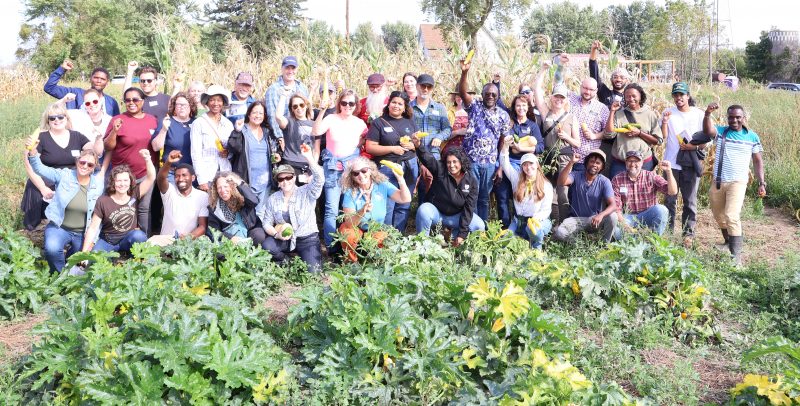
Lawmakers and farmers posed for a photo after a tour of Farmland Produce near Rochester.
Category: News Releases
Tags: community based food systems • emerging farmers • Farm Aid • Moses Momanyi • Shea-Lynn Ramthun • soil health • State Innovation Exchange • state policy

Contact

Brian DeVore, LSP, e-mail, 612-816-9342

Photo Available

For a photo of the SIX farm tour, contact LSP’s Brian DeVore via e-mail

Upcoming Events

×

November 2025

Thursday November 13

8:30 am – 1:00 pm
Women in Conservation Northern Network Gathering: Stories from the Field
Thursday November 13
8:30 am – 1:00 pm
Women in Conservation Northern Network Gathering: Stories from the Field
Bigwood Event Center, 921 Western Ave, Fergus Falls, MN 56537, USA

Join Minnesota Women in Conservation and Renewing the Countryside for a relaxed, creative, restorative, and interactive day of networking and learning with fellow women conservation professionals. Breakfast and lunch are included at the lovely Bigwood Event Center. Cost is $25. 
 
For more information and to register, click here. 
 
Please reach out to burke@rtcinfo.org for information on scholarships before registering.

Friday November 14

9:00 am – 3:00 pm
Scaling Up Soil Health Strategies Bus Tour
Friday November 14
9:00 am – 3:00 pm
Scaling Up Soil Health Strategies Bus Tour
Leatherdale Equine Center, 1801 Dudley Ave, St Paul, MN 55108, USA

Visit three farms near Northfield, Minn., to explore soil health at a larger scale. Learn about mechanized cover cropping, reduced tillage, erosion control, and using perennials and pollinator strips.
 
This is the third tour in a three-part soil health bus tour series. Participants can sign up for just one, two, or all three tours. Register at https://z.umn.edu/vegetablebustours. The cost is $15 (flat fee, covers 1, 2, or 3 tours). There are more details in the attached flyer.

Wednesday November 19

12:15 pm – 1:45 pm
We Can Do Better Book Discussion at Iowa Nature Summit
Wednesday November 19
12:15 pm – 1:45 pm
We Can Do Better Book Discussion at Iowa Nature Summit
Olmsted Center, 2875 University Ave, Des Moines, IA 50311, USA

The Johnson Center for Land Stewardship Policy is excited to share that one of our its primary pillars of work — a published collection of Paul Johnson’s writings —  is set for release on Oct. 2.  The book features a brief biography and a discussion of Paul’s ideas within the historical and future contexts of private lands conservation. For details on We Can Do Better: Collected Writings on Land, Conservation, and Public Policy click here.

Curt Meine will speak about the book during the 12:15 p.m.-1:30 p.m. luncheon at the Iowa Nature Summit on Nov 19. 

Thursday November 20

All Day
Give to the Max Day
Thursday November 20
Give to the Max Day
Online

Give to the Max Day is coming up on Thursday, November 20. But you don’t have to wait until Give to the Max Day to make your gift to LSP. Any contribution made through the GiveMN portal, now until November 20, will count toward our $15,000 goal and is fully tax-deductible!

This Give to the Max Day season, the Land Stewardship Project is gearing up to share the stories of resilience, change, and action that LSP members are a part of in their towns and on their farms. 

 We’re up against some pretty overwhelming challenges these days and now is the time for turning hope into action and coming together over common goals. One way to do that is to support the work of building the farm and food system we want and need for the future.

We know the future of farming is diverse and innovative, and should be set up to reward stewardship-minded farmers for the solutions they bring to some of our biggest challenges like soil health, clean water, and a changing climate. 

Bringing that vision for the future into reality requires taking on the biggest of the big in the agriculture industry, supporting the next generation of farmers, and reforming farm policies, as well as developing new, reliable, fair markets for all farmers that support conservation, healthy food, and local prosperity. 

That’s a big mountain to climb and we need people power to make it happen. LSP brings farmers, rural, urban, and suburban people together to take action around our common goal of a fair and sustainable farm and food system in this country.

Give to the Max Day is a fun and collective way to get into the giving spirit across the entire state of Minnesota. Thank you for being part of LSP’s work to build a better future for our farm and food system.  Please join, renew, or make a special gift to LSP as part of Give to the Max Day this year.

Saturday November 22

1:00 pm – 4:00 pm
Farm Scale Deep Winter Greenhouse Open House
Saturday November 22
1:00 pm – 4:00 pm
Farm Scale Deep Winter Greenhouse Open House
Tintah Beach Farm, Thief River Falls, MN

Please join Marcus Langevin from Tintah Beach Farm and the University of Minnesota at an open house and ribbon cutting celebrating the completion of the farm scale deep winter greenhouse prototype on Nov. 22, from 1 p.m.-4 p.m. 

This new deep winter greenhouse design allows farmers in cold climates to grow crops for sale to their customers throughout the winter months. The heavily insulated greenhouse utilizes a steeply sloped south-facing glazing wall to capture solar heat which is stored in an underground soil thermal mass where it is available to heat the greenhouse at night when the outside temperatures drop. 

The new energy efficient greenhouse was designed to suit the needs of small and medium scale vegetable farmers. It is larger, cheaper per square foot to construct than previous designs, and is simple enough that farmers with minimal construction experience can build it themselves. Deep winter greenhouses like these allow farmers the ability to grow market crops year-round, thereby increasing their yearly revenues and allowing Minnesotans year-round access to healthy, fresh, locally grown produce. 

Registration: This event is free to attend, but registration is required at z.umn.edu/TintahBeachOpenHouse. Please register by November 15.

Download farm scale deep winter greenhouse building documents. This farm scale deep winter greenhouse design is available for free download from the UMN Extension RSDP’s deep winter greenhouse website. 

This work is made possible by University of Minnesota Extension; College of Food, Agriculture and Natural Resource Sciences (CFANS); College of Design Center for Sustainable Building Research (CSBR); and the Agriculture Research, Education, Extension and Technology Transfer Program (AGREETT). 

View Full Calendar

Recent Posts

  • Land Line: Corn Belt Cancer, Integrating Crops & Livestock, Trade Turmoil, Farmland Access, Erosion, SNAP, Microbe Memory October 31, 2025
  •  ‘Big Ag, Big Problems’ Panel to Feature 2 Experts on Consolidation Nov. 4 in Lanesboro October 27, 2025
  • Reflections from LSP’s 2025 Summer Events Season October 24, 2025
  • Another Farm Crisis Looms, but it’s Not too Late to Take Action October 23, 2025
  • Tell Congress: Support Market Access for Farmers by Funding Local Food Purchasing October 22, 2025

Montevideo

111 North First Street
Montevideo, MN 56265

(320) 269-2105

Lewiston

180 E. Main Street
Lewiston, MN 55952

(507) 523-3366

Minneapolis

821 E. 35th Street #200
Minneapolis, MN 55407

(612) 722-6377

  • Privacy Policy

Copyright © 2025 Land Stewardship Project. All rights reserved.

https://landstewardshipproject.org/area-farmers-share-land-access-marketing-concerns-with-legislators-from-9-states