
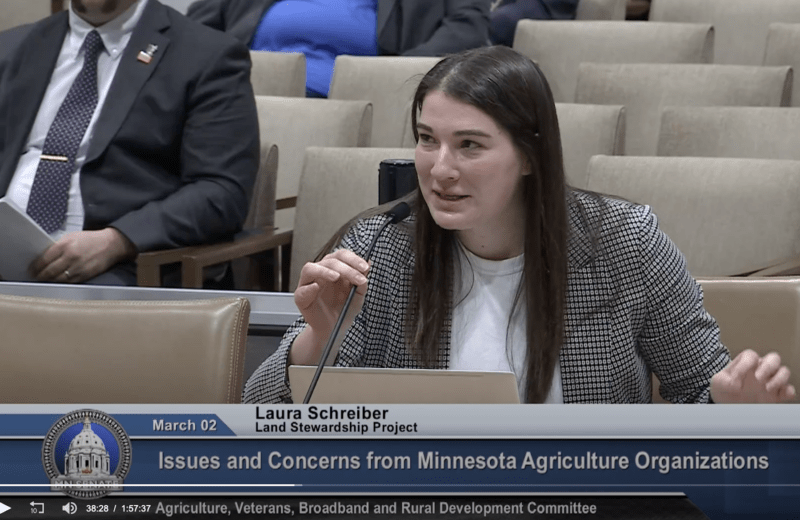
Note: On March 2, Minnesota Senate Agriculture Committee Chair Aric Putnam invited agricultural groups to share insights on their members’ concerns, frustrations, and current work in a special “State of Agriculture” hearing at the capitol. Below is the testimony shared by Laura Schreiber, the Land Stewardship Project’s government relations director, with the Agriculture, Veterans, Broadband, and Rural Development Committee. To watch a recording of Schreiber’s testimony, click here (her testimony starts at the 38-minute mark).
Senator Putnam, committee members, thank you for the opportunity to share today and for holding this hearing. My name is Laura Schreiber, I am the government relations director for the Land Stewardship Project. We are a grassroots, member-led nonprofit working to create a more sustainable and just farm and food system that works for both people and the land.
As you have heard today and will continue to hear, right now farmers and our communities at large are facing an extreme level of volatility, and uncertainty — farmers and communities across the board are really struggling right now.
A few weeks ago, I traveled to Washington, D.C., with an LSP member and row-crop farmer from Hutchinson, Minn., Adam Griebie, along with partners from Renewing the Countryside, the Institute for Agriculture and Trade Policy, and Marbleseed, as well as Ellen Gardner a farmer from Spring Grove, Minn., who raises pastured poultry. We were there to continue to advocate for the passage of a Farm Bill —which we are well overdue for — and share what impacts the current federal climate and the happenings in Minnesota have had on agriculture.
Their stories were stark and I want to share them with you today. Ellen has customers in Rochester and the Twin Cities— she sells at the Northeast Farmers’ Market — and her customers have been sheltering in place due to the presence of ICE agents; they had been staying home for weeks. After hearing that she has customers who needed help getting food, Ellen sent one e-mail to her list and was able to raise $4,000 and provide chicken and turkey to people in need. I know we have heard these types of stories from all across Minnesota, and I think it is important we continue to share them. She shared that a mother resorted to washing disposable diapers because they were so scared to leave their home. We have farmers who are not sure if their skilled H-2A visa workers will be able to come back to the farm this year, leaving them struggling to figure out labor in an already stressful climate. BIPOC farmers are concerned about sustaining their farm businesses and are organizing rapid response and mutual aid.
Since November 2024, LSP has been in deep partnership with COPAL, a Latine power-building organization that has members across Minnesota. In 2025, COPAL launched the Immigrant Defense Network and LSP has been co-facilitating its rural initiative. Our role over the past year has been connecting, listening, and community-building. We are connecting people in rural places to know their rights, listening to understand how rural communities are being impacted and what they need, and bringing people to be together in community. LSP has trained more than 550 people in “Know Your Rights” sessions, and with partners have created a network of support throughout the state. Together, we have supported food deliveries, rides and errands, mutual aid financial funds, local business support, and more.
It was important for us to get involved and support this work because we cannot have a truly just and sustainable farm and food system without supporting and recognizing the critical role that immigrants play in feeding our communities. And not only immigrants, but Black, Indigenous and people of color communities that have also been under attack during Operation Metro Surge. The future of agriculture demands that we have more farmers on the land, from all backgrounds and races. That is why Minnesota must continue to play a pivotal role in supporting the next generation of farmers through support of programs like the Farmland Down Payment Assistance Program, as well as via staffing and supporting the Emerging Farmers Office, and continuing to explore more ways to help farmers secure land and the infrastructure and equipment needed to have a successful operation.
I’d like to pivot now: I had mentioned that row crop farmer Adam Griebie was also in D.C. with me, and I want to share what he’s been experiencing. Right now, as you all know, farmers are facing an intense amount of uncertainty as a result of export market volatility. They are facing the continuing rise of input prices, and are feeling the staffing shortages at the USDA’s Farm Service Agency and Natural Resources Conservation Service. To put into context, nationwide, the NRCS has lost at least 2,400 employees since January 2025 due to the Trump administration’s efforts to reduce the federal workforce. Adam now has to travel two counties over to talk with FSA and NRCS staff about his contracts. We have farmers who had gaps or delays, like Adam, in receiving their payments for conservation program payments and last year, of course, a number of federal grants and contracts were cancelled; farmers are still feeling the effects of those cancellations. Minnesota was set to receive over $17 million from the federal government for Farm to School and Local Food Purchase Assistance programs. You all as a committee stepped in and created a state LFPA program and increased the funding for Farm to School, but we know the need is much greater than current funding levels.
For commodity growers, there is $11 billion in the federal farmer bridge loan assistance payments that are now open and $1 million available for specialty crop growers, but these are Band-Aid solutions. Our current farming system is not working for folks across the board; it’s time for some transformational changes. Part of that requires growing out our local markets and processing infrastructure.
At LSP, we have long been working to develop more local markets, and in the last two years especially we have seen a great interest in developing small-grains markets in Minnesota and the Midwest, providing an alternative to the commodity export system. Oats and small grains are attractive to farmers who are seeking water quality benefits and a reduction in the use of expensive inputs. Adding a third crop to the rotation also produces soil health benefits while providing food for their communities. This year in Rochester and last year in Albert Lea LSP held our Winter Soil Health Workshops, which focused on building out local markets and the processing needed to support crops that are outside the dominant corn-soybean rotation.
We had more than 100 farmers come to Rochester and more than 200 come to Albert Lea for these workshops, which featured leaders in the field such as farmers Martin Larsen and Landon Plagge. There is an appetite from farmers to diversify what is on the landscape while creating fair, local market that pay a good price. A new processing facility, Green Acres Milling, is being built in Albert Lea and is exactly the type of investment we need. The farmer organizing and support that went into this endeavor is awesome.
We know farmers are innovators and resilient, they are already working on solutions. Minnesota needs to continue to be a leader and supporter in building out the infrastructure and markets for these crops. We are seeing what consolidated markets have done to farmers, and it’s not great; we need to move away from this dynamic and support new, alternative markets.
I want to address another area of concern for our members and that is animal agriculture. A common thread that I hear through many of my conversations with LSP staff and members is the impact that agricultural consolidation and concentration has on both farmers and our rural communities. For eample, Minnesota has lost 528 dairy farms in the past four years; 1,987 since 2017. Our state is losing dairy farms due to inconsistent and often below cost-of-production milk prices. This disaster in price is largely caused by massive dairy operations being able to glut the milk market with overproduction, making it hard for smaller family farms to compete.
I raise this today as we are hearing concerns about a planned dairy expansion out in Morris, Minn., that will involve expanding one facility from 7,800 dairy cattle to 18,855. There are concerns about what this move means for Minnesota dairy farmers who are already struggling with consolidation of the market. Such a facility of unprecedented scale would have major negative impacts not only on rural economies but the environment as well, with water usage alone being of astronomical proportions.
Last week, in the House Environment hearing, we heard from staff at the Department of Natural Resources that there are already concerns in western Minnesota when it comes to groundwater and aquifer capacity; not all those aquifers are even mapped. The DNR staffers shared that they are already concerned about water capacity in the region, and now data centers and larger dairy farms are adding to those fears. A bill that was brought before this committee by Senator Putnam would require an Environmental Impact Statement for any new projects of 10,000 animal units or more to better understand the potential environmental, economic, and social impacts of a proposed project and identify ways to minimize those impacts. This new proposal near Morris would be over 20,000 animal units. Members, I think it is critical we fully understand the potential risks of such an unprecedented facility.
To end, what is currently happening in D.C. has changed the equilibrium of our federal farm policy — we have a food pyramid that was literally flipped on its head and we have seen a level of violence and disruption brought to Minnesota that will have repercussions for years to come. I want to leave this committee with a question: how might Minnesota be a leader in supporting the next generation of farmers, creating fair, local markets that feed people and support a type of agriculture that keeps and welcomes new people in our rural towns and communities, and has the health of our people and the land guiding it?
For more information on LSP’s priorities for the 2026 session of the Minnesota Legislature, check out this blog. You can have an opportunity to talk directly to lawmakers during LSP’s Family Farm Breakfast and Lobby Day, which is being held Wednesday, March 11. You can register for that event here. Details on LSP virtual lobby trainings are available here.