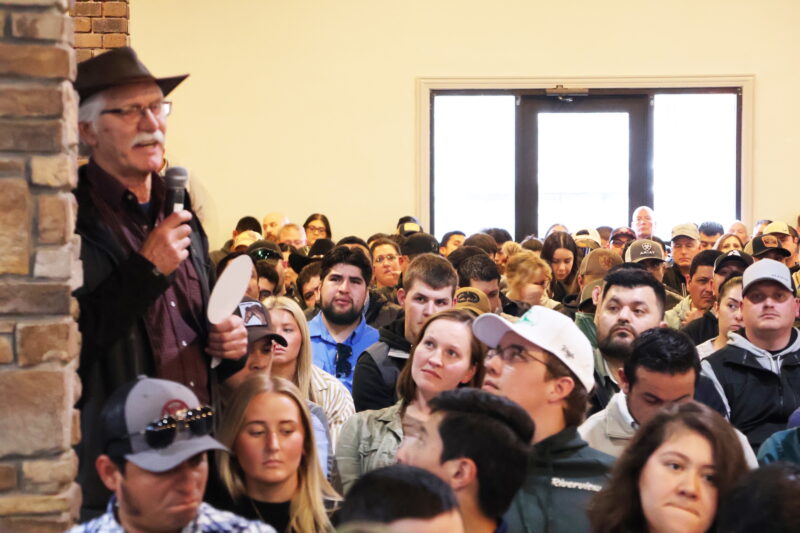
When debating a controversial topic in public, a well-proven trick is to never ask a question you don’t already have the answer to. That technique was on full display Tuesday evening in a packed-to-the-gills meeting held at Old No. 1 Bar & Grill in Morris, Minn.
The topic at hand was a proposal by Riverview LLP to create the largest livestock operation in the state — by a lot. Riverview, one of the biggest milk producers in the nation, wants to expand an existing concentrated animal feeding operation (CAFO) in Stevens County to 18,855 dairy cattle, resulting in 26,397 animal units housed in one location. It would be nearly double the size of the next largest livestock operation in Minnesota in terms of animal units and it would be more than 60 times the size of the average Minnesota dairy, which had fewer than 280 cows in 2025.
The proposal is currently undergoing a Minnesota Pollution Control Agency (MPCA) environmental review process; public comments on the project are due Thursday, May 7, and the MPCA’s commissioner, Katrina Kessler, has until mid-June to decide whether to issue a permit or whether a more extensive review, called an environmental impact statement (EIS), is in order.
According to a permit filed with the MPCA, the proposed project would be allowed to pump up to 226 million gallons of water per year from an off-site well. The so-called “West River Dairy Expansion” would have liquid manure storage encompassing 250 million gallons of waste and would require 13,200 acres of farmland for manure application. The expanded facility would sit within five miles of eight different protected waterfowl and wildlife production areas and is part of the Pomme de Terre River watershed, just 25 miles from its confluence with the Minnesota River. The MPCA already lists as impaired the two closest waterways to the facility, the Pomme de Terre River and an unnamed creek.
That this unprecedented facility would be operating in the Pomme de Terre watershed is important to note. According to a 2019 research paper written by Dara Meredith Fedrow, the Pomme de Terre was the most heavily used watershed for hog and dairy CAFO livestock watering in 2017. And, according to the paper’s examination of MPCA and Minnesota Department of Agriculture data, at that time Riverview’s cows consumed one-quarter of the water used by all hog and dairy CAFOs in the state.
So, it’s no surprise that local residents have concerns about a significant expansion of Riverview’s hoof print in their backyard. But it’s not just water quality and quantity that’s at issue. As the Land Stewardship Project makes clear in a white paper we released last week, Riverview’s seemingly unlimited appetite for growth has major repercussions for our agricultural economy. The firm now owns 15 dairy CAFOs, totaling 133,000 milk cows, in Minnesota alone, and accounts for nearly a third of the state’s entire dairy herd (it’s been reported Riverview has anywhere from 13 to 16 milking operations in Minnesota; however, LSP recently confirmed with the MPCA it’s actually 15). Riverview also has a major presence in North Dakota, South Dakota, Nebraska, New Mexico, and Arizona. In 2025 alone, Riverview submitted applications to construct and operate three dairy facilities in the Dakotas. Two of these operations — the 12,500-head Abercrombie Dairy and the 25,000-head Herberg Dairy — would quadruple the number of dairy cows in North Dakota.
Meanwhile, a state like Minnesota has lost nearly 75% of its dairy farms over the past two decades as small and medium-sized operations get pushed out of the market by the Riverviews of the world. While scanning Minnesota dairy operation stats recently, LSP policy director Sean Carroll came upon a “fun” fact: because Riverview represents practically all dairy cattle in several areas, for those counties the USDA Agriculture Census now has a notation in the “number of cows” area that says simply: “Withheld to avoid disclosing data for individual farms.” That’s because all the dairy cows are Riverview cows in those counties.
As Renville County dairy farmer James Kanne made clear Tuesday, adding this many cows to one operation comes at a devastating time for the Minnesota dairy industry, and that’s bad news for our rural economies. It’s been well documented that having several small and medium-sized dairies in a community is a major benefit to Main Street economies, given their reliance on numerous services.
An EIS would examine not only alternatives to such an extreme expansion, but the sociological and economic impacts it could have. That’s why LSP is joining farmers like Kanne in calling for such a study before the Riverview proposal gets a green light. (You can sign LSP’s MPCA petition calling for an EIS here.)
“I’m concerned about dairy farms across the state,” said Kanne at the Morris meeting. “If we have something of this scale, why doesn’t it get an EIS?”
Unfortunately, the farmer had to ask that question while standing half-hidden behind a stone pillar on one side of the event space at Old No. 1. That’s because there was no seating available in the room, which officially accommodates 300 people, but which on this particular night was holding many more. Even after pushing the seating capacity by allowing people like Kanne to stand along the walls, MPCA officials had to turn dozens of people away at the door before the 6 p.m. start. LSP organizer Matthew Sheets estimates over 100 people didn’t make it inside. That’s because Riverview had gotten its supporters, including many employees, to arrive early and occupy virtually every seat in the house. Well over an hour before the meeting’s scheduled start, Riverview’s people were milling around in the parking lot.
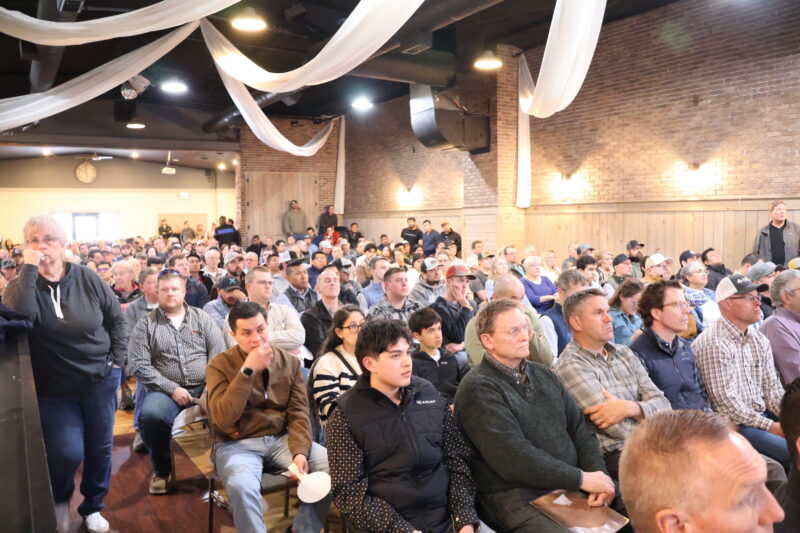
And these folks were well-prepped to promote Riverview, the way it does business, and this particular proposal. The meeting started out with short presentations by MPCA feedlot officials on what the proposal consists of and how environmental reviews like this are conducted. The officials made it clear that having a public meeting like this was not required under environmental review rules, but they decided to convene one as a result of demands from members of the public. As of this morning, over 1,000 comments had been submitted to the MPCA’s website on Riverview’s draft Environmental Assessment Worksheet (EAW). The deadline for submitting comments, which was originally March 12, had to be extended to May 7 as a result of immense interest in this unprecedented expansion.
After the MPCA’s PowerPoint presentations, the room was opened up for questions, and soon a pattern emerged: someone who has “long worked with” or “long known” Riverview’s owners would first thank the MPCA officials for holding the meeting, then point out how they had, for example, benefited from the fertility one of its operations had provided their crop ground via manure applications. Their “questions” were invariably on topics that had already been covered in the MPCA officials’ presentations. Does the permit require covers on the manure storage facilities? Will wastewater be re-used? Will Riverview seed cover crops on land that receives manure applications? Who can order an EIS? Will rainwater be stored? Will the nutrient content of the manure be tested? What’s the purpose of this meeting? Why does the process take so long?
At one point, an environmental consultant who assisted Riverview in its EAW process — she had somehow snagged a front row seat — used the bulk of her “question” time to basically explain the environmental review process that had already been described by MPCA officials at the outset of the meeting. Later, another consultant who assisted in the environmental review — he also happened to have a front row seat — prefaced his “question” by describing how water would be collected and saved, and how manure would be stored and applied. You guessed it: that was all covered in the MPCA presentations. He then asked, “Can you confirm if in-place regulatory authority will be enforced?” Again, that had been covered, but maybe the acoustics weren’t as good in the front row and he didn’t hear it the first time around — or see it in the PowerPoint presentations that were flashed on a giant screen.
The three MPCA officials, along with one Department of Natural Resources staffer, patiently fielded these questions, often beginning their answers with, “As we said in our presentation…”
Even questions that weren’t basically rewordings of the MPCA’s PowerPoints served as a way to burnish Riverview’s standing in the community. For example, recently the PR-minded dairy giant donated $1 million to Minnesota 4-H to help them revamp their building at the State Fairgrounds. One statement/question: “The generosity of Riverview is second to none in our community…When evaluating a project like this, is there any consideration given to the generous amount Riverview has willingly given back to the community?” Answer: No, that’s not really something an environmental review considers.
The MPCA officials made it clear that nothing said during Tuesday’s meeting would be made part of the official environmental review comments — people would still need to submit those officially through the agency’s website. So what was the point of basically repeating points that had already been covered? Were the questioners asleep during the first 30 minutes of the meeting?
Part of the strategy may have been to simply make Riverview look good for the media present, which included a reporter for Agweek and a columnist for the Minnesota Star Tribune. But even more importantly, this form of redundant public discourse served to run out the clock on a public meeting that, all told, allowed around 90 minutes for questions. The more time devoted to fielding questions (many were broached by folks who have an economic interest in seeing the expansion go forward) that had mostly already been answered, the less time there was for folks who had honest-to-goodness queries that they didn’t already have answers to. What happens if there’s a major emergency such as a manure spill? What does the community do when drought hits an area that is a top consumer of CAFO water? What about major disease outbreaks? Will water runoff from the dairy be tested? What impact will this have on small and medium-sized farms?
Could the meeting have been run in a way that gave room for more authentic questions to be asked? Each questioner was limited to two minutes, which was a good start. But the MPCA could have given more community voices a chance by holding the meeting in a bigger venue. The University of Minnesota-Morris, which sits just a few blocks from Old No. 1, comes to mind.
Fortunately, a few local folks who have concerns about the proposed project were able to squeeze into the room and ask questions that need answered. Besides Kanne, there was Kathy DeBuhr, whose farming family was part of the Riverview fight back in 2014 that led Big Ag interests such as the Minnesota AgriGrowth Council to pressure state legislators to eliminate the MPCA Citizens’ Board. DeBuhr had a question about how the size of the dairy cows impacted manure output. Anne Schwagerl, a crop and livestock farmer and vice-president of the Minnesota Farmers Union, raised an important question about what will be done in the case of a zoonotic disease outbreak or a natural disaster.
Willis Mattison, who spent 28 years at the MPCA, during which he worked on feedlot permits, asked why a dairy like this could still meet the MPCA’s permit requirements when groundwater monitoring is not required and design specifications allow for 100 gallons of manure per acre, per day, to leak out of the bottom of lagoons. Another woman asked whether a moratorium should be placed on issuing permits for large CAFOs until the conclusion of the current Minnesota legislative session, where a bill automatically requiring an EIS for the state’s largest livestock operations is being considered.
Kudos to those handful of brave folks who spoke up in a room full of pro-Riverviewers. Judging by the Facebook comments that popped up afterwards, their concerns are shared by a ton of people in the community who didn’t get a chance to get into the room or otherwise participate in the meeting. Another result of flooding the zone with your allies and occupying every seat in the house is that it intimidates anyone who may walk in and have a different point of view. In the end, Tuesday’s meeting was a reminder of the importance of public engagement, even if it requires wading into less-than-inviting waters.
Matthew Sheets, a lifelong Morris resident and LSP organizer, was one of those folks who was able to make his voice heard during the meeting. As he says in a video shot by my colleague Heather Benson, “I know this is my community, too, and this is a conversation I’m entitled to be involved in just as much as everybody that packed that room. I hope that other people know that too, that regardless of how much money, how much power, how much property a big operation like Riverview owns in the community, that doesn’t give them more of a right to have a say on what is happening on this operation or anything in the community. Everybody has that right.”
LSP managing editor Brian DeVore can be reached via e-mail.