
Periodically, I get this question from our members, allies, and the general public: Why is the Land Stewardship Project involved in supporting the immigrant community? What does standing with allied organizations as they speak out against unfair treatment of immigrants — documented and undocumented — have to do with our mission of fostering an ethic of stewardship for farmland, promoting sustainable agriculture, and developing healthy communities? It’s a question I welcome, one that is particularly relevant at a time when immigration is at the epicenter of a white-hot political debate.
The short answer is that this is a moral imperative directly connected to our mission. As our current long-range plan makes clear, we center our work around shared values of stewardship, justice, fairness, democracy, health, and community. The kind of world we are trying to create is one in which all people — no matter their age, race, gender, or immigration status — can live safe and productive lives and contribute to their communities. Another way to say it is that we will not have a truly sustainable farm and food system unless it’s sustainable for everyone.
But such an answer leaves a lot of room for interpretation, and misinterpretation. So, let’s dig a little deeper into why LSP sees this issue as a priority if we are to be successful in our overall work.
Shared Interests/Threats
As LSP members know well, rural voices have been marginalized and, in many cases, outright dismissed in the political process, and we’re seeing the results of that in public policy that has emptied our Main Streets, shuttered our schools, consolidated the food and farm system, denied farmers access to a fair and open market, eroded our soil, and dirtied our water. The same force that threatens the demise of small and medium-sized farms — a government/business model that prioritizes corporate profits above all else — also threatens the immigrant community. For example, concentrated animal feeding operations (CAFOs) and large-scale meatpackers depend on an immigrant workforce that is constantly in danger of being deported, and thus lacks the stability required to organize and demand better wages and safer working conditions. Those same CAFOs and packers are pushing small and medium-sized farmers out of business at a record pace.
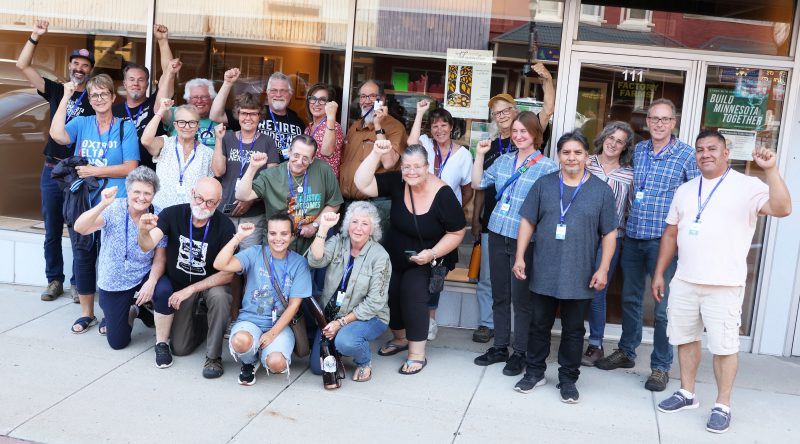
What I’m saying is that farmers who are resisting the coercive model of corporate ag interests are natural allies with immigrant residents of our rural communities. Dividing us is a strategy of corporate and political interests that want to minimize rural voices. By standing with our immigrant neighbors today, we’re planting the seeds for greater rural power tomorrow.
Economic Resiliency of Rural Communities
Studies and real-world experience show that rural communities benefit from the entrepreneurial spirit of new immigrants, whether they be involved with farming itself or an ancillary business that supports agriculture, such as small-scale meat processing, equipment repair, or a grocery store. As Ryan Perez, the director of organizing for COPAL (Communities Organizing Latine Power and Action), explains in episode 373 of LSP’s Ear to the Ground podcast, immigrants have long been a vital part of the food system in the Upper Midwest. The early sugar beet industry started employing many Latino immigrants in the 1920s, and in the 1940s, Mexican laborers came to the region under the “Bracero” program to ease the shortage of agricultural workers. Many of the recent immigrants to the region come from agrarian backgrounds in their home country and have an intense interest in food production. Relyndis Tegomoh, who immigrated to Minnesota from Cameroon, says in our most recent farm transition profile that, “Just one day of farming is so satisfying that it makes up for 25 years of doing something I didn’t like.”
That’s why it’s exciting to see that the Minnesota Farmers Union’s “Solving the Local Meat Processing Bottleneck Project” is reaching out to members of the Hispanic community who may be interested in running a local meat processing business. In recent years, LSP’s Farm Beginnings course, as well as our other educational workshops, have been attracting an increasing number of people of color, including new immigrants. LSP is working with our allies to figure out how to create a pathway from being a food and farming system worker, to a full-blown entrepreneur. Rodrigo Cala, who, before starting a vegetable and livestock operation in western Wisconsin immigrated here from Mexico, encouraged participants in a recent LSP Spanish-language workshop on land access to look beyond being mere widgets in the food system. He says, “If they are the people who do the work, why aren’t they the people who have the opportunity to handle their own business?”
It’s an All-Hands-On-Deck Moment
If we are to rebuild our dysfunctional farm and food system, we need to create opportunities for everyone to have a chance to participate in creating a more sustainable future. A regenerative farming system requires more eyes to the acre, so we can’t afford to exclude people who are our neighbors, even if they don’t look like us or talk like us.
What Are We Doing?
LSP is involved with supporting our immigrant neighbors in a couple of ways. On the practical side, through our Farm Beginnings course and Spanish-language “Land Access: Are You Ready?” workshops, as well as our support of the annual Emerging Farmers Conference, we are working to provide these folks an opportunity to help us build a vibrant farm and food system from the ground up.
But teaching someone how to do holistic business planning does little good if they are being scapegoated and in general made unwelcome in the community. That’s why we are also standing with our allies as the immigrant community comes under attack by the federal government, and U.S. Immigration and Customs Enforcement agents in particular. Often-violent immigration raids that violate Constitutional rights, separate families, and vilify certain members of our community sow the kind of fear and mistrust that undermines any efforts to create a fair, just farm and food system.
LSP is working closely with partners who are on the ground in immigrant communities by taking part as an active member of the Immigrant Defense Network (IDN), a partnership of more than 90 Minnesota groups formed to protect the rights of immigrants, and to provide trusted information and education in communities throughout Minnesota. As part of our involvement with IDN, we are co-facilitating the coalition’s Greater Minnesota caucus, and I am serving on the Network’s steering committee.
It’s also important to note that IDN is a network, not a monolith. IDN and some network members will engage in tactics that we steer clear of, and vice versa. What holds us together is a belief that our immigrant neighbors strengthen and enrich Minnesota’s communities, and that we are stronger together.
Through our connection to IDN and partnership with COPAL, we have been holding constitutional observer trainings in rural communities throughout the state (see article below) for our members and allies, and taking part in pro-immigrant press conferences and other events at the Minnesota state capitol. We have also created a “Community Care” web page that provides resources for immigrants, as well as allies and farmers who may be employing them.
Get to Know Your Neighbor
In the end, this is all about making connections with our neighbors, no matter their country of origin. In these politically-charged times, a lot of us feel isolated. Are there neighbors you feel uncomfortable saying hello to or inviting over for a meal? During the past two summers, LSP has partnered with COPAL to hold events on southeastern farms that bring together white and Latino folks over good food and some good old-fashioned fun.

Maybe we can use this moment of fear and anxiety as an opportunity to reach out, even if language barriers and skin color at first make that interaction uncomfortable. As Perez says, “Get to know people and don’t be a stranger. If you know your people around you, you’re going to be in a better place in your community.”
If you have questions about the Land Stewardship Project’s involvement with standing up for our immigrant neighbors, feel free to contact me.
LSP executive director Scott Elkins can be reached at selkins@landstewardshipproject.org or 612-722-6377.
♦ ♦ ♦
Bearing Witness
In an Era of Legal Confusion, Exposing Civil Rights Violations to the Light of Day
At the outset of a workshop held on an August evening in the western Minnesota community of Montevideo, Nick Olson attempted to provide some assurances to the over two-dozen people gathered in the Land Stewardship Project’s office on Main Street. “It’s okay to feel nervous. It’s okay to feel out of your comfort zone,” he said.
What Olson, an LSP organizer, was about to talk about was how to stand up for the rights of undocumented immigrants who are being snatched off the streets, out of their homes, and from their places of employment and imprisoned by agents working for U.S. Immigration and Customs Enforcement (ICE). As has been well-documented, this flurry of activity has sometimes been characterized by the suspension of basic constitutional rights, such as the right to be brought before a judge to determine if someone’s detention is legally valid. Immigrants with no criminal records are being labeled as violent offenders and shipped off to detention centers such as the so-called “Alligator Alcatraz” in Florida, or deported to countries they are not native to. The ICE agents are often masked and recordings show them refusing to identify their official capacity.
It turns out undocumented immigrants, along with everyone else residing in this country, are guaranteed certain civil rights when being arrested, including the right to seek legal counsel, the right to remain silent and not sign documents, and the right to refuse entry into one’s home by law enforcement without a warrant signed by a judge.
In recent months, LSP has been partnering with the Immigrant Defense Network to offer rural residents trainings as “constitutional observers.” (The training in Montevideo was co-sponsored by CURE.) Developed by Communities Organizing Latine Power and Action (COPAL) and South Dakota Voices for Peace, these trainings provide participants the tools to observe and document law enforcement interactions with immigrants and to inform the detainees of their civil rights during the interactions, as well as to provide them resources such as contact information for legal services.
At the Montevideo workshop, several of the rural residents gathered said they were seeking the training because they were concerned about how ICE activities threatened their immigrant neighbors, friends, and co-workers.
“I’m just sickened by what’s going on — I have friends from Mexico,” said a woman whose family raises corn and soybeans in the area.
Serving as a constitutional observer (see sidebar below) does not make someone an expert on the law who can provide legal advice. And it does not involve obstructing justice or otherwise participating in civil disobedience. Rather, it’s a way to be a practitioner of a “civil initiative,” as the Immigrant Defense Network puts it.
Olson acknowledged that recording an ICE action can be stressful; in some cases, ICE agents have reacted aggressively to observers. But he reminded training participants that as American citizens, they are less at risk than those being detained.
“We’re in times where this type of action is needed,” he said.
Besides the direct impact ICE’s aggressive campaign is having on detainees who are separated from loved ones with no notice, there is the atmosphere of “fear” it’s spawning. Such an environment threatens to instill a sense within the general public that all immigrants are a danger to society and thus enforcement actions that at times violate their civil rights are justified. Olson said it’s the job of all of us to resist that fear and to get to know our immigrant neighbors as fellow human beings rather than as faceless “villains.”
“Immigrants have stores on Main Street, go to church, have kids in our schools, are an active part of the community, and yet anti-immigrant folks continue to pound this message into us that we are supposed to be afraid of them,” said Olson. “How do we shift this narrative?”
For a copy of the Handbook for Constitutional Observers and information on being trained as a constitutional observer, see
immigrantdefensenetwork.org. These articles originally appeared in the No. 2, 2025, Land Stewardship Letter.