Land Stewardship Project

Land Stewardship Project
  • About Us
    • Our Mission
    • Long Range Plan
    • Staff Directory
    • Board of Directors
      • LSP Board Committees
    • LSP Steering Committees & Working Groups
    • Contact Us
    • Past LSP Projects
    • Employment & Volunteer Opportunities
    • LSP Publications
    • Financial Statements
  • The Latest
    • Community Care
    • Songs for the Soil
    • CSA Farm Directory
    • Upcoming Events
    • News
      • News Releases
      • Media Contacts
      • LSP in the News
    • Blog
    • Podcast
    • Land Stewardship Letter
    • LIVE-WIRE Sign-up
    • Myth Busters
    • Fact Sheets
    • Farm Crisis Resources
  • For Farmers & Landowners
    • Farmland Clearinghouse
    • New Farmers
      • Farm Beginnings Class
      • Journeyperson Course
      • Farm Dreams
      • Accessing Farmland
      • Farmland Clearinghouse
      • Beginning/Retiring Farmer Tax Credit
      • Beginning Farmer Profiles
      • Fresh Voices Podcast Series
    • Retiring Farmers & Landowners
      • Farmland Clearinghouse
      • Farm Transition Course 2026
      • Conservation Leases
      • Beginning/Retiring Farmer Tax Credit
      • Land Transition Tools
      • Transition Stories
    • Soil Health
      • Cover Crops
      • Grazing
      • No-till
      • Microbiology
      • Kernza
      • Soil Builders’ Network
      • Soil Builders’ E-Letters
      • Soil Health Steering Committee Members
      • Ear Dirt Soil Health Podcast Series
    • Cropping Systems Calculator
    • Conservation Leases
  • Creating Change
    • Community-Based Food Systems
      • Ear Bites Community-Based Food Podcast Series
    • Policy Campaigns
      • Soil Health & Climate Change
      • Healthcare
      • Factory Farms
        • Anti-Competitiveness & Price Gouging
      • Federal Policy
        • A Farm Bill For Us
      • State Policy
        • MN Farm, Food & Climate Funding
      • Developing Leadership
    • Justice & Stewardship
    • Organizational Stewardship
  • Get Involved
    • Your Membership Matters
    • Take Action!
    • Upcoming Events
    • Land Stewardship Action Fund
    • Connect with LSP
      • Stay Connected
      • Join, Donate, or Renew Today!
      • Shop
      • Employment & Volunteer Opportunities
      • Legacy Giving
    • Network with LSP Members
      • Farmland Clearinghouse
      • Soil Health
    • Farmland Clearinghouse
  • Join, Donate, or Renew Today!
  • Stay Connected
  • Contact Us
  • Shop
Search
More...

Factory Farms

Share

  • Facebook
  • Pinterest
  • email

Factory farms pose a serious threat to the health and well-being of rural communities. These large-scale industrial operations push family farmers off the land and put independent producers out of business. Local economies suffer as more and more land is consolidated into fewer and fewer hands. Factory farms also pose numerous environmental hazards — such as water pollution, noxious odors, and toxic air emissions — that greatly impact the health of nearby residents.
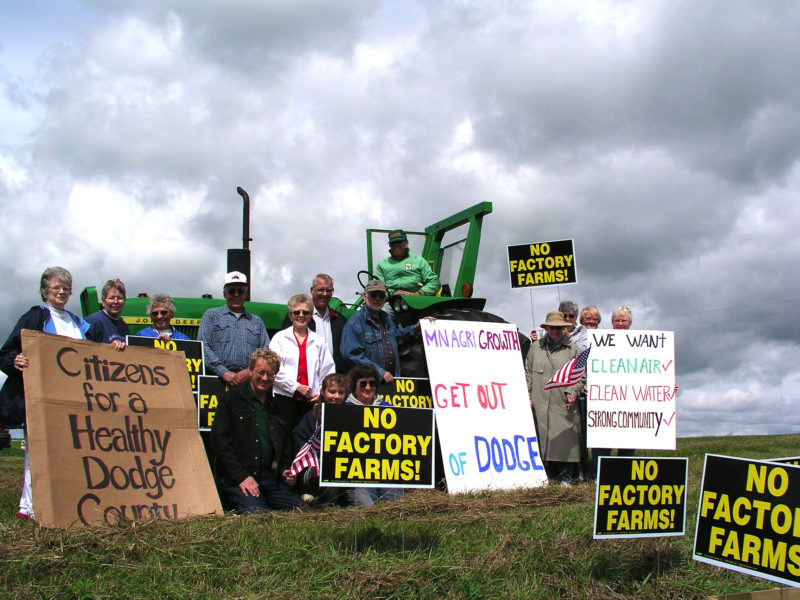
Yet, for decades, Land Stewardship Project members have used the power of local democracy to stop factory farms and build more vibrant rural communities. Through local control, townships and counties can block unwanted development, planning instead for projects that put the land and the people first.

LSP members have also worked at the state level for policies that hold factory farms accountable to higher standards. For example, members fought for policies that control hydrogen sulfide emissions and require factory farms to build covered, concrete lined basins for hog manure lagoons.

A recent blog on a factory farm fight LSP is currently involved in highlights what is at stake and what can be accomplished when community members make their voices heard.

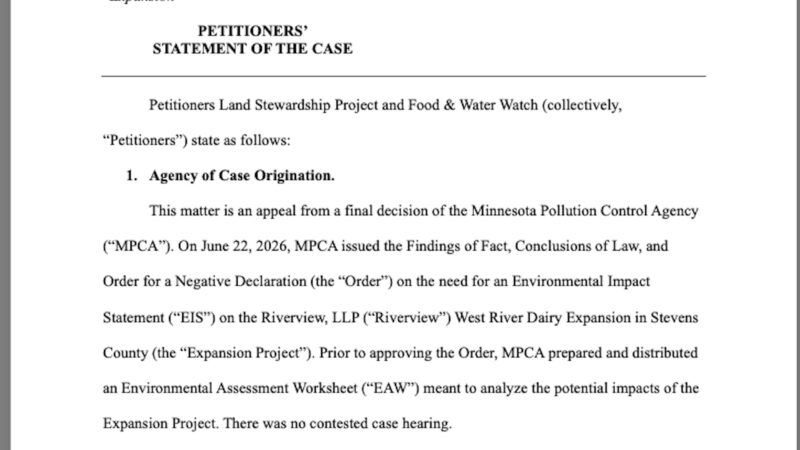
Click Here to Get Involved with
Factory Farm Organizing

Check Out Our Latest Action Alerts

LSP Powerline Story Center

Do you care about the future of your rural community? Do you want to be heard? Submit your story to LSP’s Powerline Story Center today!

The Winona County Factory Farm Fight

During the past three years, a dairy CAFO in Minnesota’s Winona County has made repeated, unsuccessful attempts to force through an unprecedented expansion that could have profound negative impacts on the community. A major reason that, despite backing from powerful interests, Daley Farm has not been successful in ignoring common sense rules is that Winona County residents have repeatedly made their voices heard. Their message is  clear: exceeding the animal unit cap is not good for the land, water, family farms, or rural communities. Check out this page for more on their fight.

Take the Pledge: Say NO to Factory Farms

In the Upper Midwest, we know how special the land that sustains us is. Factory farms jeopardizes not only the land itself but the communities that rely on it. They threaten the water and land with pollution, force small to mid-sized farmers out of business, and weaken local economies. Join other LSP members in taking the “No to Factory Farms” pledge today.

Factory Farm Resources

• Manual: Protecting Your Township From Unwanted Development: A Guide for MN Townships on Using the Interim Ordinance

• Myth #57: Abusive Work Conditions are ‘Essential’ to Heading off a Meat Famine

• Myth #60: CAFO Digesters are a Good Public Investment

• Myth #56: Mega-Dairies = Mega-Benefits for Rural Communities

• The Money Pit: How Minnesota Property Taxpayers are Subsidizing Factory Farms

• Fact Sheet: Factory Farming’s False Promise

• Fact Sheet: Hometown Factory Farm Fighting

• Fact Sheet: Hydrogen Sulfide and Factory Farms

• Fact Sheet: Writing a Letter to Your Newspaper: Putting pen to paper can be a powerful media tool

Related Posts

  • As Avian Flu Reemerges in Minnesota, White Paper Asks: Are Factory Farms the Victims or the Vectors?

    September 25, 2025

    LEWISTON, Minn. — Last week’s announcement that a deadly strain of avian influenza has reemerged in Minnesota raises renewed questions about the role large, industrialized…

    News Releases
    avian flu, CAFO, factory farm, healthy food, pandemic, pastured poultry, public health, regenerative livestock production
    As Avian Flu Reemerges in Minnesota, White Paper Asks: Are Factory Farms the Victims or the Vectors?
  •  ‘Big Ag, Big Problems’ Panel to Feature 2 Experts on Consolidation Nov. 4 in Lanesboro

    October 27, 2025

    LANESBORO, Minn. — The impacts on rural communities of unprecedented consolidation in agriculture and what local citizens can do to address this issue will be…

    News Releases
    ag consolidation, Austin Frerick, CAFO, federal ag policy, monopolies, rural economic development, Sonja Trom Eayrs
     ‘Big Ag, Big Problems’ Panel to Feature 2 Experts on Consolidation Nov. 4 in Lanesboro
  • Local Democracy Challenge Launched by LSP in MN

    October 1, 2025

    MONTEVIDEO, Minn. — The Land Stewardship Project (LSP) today launched an initiative in Minnesota communities aimed at increasing citizen engagement in the local democratic process…

    News Releases
    Land Stewardship Action, local democracy, Local Democracy Challenge, Minnesota Legislature, state policy
    Local Democracy Challenge Launched by LSP in MN

Contact:

Matthew Sheets, LSP organizer
e-mail, 612-767-9709

  • Creating Change
    • Community-Based Food Systems
      • Ear Bites Community-Based Food Podcast Series
    • Policy Campaigns
      • Soil Health & Climate Change
      • Healthcare
      • Factory Farms
        • Anti-Competitiveness & Price Gouging
      • Federal Policy
        • A Farm Bill For Us
      • State Policy
        • MN Farm, Food & Climate Funding
      • Developing Leadership
    • Justice & Stewardship
    • Organizational Stewardship
  • Join, Donate, or Renew
  • Building People Power

Upcoming Events

×

December 2025

Wednesday December 10

9:00 am – 11:30 am
Organic Fruit Growers Climate Resilience Workshop
Wednesday December 10
9:00 am – 11:30 am
Organic Fruit Growers Climate Resilience Workshop
Zoom online

In December and January, the Organic Fruit Growers Association is offering a series of climate resilience workshops. Workshop goals are to learn about the changing climate in our region and the expected impacts on fruit farmers and to select climate resilience practices which are suited to your farm’s goals and values. The outcome of the workshops will be a written climate resilience plan with actionable steps to make your farm more resilient to changing climate. 
 
Workshops will be led by University of Minnesota extension educators Katie Black and Madeline Wimmer and include times for farmer-to-farmer discussion. This series includes the following four meetings. Expect to spend an additional 4-10 hours outside the meetings developing your farm’s climate resilience plan:

  • Wednesday Dec. 3, 9 a.m.-11:30 a.m. (online via Zoom)
  • Wednesday, Dec. 10, 9 a.m.-11:30 a.m. (online via Zoom)
  • Monday, Dec. 22, discussion (online via Zoom — optional but encouraged)
  • Wednesday, Jan. 7, 10 a.m.-3 p.m. (in-person workshop in La Crosse, Wis. Lunch provided, and you can be reimbursed for mileage traveling to and from the meeting.)

For details and to register, click here. 

6:30 pm – 8:00 pm
How to Make Your Farm's Website Convert Visitors to Customers
Wednesday December 10
6:30 pm – 8:00 pm
How to Make Your Farm's Website Convert Visitors to Customers
Zoom Online

Join Sarah Carroll of Greener Pastures and Michelle M Sharp of Meet the Minnesota Makers in this 90-minute virtual workshop to learn about what your business website needs to tell its story, engage customers, and turn visits into real sales.

This workshop lays out the essential components of a user-friendly website for direct-to-consumer farms or food producers. No prior website skills are required.

Topics covered:

• How to make your products searchable by customers.

• What makes a compelling About Me page.

• The right balance of images to text.

• How to engage customers right from your home page.

• Incorporating FAQs.

Who this training is for:

This workshop is ideal for the farm or ag business that has launched an initial website that’s ready to upgrade or for the farm that has not yet created its own website. This workshop is both for farmers/food producers and ag ecosystem professionals that support farmers/food producers in their marketing and website efforts.

For details and to register, click here. 

Thursday December 18

All Day
MDA Urban Farm Conservation Mini-grant Deadline
Thursday December 18
MDA Urban Farm Conservation Mini-grant Deadline
MDA

A grant opportunity for urban farmers in Minnesota to receive up to $5,000 to make conservation-focused improvements is now open for applications.

The Minnesota Department of Agriculture (MDA) is once again offering an Urban Farm Conservation Mini-grant with approximately $100,000 available, thanks to funding from the USDA’s Natural Resources Conservation Service. This year the program has expanded eligibility.

Who is eligible:

  • Entities commercially farming in Minnesota, meaning they sell or donate at least $1,000 of what they produce.
  • Farm applicants must be located in or selling into a city with a population over 5,000 people, or be located within the boundaries of federally recognized tribal land in Minnesota and serve tribal community members.

The grant offers up to $5,000 per approved recipient which can be used to cover a variety of tools, supplies, services, and other expenses related to improving their urban farm.

Eligible projects include irrigation infrastructure improvements, tools and amendments for improving soil health, composting infrastructure, specialty crop rotation equipment and many other farm improvements which generate conservation outcomes.

Up to 100% of the total project costs may be covered by the grant, and a cash match is not required. Grantees will need to pay for eligible expenses up front and then request reimbursement, using proof of purchase and proof of payment.

An informational session will take place online at 1 p.m. on November 20 and registration is required. Language interpretation services may be requested for the information session by contacting Emily Toner at emily.toner@state.mn.us.

This is a competitive grant program and applications must be submitted by December 18.

Visit the Urban Farm Conservation Grant web page for more information on its application. The Request for Proposals is available for download in English, Spanish, Hmong and Somali.

11:00 am – 2:00 pm
Managing Cover Crops Effectively
Thursday December 18
11:00 am – 2:00 pm
Managing Cover Crops Effectively
830 Whitewater Ave, St Charles, MN 55972, USA

Program Includes:

  • Introduction to cover crop management
  • Funding and cost-share opportunities
  • Farmer panel and Q & A with panelists Mike Unruh, Ken Bergler, and Myron Sylling

Presentations from: Bailey Tangen (UMN) and Brad Jordahl Redlin (MDA).
 
Holiday conservation mixer following program.
 
This event is free but registration is required. For more information and to register, click here or call 262-325-6637. Details are also available on this flyer.

1:00 pm – 4:00 pm
Workshop: Sharing No-till Knowledge & Microbial Insights
Thursday December 18
1:00 pm – 4:00 pm
Workshop: Sharing No-till Knowledge & Microbial Insights
Olmsted County Public Works Service Center, 1188 50 St SE, Rochester, MN 55904, USA

Whitewater Gardens, The Olmsted SWCD, and The University of Minnesota Extension Olmsted County is offering a workshop called The Living Soil Roundtable: Sharing No-Till Knowledge and Microbial Insights. This workshop will offer practical information on how to read soil tests (both the Haney and the Soil Food Web), share findings from a recent NRCS SARE research project Optimizing No-Till Methods for a Direct-to-Market Organic Vegetable Farm on various mulching methods (deep composting, cut and carry, and living mulch), and provide plenty of time for questions and answers to discuss incorporating mulching in reduced till systems as a weed management practice and how to incorporate practices to increase soil microbiology. 


Participants are encouraged to bring soil or compost samples for viewing under a microscope and for analysis to detect microbial life. Class cost is free and will be held at Olmsted County Public Works Service Center (1188 50 St SE, Rochester, MN 55904) on December 18th from 1- 4 PM. 
 
Register at z.umn.edu/soilroundtable. Contact Shona Langseth at
shona.langseth@olmstedcounty.gov
 or 507-328-6905 with any questions.

View Full Calendar

Recent Posts

  • Standing In Solidarity With Our Immigrant Neighbors December 4, 2025
  • Farm Aid Fridays: Hannah Bernhardt, Moses Momanyi & Lonah Onyancha Kilimo December 4, 2025
  • Growing New Grains for Better Bread December 3, 2025
  • Land Line: Ag Bailout, Trade War, Manure Digesters, Bird Flu, Local Food Kitchen, Eco-Ag Labor, Ultra-Processed Foods November 26, 2025
  • Help Sustain our Movement Ecosystem on Give to the Max Day! November 20, 2025

Montevideo

111 North First Street
Montevideo, MN 56265

(320) 269-2105

Lewiston

180 E. Main Street
Lewiston, MN 55952

(507) 523-3366

Minneapolis

821 E. 35th Street #200
Minneapolis, MN 55407

(612) 722-6377

  • Privacy Policy

Copyright © 2025 Land Stewardship Project. All rights reserved.

https://landstewardshipproject.org/factory-farms