
Land Stewardship Project

Land Stewardship Project
  • About Us
    • Our Mission
    • Long Range Plan
    • Staff Directory
    • Board of Directors
      • LSP Board Committees
    • LSP Steering Committees & Working Groups
    • Contact Us
    • Past LSP Projects
    • Employment & Volunteer Opportunities
    • LSP Publications
    • Financial Statements
  • The Latest
    • Community Care
    • Songs for the Soil
    • CSA Farm Directory
    • Upcoming Events
    • News
      • News Releases
      • Media Contacts
      • LSP in the News
    • Blog
    • Podcast
    • Land Stewardship Letter
    • LIVE-WIRE Sign-up
    • Myth Busters
    • Fact Sheets
    • Farm Crisis Resources
  • For Farmers & Landowners
    • Farmland Clearinghouse
    • New Farmers
      • Farm Beginnings Class
      • Journeyperson Course
      • Farm Dreams
      • Accessing Farmland
      • Farmland Clearinghouse
      • Beginning/Retiring Farmer Tax Credit
      • Beginning Farmer Profiles
      • Fresh Voices Podcast Series
    • Retiring Farmers & Landowners
      • Farmland Clearinghouse
      • Farm Transition Course 2026
      • Conservation Leases
      • Beginning/Retiring Farmer Tax Credit
      • Land Transition Tools
      • Transition Stories
    • Soil Health
      • Cover Crops
      • Grazing
      • No-till
      • Microbiology
      • Kernza
      • Soil Builders’ Network
      • Soil Builders’ E-Letters
      • Soil Health Steering Committee Members
      • Ear Dirt Soil Health Podcast Series
    • Cropping Systems Calculator
    • Conservation Leases
  • Creating Change
    • Community-Based Food Systems
      • Ear Bites Community-Based Food Podcast Series
    • Policy Campaigns
      • Soil Health & Climate Change
      • Healthcare
      • Factory Farms
        • Anti-Competitiveness & Price Gouging
      • Federal Policy
        • A Farm Bill For Us
      • State Policy
        • MN Farm, Food & Climate Funding
      • Developing Leadership
    • Justice & Stewardship
    • Organizational Stewardship
  • Get Involved
    • Your Membership Matters
    • Take Action!
    • Upcoming Events
    • Land Stewardship Action Fund
    • Connect with LSP
      • Stay Connected
      • Join, Donate, or Renew Today!
      • Shop
      • Employment & Volunteer Opportunities
      • Legacy Giving
    • Network with LSP Members
      • Farmland Clearinghouse
      • Soil Health
    • Farmland Clearinghouse
  • Join, Donate, or Renew Today!
  • Stay Connected
  • Contact Us
  • Shop
Search
More...

Why LSP Stands With Our Immigrant Neighbors

If We Are to Succeed, Everyone Needs an Opportunity to Participate in Transforming Our Farm & Food System

By Scott Elkins
January 8, 2026

Share

  • Facebook
  • Pinterest
  • email

Periodically, I get this question from our members, allies, and the general public: Why is the Land Stewardship Project involved in supporting the immigrant community? What does standing with allied organizations as they speak out against unfair treatment of immigrants — documented and undocumented — have to do with our mission of fostering an ethic of stewardship for farmland, promoting sustainable agriculture, and developing healthy communities? It’s a question I welcome, one that is particularly relevant at a time when immigration is at the epicenter of a white-hot political debate.

The short answer is that this is a moral imperative directly connected to our mission. As our current long-range plan makes clear, we center our work around shared values of stewardship, justice, fairness, democracy, health, and community. The kind of world we are trying to create is one in which all people — no matter their age, race, gender, or immigration status — can live safe and productive lives and contribute to their communities. Another way to say it is that we will not have a truly sustainable farm and food system unless it’s sustainable for everyone.

But such an answer leaves a lot of room for interpretation, and misinterpretation. So, let’s dig a little deeper into why LSP sees this issue as a priority if we are to be successful in our overall work.

Shared Interests/Threats

As LSP members know well, rural voices have been marginalized and, in many cases, outright dismissed in the political process, and we’re seeing the results of that in public policy that has emptied our Main Streets, shuttered our schools, consolidated the food and farm system, denied farmers access to a fair and open market, eroded our soil, and dirtied our water. The same force that threatens the demise of small and medium-sized farms — a government/business model that prioritizes corporate profits above all else — also threatens the immigrant community. For example, concentrated animal feeding operations (CAFOs) and large-scale meatpackers depend on an immigrant workforce that is constantly in danger of being deported, and thus lacks the stability required to organize and demand better wages and safer working conditions. Those same CAFOs and packers are pushing small and medium-sized farmers out of business at a record pace.
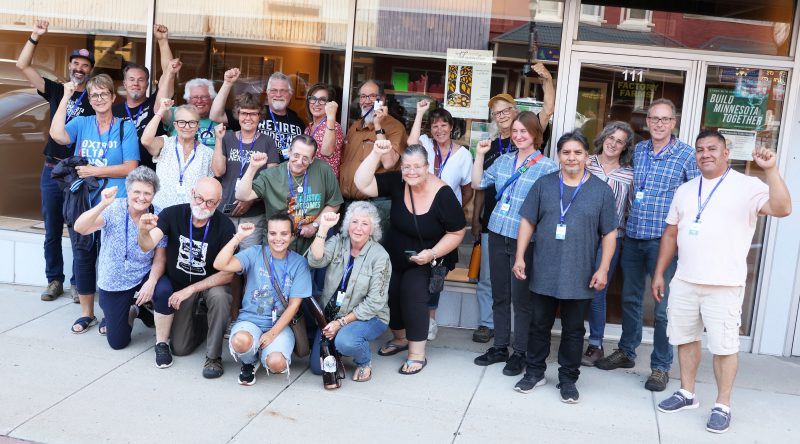
Participants in a recent constitutional observer training held at the Land Stewardship Project’s office in Montevideo, Minn., pose for a group photo. As an active member of the Immigrant Defense Network, LSP is working closely with partners who are on the ground in immigrant communities.

What I’m saying is that farmers who are resisting the coercive model of corporate ag interests are natural allies with immigrant residents of our rural communities. Dividing us is a strategy of corporate and political interests that want to minimize rural voices. By standing with our immigrant neighbors today, we’re planting the seeds for greater rural power tomorrow.

Economic Resiliency of Rural Communities

Studies and real-world experience show that rural communities benefit from the entrepreneurial spirit of new immigrants, whether they be involved with farming itself or an ancillary business that supports agriculture, such as small-scale meat processing, equipment repair, or a grocery store. As Ryan Perez, the director of organizing for COPAL (Communities Organizing Latine Power and Action), explains in episode 373 of LSP’s Ear to the Ground podcast, immigrants have long been a vital part of the food system in the Upper Midwest. The early sugar beet industry started employing many Latino immigrants in the 1920s, and in the 1940s, Mexican laborers came to the region under the “Bracero” program to ease the shortage of agricultural workers. Many of the recent immigrants to the region come from agrarian backgrounds in their home country and have an intense interest in food production. Relyndis Tegomoh, who immigrated to Minnesota from Cameroon, says in our most recent farm transition profile that, “Just one day of farming is so satisfying that it makes up for 25 years of doing something I didn’t like.”

That’s why it’s exciting to see that the Minnesota Farmers Union’s “Solving the Local Meat Processing Bottleneck Project” is reaching out to members of the Hispanic community who may be interested in running a local meat processing business. In recent years, LSP’s Farm Beginnings course, as well as our other educational workshops, have been attracting an increasing number of people of color, including new immigrants. LSP is working with our allies to figure out how to create a pathway from being a food and farming system worker, to a full-blown entrepreneur. Rodrigo Cala, who, before starting a vegetable and livestock operation in western Wisconsin immigrated here from Mexico, encouraged participants in a recent LSP Spanish-language workshop on land access to look beyond being mere widgets in the food system. He says, “If they are the people who do the work, why aren’t they the people who have the opportunity to handle their own business?”

It’s an All-Hands-On-Deck Moment

If we are to rebuild our dysfunctional farm and food system, we need to create opportunities for everyone to have a chance to participate in creating a more sustainable future. A regenerative farming system requires more eyes to the acre, so we can’t afford to exclude people who are our neighbors, even if they don’t look like us or talk like us.

What Are We Doing?

LSP is involved with supporting our immigrant neighbors in a couple of ways. On the practical side, through our Farm Beginnings course and Spanish-language “Land Access: Are You Ready?” workshops, as well as our support of the annual Emerging Farmers Conference, we are working to provide these folks an opportunity to help us build a vibrant farm and food system from the ground up.

But teaching someone how to do holistic business planning does little good if they are being scapegoated and in general made unwelcome in the community. That’s why we are also standing with our allies as the immigrant community comes under attack by the federal government, and U.S. Immigration and Customs Enforcement agents in particular. Often-violent immigration raids that violate Constitutional rights, separate families, and vilify certain members of our community sow the kind of fear and mistrust that undermines any efforts to create a fair, just farm and food system.

LSP is working closely with partners who are on the ground in immigrant communities by taking part as an active member of the Immigrant Defense Network (IDN), a partnership of more than 90 Minnesota groups formed to protect the rights of immigrants, and to provide trusted information and education in communities throughout Minnesota. As part of our involvement with IDN, we are co-facilitating the coalition’s Greater Minnesota caucus, and I am serving on the Network’s steering committee.

It’s also important to note that IDN is a network, not a monolith. IDN and some network members will engage in tactics that we steer clear of, and vice versa. What holds us together is a belief that our immigrant neighbors strengthen and enrich Minnesota’s communities, and that we are stronger together. 

Through our connection to IDN and partnership with COPAL, we have been holding constitutional observer trainings in rural communities throughout the state (see article below) for our members and allies, and taking part in pro-immigrant press conferences and other events at the Minnesota state capitol. We have also created a “Community Care” web page that provides resources for immigrants, as well as allies and farmers who may be employing them.

Get to Know Your Neighbor

In the end, this is all about making connections with our neighbors, no matter their country of origin. In these politically-charged times, a lot of us feel isolated. Are there neighbors you feel uncomfortable saying hello to or inviting over for a meal? During the past two summers, LSP has partnered with COPAL to hold events on southeastern farms that bring together white and Latino folks over good food and some good old-fashioned fun.


During a 2024 LSP-COPAL tour of the Jon and Ruth Jovaag farm in southern Minnesota, participants had a chance to see regenerative agriculture firsthand, discuss shared concerns about the future of rural communities, and bond over a locally-sourced meal.

Maybe we can use this moment of fear and anxiety as an opportunity to reach out, even if language barriers and skin color at first make that interaction uncomfortable. As Perez says, “Get to know people and don’t be a stranger. If you know your people around you, you’re going to be in a better place in your community.”

If you have questions about the Land Stewardship Project’s involvement with standing up for our immigrant neighbors, feel free to contact me.

LSP executive director Scott Elkins can be reached at selkins@landstewardshipproject.org or 612-722-6377.

♦ ♦ ♦

Bearing Witness

In an Era of Legal Confusion, Exposing Civil Rights Violations to the Light of Day

At the outset of a workshop held on an August evening in the western Minnesota community of Montevideo, Nick Olson attempted to provide some assurances to the over two-dozen people gathered in the Land Stewardship Project’s office on Main Street. “It’s okay to feel nervous. It’s okay to feel out of your comfort zone,” he said.

What Olson, an LSP organizer, was about to talk about was how to stand up for the rights of undocumented immigrants who are being snatched off the streets, out of their homes, and from their places of employment and imprisoned by agents working for U.S. Immigration and Customs Enforcement (ICE). As has been well-documented, this flurry of activity has sometimes been characterized by the suspension of basic constitutional rights, such as the right to be brought before a judge to determine if someone’s detention is legally valid. Immigrants with no criminal records are being labeled as violent offenders and shipped off to detention centers such as the so-called “Alligator Alcatraz” in Florida, or deported to countries they are not native to. The ICE agents are often masked and recordings show them refusing to identify their official capacity.

It turns out undocumented immigrants, along with everyone else residing in this country, are guaranteed certain civil rights when being arrested, including the right to seek legal counsel, the right to remain silent and not sign documents, and the right to refuse entry into one’s home by law enforcement without a warrant signed by a judge.

In recent months, LSP has been partnering with the Immigrant Defense Network to offer rural residents trainings as “constitutional observers.” (The training in Montevideo was co-sponsored by CURE.) Developed by Communities Organizing Latine Power and Action (COPAL) and South Dakota Voices for Peace, these trainings provide participants the tools to observe and document law enforcement interactions with immigrants and to inform the detainees of their civil rights during the interactions, as well as to provide them resources such as contact information for legal services.

At the Montevideo workshop, several of the rural residents gathered said they were seeking the training because they were concerned about how ICE activities threatened their immigrant neighbors, friends, and co-workers.

“I’m just sickened by what’s going on — I have friends from Mexico,” said a woman whose family raises corn and soybeans in the area.

Serving as a constitutional observer (see sidebar below) does not make someone an expert on the law who can provide legal advice. And it does not involve obstructing justice or otherwise participating in civil disobedience. Rather, it’s a way to be a practitioner of a “civil initiative,” as the Immigrant Defense Network puts it.

Olson acknowledged that recording an ICE action can be stressful; in some cases, ICE agents have reacted aggressively to observers. But he reminded training participants that as American citizens, they are less at risk than those being detained.

“We’re in times where this type of action is needed,” he said.

Besides the direct impact ICE’s aggressive campaign is having on detainees who are separated from loved ones with no notice, there is the atmosphere of “fear” it’s spawning. Such an environment threatens to instill a sense within the general public that all immigrants are a danger to society and thus enforcement actions that at times violate their civil rights are justified. Olson said it’s the job of all of us to resist that fear and to get to know our immigrant neighbors as fellow human beings rather than as faceless “villains.”

“Immigrants have stores on Main Street, go to church, have kids in our schools, are an active part of the community, and yet anti-immigrant folks continue to pound this message into us that we are supposed to be afraid of them,” said Olson. “How do we shift this narrative?”

♦ ♦ ♦

Being a Constitutional Observer

When arriving on the scene of an immigration enforcement action, identify yourself as a constitutional observer and do not interfere with the arrest in any way (constitutional observer ID badges are available from the Immigrant Defense Network). Although members of the general public have the right to record law enforcement actions taking place in public, they are required to provide a certain amount of space between themselves and the arresting officers. If you touch a federal agent, you can be charged with assault, which is a felony. The buffer requirement can vary by state, but a good rule of thumb is eight feet. If you are ordered to step back even further, record yourself complying to that order.

It’s best not to share your recordings immediately on social media, etc. — those images may put detainees at risk. Create a back-up file of any recordings and contact the family of the detainee and/or an immigration rights organization or a reputable journalist about the documentation you have.

Constitutional observers should carry “Red Cards” that list an immigrant’s civil rights that they can present to detainees or read aloud to those present during an enforcement action (Red Cards in multiple languages are available at ilrc.org/redcards).

At times, ICE agents have lashed out at people recording their actions, even threatening to arrest observers or to confiscate telephones. The best response is to ask two questions: 1) “Am I being detained?” 2) “Am I free to go?” In general, this is enough to end a threat of arrest. However, if arrested, say, “I want to remain silent and speak to a lawyer.”

For a copy of the Handbook for Constitutional Observers and information on being trained as a constitutional observer, see
immigrantdefensenetwork.org.

These articles originally appeared in the No. 2, 2025, Land Stewardship Letter.

Category: Blog
Tags: COPAL Minnesota • corporate control • economic justice • ICE • Immigrant Defense Network • immigration • rural economic development • social justice

Upcoming Events

×

January 2026

Thursday January 22 – Saturday January 24

GrassWorks Grazing Conference
Thursday January 22 – Saturday January 24
GrassWorks Grazing Conference
La Crosse Center, 300 Harborview Plaza, La Crosse, WI 54601, USA

The 34th Annual GrassWorks Grazing Conference will take place Jan. 22–24 at the La Crosse Center in La Crosse, Wis.

The 2026 conference will be centered on the theme: “Pastures to Prosperity: Building financially smart grazing systems for today’s land stewards.” This year’s focus highlights practical, innovative, and profitable approaches to grass-based livestock production, equipping farmers with tools to strengthen both environmental and economic sustainability.

GrassWorks is excited to welcome two nationally recognized keynote speakers:

  • Melinda Sims, Wyoming cattle rancher and Ranching for Profit instructor, known for her expertise in financial decision-making and resilient ranch business models.
  • Dwayne Estes, Executive Director of the Southeastern Grasslands Institute, a leading voice in grassland restoration, regenerative grazing, and agricultural landscape resilience.

Conference highlights include:

  • More than 60 expert speakers from across the grazing and agricultural sectors
  • Over 45 industry exhibitors featuring the latest in grazing tools, technology, and services.
  • Workshops for beginning, expanding, and experienced graziers
  • Panel discussions on farm profitability, land stewardship, and long-term business resilience.
  • Robust networking opportunities with farmers, technical service providers, and industry partners.

The GrassWorks Grazing Conference draws farmers, agricultural professionals, educators, and conservation partners from across the Midwest and beyond. Attendees can expect practical education, actionable strategies, and meaningful connections.

Registration information can be found at https://grassworks.org/events/grazing-conference.

Tuesday January 27

9:00 am – 3:00 pm
'Beyond Exports: Rebuilding Local Markets' LSP Soil Health Workshop
Tuesday January 27
9:00 am – 3:00 pm
'Beyond Exports: Rebuilding Local Markets' LSP Soil Health Workshop
Rochester International Event Center, 7333 Airport View Dr SW, Rochester, MN 55902, USA

On Tuesday, January 27 join Land Stewardship Project for our signature winter workshop. This year’s theme is “Beyond Exports: Rebuilding Local Markets”.

The workshop will be held from 9am to 3pm at the Rochester International Event Center (73333 Airport View Dr SW, Rochester, MN 55902).  Our featured keynote speaker is Martin Larsen, a farmer who is a founding member of the “Oat Mafia” in south-central Minnesota.  In the morning session, Martin will highlight the challenges and opportunities facing all farmers as they look beyond export load-out at the elevator and instead look to recreate the local markets that once served our farmers and consumers.  He will share his journey establishing food grade oats and founding the “oat mafia” and the agronomic, economic, and market impacts it has made for his farm.

After the keynote, attendees will have the option to choose two of three breakout sessions with local experts:

Session 1: Economics of Diversifying Your Rotations
Session 2: Marketing Your Alternative Crops
Session 3: Derisking Diversifying Your Rotations

Breakfast and a catered lunch will be provided.  

For details and to register, click here.
 
You may also contact event organizer Shea-Lynn Ramthun at 651-301-1897 or slramthun@landstewardshipproject.org. 

5:30 pm – 8:00 pm
LSP Farm Transition Planning Course
Tuesday January 27
5:30 pm – 8:00 pm
LSP Farm Transition Planning Course
Zoom Online

The Land Stewardship Project’s long-running course for farmers and other landowners looking to transition their agricultural operations to the next generation is expanding into South Dakota in 2026. The Land Stewardship Project (LSP) Winter Farm Transition Planning Course, which enters its 10th session in 2026, provides a holistic opportunity to dig into important topics and learn from experienced farmers and professionals about the options that farmers and landowners have when looking to pass their farm on.

The standard Zoom online LSP course will be held on seven Tuesday evenings starting on January 27 and running through March 10. The sessions build on one another, so attendance at all sessions ensures the greatest understanding and planning opportunities. The course fee is $250 per family, and registration is open through Jan. 9 at https://landstewardshipproject.org/transition2026.

New this year is an expanded course offering for South Dakota attendees as part of a partnership LSP has formed with Dakota Rural Action and Rural Revival.

The South Dakota course, led by Dakota Rural Action and Rural Revival and using the LSP curriculum, includes seven weekly in-person sessions, with a full-day Saturday kick-off session, and another full-day session to close the training. Sessions two through six will take place on Tuesday evenings for two-and-a-half hours. The dates are: Jan. 31, Feb. 3, Feb. 10,  Feb. 17, Feb. 24, March 3 and March 14. As with the fully online course, the course fee is $250 per family, and the registration deadline is Jan. 9. To register for the South Dakota course, visit https://qrco.de/farmtransitions2026.

Presenters at both workshops will include other area farmers who are implementing farm transition plans, as well as professionals representing the legal and financial fields as they relate to agricultural businesses. Workshop participants will have an opportunity to begin engaging in the planning process as well as to learn about resources for continuing the process after the workshop has ended.

Friday January 30

9:00 am – 10:00 am
'Fridays with a Forester' Webinars
Friday January 30
9:00 am – 10:00 am
'Fridays with a Forester' Webinars
Recurs weekly
Zoom online

Join Extension foresters to discuss some of the key issues and questions around forest and woodlands facing Minnesota land stewards. These online sessions will be very informal, open to the public, and free of charge. Each session will start with a brief presentation followed by a discussion framed around participant questions on the topic. 
 

  • January 30: Life, death, and dinner in the forest canopy: a review of the spruce budworm and its predators – Jessica RootesFebruary 13: Stewardship strategies for resilient forests – Anna Stockstad 
  •  February 20: ParSci summary from 2025 and what’s coming in 2026 – Angela Gupta & Hana Kim 
  • February 27: Climate Ready Trees for Windbreaks and Silvopasture – Gary Wyatt, Angie Gupta and Kira Pollack 
  • March 20: Disturbance and Woodland Stewardship – Eli Sagor 
  • March 27: Recognizing, Preventing, and Managing Oak Wilt – Grace Haynes 
  • April 10: Management Considerations to Enhance Forest Habitat for Birds – Peter DieserA
  • April 17: Get Ready for Tree Seed Collection in Spring (Scouting & ParSci) – Kira Pollack
  • April 24: Growing and selling wood: Production forestry on private lands. – Eli Sagor, Extension Educator or Lane Moser, SFEC. Informal panel discussing production forestry and selling wood on private lands with Dave Nolle (MLEP), a consulting forester, and an industry forester.

To sign-up for these Zoom sessions, register at this link.

Recordings from all webinars over the years are available on this YouTube page.

5:00 pm – 4:00 pm
Multi-Generational Farm Transition Retreat: Red Wing
Friday January 30
5:00 pm – 4:00 pm
Multi-Generational Farm Transition Retreat: Red Wing
Pier 55 Red Wing Area Seniors, 240 Harrison St #2, Red Wing, MN 55066, USA

Join U of M Extension for hands-on planning and discussion on farm transition for the whole farm family. All generations actively involved in the farm should attend the retreat together, including spouses, partners and other relevant parties.

The farm transition program helps farm families dive deeper into conversations about:

  • Family and business goals
  • Job responsibilities
  • Financial needs of farms and families
  • Inheritance considerations
  • Mechanisms of transfer

For details and to register, click here. 

View Full Calendar

Recent Posts

  • Tell Congress Farmers Need Real Relief & Real Solutions January 18, 2026
  • LSP Stands With Immigrant Neighbors in Rural Minnesota  January 12, 2026
  • ‘Beyond Exports’ Focus of Jan. 27 Crop Diversification Meeting in Rochester January 11, 2026
  • Why LSP Stands With Our Immigrant Neighbors January 8, 2026
  • Priorities for 2026 Legislature: Soil, Water, Land Access, Consolidation, Farm to School January 8, 2026

Montevideo

111 North First Street
Montevideo, MN 56265

(320) 269-2105

Lewiston

180 E. Main Street
Lewiston, MN 55952

(507) 523-3366

Minneapolis

821 E. 35th Street #200
Minneapolis, MN 55407

(612) 722-6377

  • Privacy Policy

Copyright © 2026 Land Stewardship Project. All rights reserved.

https://landstewardshipproject.org/why-lsp-stands-with-our-immigrant-neighbors