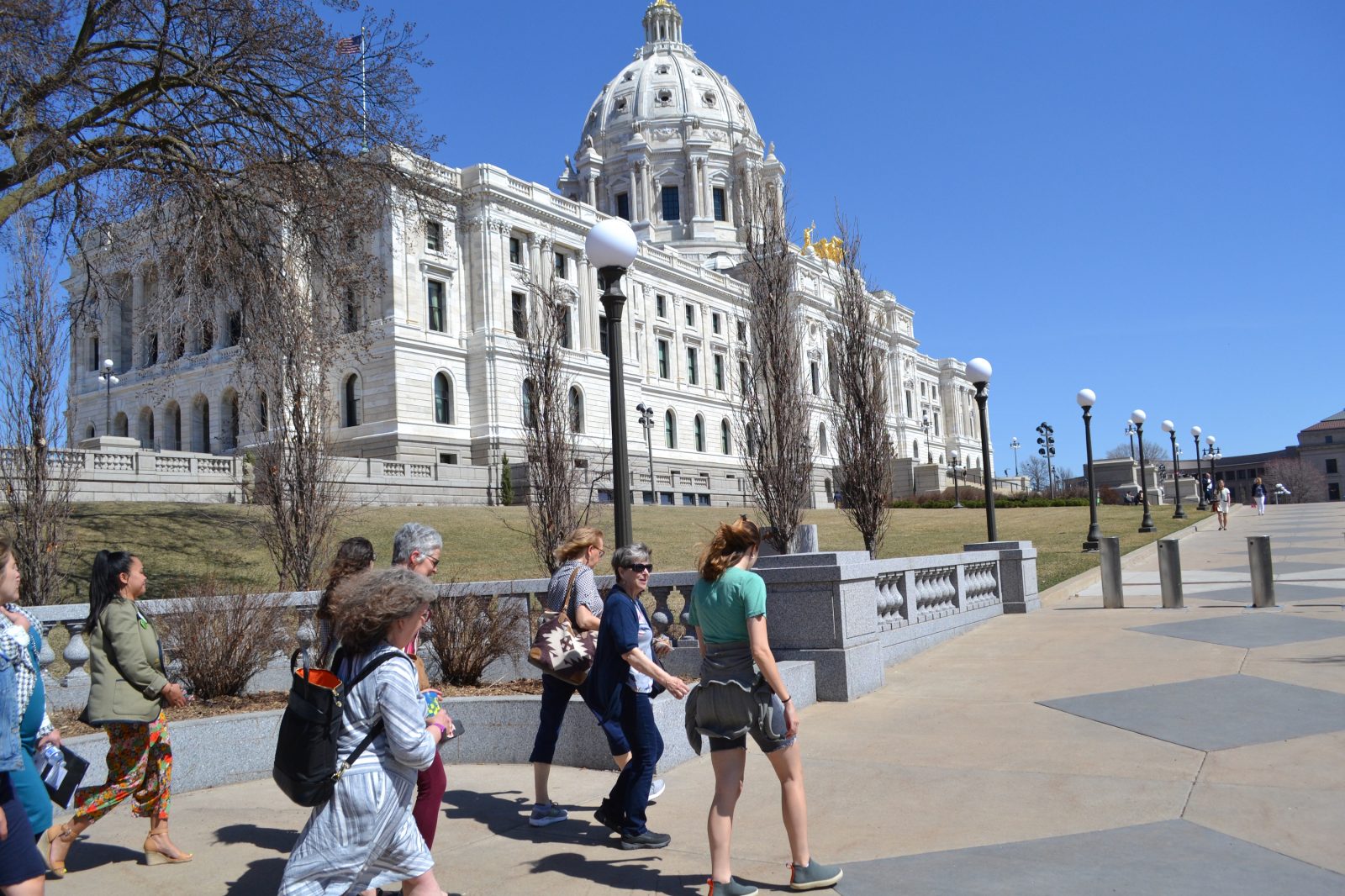
During this session of the Minnesota Legislature, Land Stewardship Project members have been making their voices heard loud and clear. Dozens of farmers and rural LSP members have testified in committee hearings, hundreds have come to the Capitol to meet with their elected officials, and thousands have taken action by signing a petition, contacting their state legislators, or organizing in their communities. Interested in our re-cap of the 2023 Family Farm Breakfast & Lobby Day? Click here!
Together, we have been advancing a powerful agenda for people and the land that builds a fair, economically just farm economy; stewards healthy soil, clean water, a resilient climate, and thriving pollinator populations; creates strong regional food systems; protects rural communities and small and mid-sized livestock farmers from factory farming; cares for farm and food system workers; greatly increases access to land and secures land tenure for those who want to farm; and builds healthy, robust rural communities.
There are now just four weeks left in the 2023 Minnesota legislative session and LSP members are working hard to ensure that our priorities for people and the land make it across the finish line!
The House and Senate have each passed their version of major budget bills. The next step is for joint House-Senate conference committees to come together to work out their differences and finalize a compromise budget. These bipartisan conference committees must finish their work by Friday, May 5.
Read on to learn about the status of LSP’s legislative priorities in these major budget bills.
Soil Health & Climate
- Additional funding for the Soil Health Financial Assistance Program to accelerate the adoption of soil-healthy farming practices was included in both the House and Senate Agriculture Budget Bills. The House included $500,000 while the Senate included $2 million.
- The establishment of a fulltime Climate Coordinator Position within the Minnesota Department of Agriculture was included in the House Agriculture Budget Bill, but not the Senate Agriculture Budget Bill. This position would work to implement the State’s Climate Action Framework, leverage federal funding, and coordinate state agencies and partners.
- $1 million for the Continuous Living Cover (CLC) Supply Chain Development Grant Program, which focuses on developing processing and markets for continuous living cover crops, was included in both the House and Senate Agriculture Budget Bills. The Senate also included an annual appropriation of $250,000 for 2026 and beyond for this program.
- Funding for grants to support fiber hemp processing was included in both the House and Senate Agriculture Budget Bills. The House included $2 million and the Senate included $500,000.
- The House Agriculture Budget Bill contains a variety of measures to steward healthy pollinator populations, including $2.5 million for the Pollinator Research Account, $100,000 for the Minnesota Department of Agriculture to develop a proposal for regulating pesticide-treated seed, and $1.68 million for identification and regulation of human-created forever chemicals — called PFOS and PFAS — in agrichemicals.
Local Meat Processing
- LSP’s bill to establish a Meat & Poultry Processing Liaison Position in the Minnesota Department of Agriculture to help processors develop Hazard Analysis and Critical Control Point (HAACP) plans, develop Sanitation Standard Operating Procedures (SSOP) plans, navigate certification and inspection processes, expand and transition their businesses, and more, was included in both the House and Senate Agriculture Budget bills.
- LSP’s bill to create a Small Meat Processor Training Grants pilot program to reimburse meat processors for attending Hazard Analysis Critical Control Point (HACCP) training courses and other meat cutting and processing courses to improve health, safety, and business planning, was included in the Senate Agriculture Budget Bill.
- Additional funding for the AGRI Meat, Poultry, Egg, and Milk Processing Grant program was included in both the House and Senate Agriculture Budget Bills. The House included $1.25 million, while the Senate included $1.5 million.
Regional Food Systems
- Increased funding for the Farm-to-School Grant Program, championed by LSP and our allies at the Institute for Agriculture and Trade Policy (IATP), was included in both the House and Senate Agriculture Budget bills. The House included $2 million for the program while the Senate included $2.3 million. Both the House and Senate included a provision extending eligibility for the program to early childhood education centers.
- Our proposal, in partnership with IATP, to establish regional food systems coordinator positions across the state was not included in either the House or Senate Agriculture Budget Bills. However, the Senate did include the creation of a fulltime Farm-to-School Coordinator position within the Minnesota Department of Agriculture in their budget!
- $100,000 for grants to support farmers’ markets with infrastructure upgrades, trainings, food aggregation and food hubs, and establishing SNAP/EBT at markets, championed by LSP and our allies at the Minnesota Farmers Market Association (MFMA), was included in the Senate Agriculture Budget Bill.
- Additional funding for The Good Acre’s Local Emergency Assistance Farmer Fund (LEAFF) was included in both the House and Senate Agriculture Budget Bills. The House included $200,000 and the Senate included $600,000.
- $100,000 per year for grants to facilitate the startup and expansion of co-packing facilities, commercial kitchens and other supply chain infrastructure was included in the House Agriculture Budget Bill.
Emerging Farmers
- Increased funding for the Emerging Farmers Office to expand staffing and services to emerging farmers was included in both the House and Senate Agriculture Budget Bills. The House included $800,000 for 2024-25 and $500,000 per year thereafter. The Senate included $1.1 million for 2024-25 and $350,000 per year thereafter.
- A repeal on the sunset on the Emerging Farmers Working Group was included in both the House and Senate Agriculture Budget Bills.
- Increased funding and improvements to the Farmland Down Payment Assistance Grant Program were included in both the House and Senate Agriculture Budget Bills. The House included $750,000 for the grant program and limits the program to emerging farmers. The Senate included $1.25 million for the grant program, a required 30-day application period, a limitation to the matching requirement of $5,000, and a set aside of $375,000 for emerging farmers.
- $500,000 for grants to beginning farmers to assist with the costs of equipment and infrastructure was included in the House Agriculture Budget Bill.
In addition, the House Taxes Budget Bill includes $16 million for 2024-25 and $20 million for 2026-27 for the Beginning Farmer Tax Credit. The House Taxes Budget Bill also prioritizes underserved farmers by setting aside 50% of funding between January 1 and September 30 each year for qualified underserved applicants. Starting October 1, any unused funds will be made available for any qualified applicant. The Senate version of the bill has yet to be released, but we expect funding the proposal to be similar. This tax credit, which serves to incentivize landowners to sell and rent farmland and assets to a beginning farmer, was conceptualized by LSP members in 2006 and passed with partner support in 2017.
Fish Kill Investigations
Following the sudden death of 2,500 brown trout in Winona County last summer, LSP members in southeastern Minnesota have been working on legislation to strengthen fish kill investigations. The bill, authored by Sen. Jen McEwen (DFL – Duluth) and Rep. Sydney Jordan (DFL – Minneapolis), would strengthen inter-agency response to fish kills by incorporating public health aspects of fish kills, speeding up response time, improving public notices, and more.
As the fish kill bill made its way through various committees, LSP members and allies developed strong bill language, worked directly with legislative champions and agencies, and testified in multiple hearings. The bill has now been rolled into both the House and Senate Environment Budget Bills. Although there are some differences and LSP members will continue to advocate for the strongest version, we expect that a version will be signed into law by the end of June.
MPCA Community Board
Land Stewardship Project members and allies worked hard to advance a bill this legislative session that would reinstate community oversight of the Minnesota Pollution Control Agency (MPCA). We made significant progress:
- LSP and allies collaborated to build new measures into the legislation to prevent the Board from being captured by corporate interests and to ensure those who are the most impacted by corporate polluters are front and center.
- The bill was championed in the House by a rural legislator, Rep. Kristi Pursell (DFL – Northfield), with 23 co-authors on the bill.
- The bill was led in the Senate by the Chair of the Environment, Climate, and Legacy Committee, Sen. Foung Hawj (DFL – St. Paul). We had three powerful co-authors: State and Local Government Committee Chair Erin Murphy (DFL – Saint Paul), Agriculture and Rural Development Committee Chair Aric Putnam (DFL – Saint Cloud), and Finance Committee Chair John Marty (DFL – Roseville). In the Senate, bills are limited to five authors total.
- The bill was heard in and passed out of a Minnesota Senate committee for the first time since the Board was abolished in 2015. There were five testifiers in support of the bill, all of whom were from Greater Minnesota. Three were farmers, one was a member of the MPCA Citizens’ Board when it was abolished, and one was an Indigenous leader.
- The bill was heard in the Minnesota House and was included in the Environment and Natural Resources Omnibus Bill.
- Approximately 150 people who attended our Family Farm Breakfast and Lobby Day on April 13 spoke to approximately 90 legislators about the issue to secure legislators’ support.
However, due to opposition from corporate agriculture and mining interests, as well as a lack of support from the MPCA and Governor Tim Walz, Reps. Jeff Brand (DFL – St. Peter), Luke Frederick (DFL – Mankato), Dave Lislegard (DFL – Aurora), and Gene Pelowski (DFL – Winona) worked together to kill the bill. Unfortunately, they were successful. On Monday, April 17, language to reinstate the MPCA Community Board was stripped out of the Environment and Natural Resources Budget Bill. As the Senate did not include this language in their Environment, Climate, and Legacy Budget Bill, reinstatement of the MPCA Community Board is off the table for the 2023 legislative session.
That being said, we’re not done fighting. LSP members involved in this fight will be debriefing what happened and building a strategy for moving forward in coming weeks. Even though the 2023 legislative session hasn’t yet ended, the 2024 legislative session is already on the horizon. If you would like to be included in these discussions, please contact LSP policy manager Amanda Koehler at akoehler@landstewardshipproject.org or 612-400-6355.
Right to Repair
Strong right to repair legislation, which would restore farmers’ right to repair the equipment they own, has been included in the House’s Commerce Budget Bill. If passed, manufacturers such as John Deere would be required to provide product owners and independent repair businesses with fair access to service information and affordable replacement parts. Although the Senate Omnibus Commerce Bill does include right to repair language, it also includes an exemption for agricultural equipment.
The right to repair agricultural equipment is important. It will reverse the decline of small, local repair shops, boost local economies in Greater Minnesota, and make repairs more affordable, accessible, and timely. Take just a few minutes to contact three key legislators and your Senator here.
Healthcare
Land Stewardship Project believes that all Minnesotans deserves to have the affordable care they need when and where they need it, regardless of vocation, income, or zip code. This legislative session, LSP members have been advocating to expand MinnesotaCare and establish a Prescription Drug Affordability Board.
The House Health Budget Bill includes a strong proposal that will allow all Minnesotans without access to employer-based coverage, regardless of immigration status or income, to purchase a MinnesotaCare plan if they choose. A restricted version that does not allow otherwise qualified undocumented adults to enroll has been included in the Senate Health Budget bill. As our communities are healthier when we all have the care we need and we all deserve affordable, accessible, high-quality care, LSP strongly supports the House version and will continue to advocate for the inclusion of undocumented Minnesotans.
The House Commerce Budget Bill includes strong language for establishing a Prescription Drug Affordability Board, but has not yet been voted upon by the entire House of Representatives. The bill must have a “floor vote” prior to the House-Senate Conference Committee and there are concerns that amendments that would weaken the Prescription Drug Affordability Board language may be added during the floor debate, as this is what happened on the Senate side.
Democracy
On April 13, the Minnesota House passed the Democracy for the People Act. If passed by the Minnesota Senate and signed into law by Governor Walz, it will strengthen and expand our democracy by:
- Expanding voter rights and voting access with automatic voter registration, restoring the right to vote for Minnesotans on parole or probation, and allowing 16- and 17-year olds to pre-register to vote.
- Addressing money in politics with increased transparency, closed loopholes for dark monied interests, and prohibiting foreign-influenced corporations from spending money on our elections.
- Strengthening election administration with a statewide ban on intimidation and harassment of election workers and voters and the creation of a robust system for online voter registration.
- Reforming the redistricting process by creating an independent redistricting commission and requiring a public process to solicit community input before finalizing.
The Senate will be voting on their version of this bill tomorrow, April 26th. Join us at 10:00 a.m. at the State Capitol in Saint Paul for a pre-vote rally with the We Choose Us Campaign! You can register and receive updates about the vote and rally here. Additionally, you can follow this link to contact your Senator here to let them know you think it’s time to strengthen our democracy.
Take Action
Again, with just a few weeks left in the Minnesota legislative session, the time to act is now! Here’s how you can take action:
- If you are a farmer or processor, add your name to the Farmer-Processor Sign-On Letter calling on the legislature to finalize a strong ag budget.
- Take just two minutes to contact your Representative to urge them to vote against any efforts to weaken the Prescription Drug Affordability Board language!
- Attend the virtual town hall on Friday, May 5, with Rep. Samantha Vang and Senator Aric Putnam, chairs of the House and Senate agriculture committees, respectively.
Amanda Koehler (akoehler@landstewardshipproject.org) is LSP’s policy manager and Laura Schreiber (schreiber@landstewardshipproject.org) is an LSP policy organizer.